1800 Gabriel Prosser Uprising: Prosser was a literate, enslaved blacksmith who planned a large slave uprising in Richmond, Virginia but was betrayed and executed before the revolt was launched. At the time, 39% of Virginia’s population was enslaved, thus the potential damage from a slave revolt was significant. It is estimated that 100 co-conspirators were involved in Gabriel’s Uprising, including several whites who he likely met working in the foundries. (Sources: Wikipedia)
 |
| Denmark Vessey |
1822 The Vessey Conspiracy: Denmark Vessey, a Caribbean slave inspired by the 1791 Haitian revolution, purchased his freedom and then plotted what would have been the largest slave insurrection in U.S. history. However, turncoats reported him and the other conspirators, leading to their execution. (Sources:Wikipedia)
1825 First Women’s Union: United Tailoresses of New York. (Sources: UHWO)
 |
| Nat Turner captured by Mr. Benjamin Phipps |
1831 Nat Turner’s Rebellion: Also known as the Southampton Insurrection, the Rebellion was a slave revolt in Virginia in which slaves killed 55-65 whites, the highest number of white casualties of any slave revolt in U.S. history. The insurrection was put down by authorities within a few days, but Turner managed to evade capture for several months. Between 100 and 200 slaves were executed by the courts or by white mobs in retaliation. (Sources: Wikipedia)
1834 Chesapeake and Ohio Canal Workers Riot: On January 29, canal workers rioted, prompting President Jackson to send in troops, the first time American troops were used to suppress a domestic labor dispute. Workers were rebelling because of terrible working conditions and low pay. Construction teams were made up mostly of Irish, German, Dutch and black workers who toiled long hours for low wages in dangerous conditions. The use of federal troops set a dangerous precedent that gave business leaders the confidence that they could count on the federal government to quash labor unrest in the future. (Sources: the Daily Bleed and History.com)
1835 Philadelphia General Strike: Workers struck for the 10-hour day in what was probably the nation’s first General Strike. In all, 20,000 workers walked off the job. After one week, the city caved to the workers’ demands, granting all city employees a 10-hour day that ran from 6 am to 6 pm, with an hour lunch and an hour for dinner. Their success inspired a wave of strikes and ultimately led to the 10-hour day in many other cities (Sources:UHWO, Socialist Webzine)
1835 Children Struck for 11-Hour Day: In the Patterson silk mills, children went on strike for an 11-hour day and a 6-day work week. (Source: AFGE)
1838 Caulkers Association Founded: One of the first black unions, the Caulkers Association began in the Baltimore shipyards, where Frederick Douglas worked before escaping to freedom. The union bargained collectively and often won wage increases for its members. (Sources: APWU)
 |
| The Last Moments of John Brown, by Thomas Hovenden |
1859 Harpers Ferry: John Brown led an unsuccessful raid on the federal armory at Harpers Ferry, WV, in an attempt to provoke a slave revolt and provide weapons to them. The raid ultimately led to his arrest and execution. (Sources: Wikipedia)
1863 Emancipation Proclamation was issued by President Lincoln, ordering the freeing of all slaves held in the Confederate states. (Sources: UHWO)
1865 13th Amendment: Abolished slavery. (Sources: UHWO)
1867 Chicago General Strike for 8-Hour Day: The 1-week strike to enforce the state’s new 8-hour day law ultimately failed, as militia were brought in to force workers back to work, general for 10-12 hour shifts. The 8-hour day movement started in earnest in 1864 and was inspired by the abolition of slavery (shorter day meant a little more freedom). The movement was about leisure, freedom and personal growth, each of which requires less time at work. (Sources: AFGE, Encyclopedia of Chicago, Truth Out)
 |
| Terence Powderly, Grand Master Workman of the Knights of Labor |
1869 The Knights of Labor (KOL), officially known as the "Noble and Holy Order of the Knights of Labor," was founded on December 28, 1869, when both American capitalism and the labor movement were young and relatively disorganized. It began as a secret society, but quickly grew into the largest and most significant labor organization in the U.S. by the 1880s. The Knights are considered by many to be a predecessor to the more well-known Industrial Workers of the World (IWW). Like its more radical cousin, the IWW, the KOL called for the abolition of the wage system and fought to organize all workers into one big union, including women, blacks and immigrants. And, like the IWW, one of the KOL’s slogans was, “An Injury to One is the Concern of All.” (Sources: Modern School; The Knights of Labor;The Lucy Parsons Project; Libcom.org; The Samuel Gompers Papers;Wikipedia)
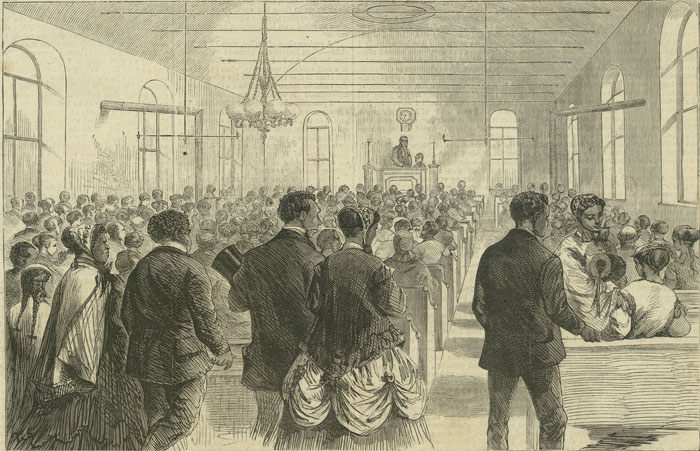 |
| National Colored Union, Harpers |
1869 First National Black Union: The Black National Labor Union was founded in Washington, D.C. under the leadership of Isaac Myers (later ceded to Frederick Douglas). Myers was born to free African Americans in Baltimore in 1835 and was a member of the Caulkers Association (see 1838, above), where he worked with Douglas. (Sources: AFGE, APWU)
 |
| 6th Regiment Repressing Workers, Baltimore, 1877 |
1877 The Great Upheaval (AKA: The St. Louis Commune, St. Louis General Strike, The Great Strike, The Great Train Strike)—As many as 100 workers were killed and over 200 were injured in the wave of strikes occurring throughout the country. The strike united diverse workers, including black and white, as well as skilled and unskilled. The Great Upheaval began in Martinsburg, WV, on July 16, when the B&O Railroad slashed wages by 10%, the second wage cut in 8 months. The train crews refused to work, drove out the police and occupied the rail yards. Local townspeople backed the strikers and came to their defense. When the militia was sent in to run the trains, the strikers and their supporters defended themselves with guns, derailed the trains and guarded the switches at gunpoint. While they halted all freight movement, they continued to move mail and passengers, thus maintaining public support. When militia reinforcements were sent in, most mutinied or refused to fight, as they were sympathetic to the workers. Throughout the country, similar scenarios unfolded, with workers taking over the railroads and other businesses, and attacking police and militias when they tried to take them back or to bring in and defend strikebreakers. In numerous towns, the soldiers fraternized with locals, refused to fight them and sometimes joined their struggle.(Soures: Modern School; UE News; Howard Zinn; Brecher, Jeremy., Strike!, 1997. ISBN 0-89608-570-8)
1877 Ten coal-mining activists ("Molly Maguires") were hanged in Pennsylvania. The Mollys were an Irish secret society of coal miners accused of kidnapping and other acts of violence. They were convicted based on the testimony of one Pinkerton private cop and various witnesses were believed by many to have been bribed or coerced. (Sources: Lutins.org; Wikipedia; Spartacus)
 |
| Chinese Railroad Workers in the Snow |
1882 Chinese Exclusion Act: Chinese men had been encouraged to immigrate to the U.S. from 1848 to 1869 to work in California’s gold fields and on the transcontinental railroad. They worked for low wages and put little pressure on state infrastructure, in part because they were single males, but also because of restrictive and racist laws and the threat of attack by whites. By the 1870s, racist attacks against the Chinese were on the rise and white citizens were complaining that the Chinese were taking their jobs. The Chinese Exclusion Act, one of America’s most restrictive anti-immigrant laws ever, remained in place until 1943, when the U.S. needed China’s assistance in its war with Japan. (Sources: Wikipedia, Harvard University Library).
 |
| Rock Springs Massacre |
1885 Rock Springs Race Riot and Massacre—28 Chinese Americans killed by white miners in a dispute stemming from Union Pacific Coal Company’s practice of paying Chinese laborers a fraction of what they paid white workers. In a particularly negative blot on U.S. labor history, the Knights of Labor not only helped organize the white workers, but many of their members participated in the attacks on the Chinese workers. (Sources: Wikipedia; History Matters)
1886 Bay View Massacre 6 workers and 1 child were killed at the Milwaukee Iron Company Rolling Mill while fighting for the 8-hour day. (Sources: Wikipedia; Links to the Past; Wisconsin Labor History Society; libcom.org)
1886 American Federation of Labor: The AFL was founded in 1886 in Columbus, OH, with Samuel Gompers as its leader. The AFL emerged in response to turf wars with the Knights of Labor, particularly after a cigar makers strike in New York. (Gompers had been the head of one of the rival cigar makers unions.) The union, which was always staunchly anti-communist, began to make alliances with the Democratic Party in 1907 and was an enthusiastic supporter of World War I, WWII, the Korean and Cold Wars. (Sources: AFGE, Wikipedia, Marxists.org)
 |
| Haymarket Rioters, Harpers |
1887 The Haymarket Affair 8 cops died, mostly from friendly fire, plus an unknown number of civilians, when a bomb was thrown at a public meeting in Haymarket Square, Chicago, during planning for a General Strike to win the 8-hour day. 8 anarchists were arrested and convicted in a kangaroo court, despite the fact none was present at the bombing. 4 were executed and one committed suicide in jail to “cheat” the state out of its revenge on him. May 1st is celebrated as International Workers Day in virtually every country of the world (except the U.S.) to commemorate this struggle. (Sources: Modern School; IWW;Lucy Parsons Project; Recollection Books; Libcom.org)
1887 The Thibodaux Massacre: The Louisiana Militia and bands of whites shot at least 35 unarmed black sugar workers and lynched two strike leaders. Some sources place the death toll at over 300. The massacre came during a 3-week labor dispute that had been organized by the Knights of Labor. Gov. Sam McEnery eventually brought in 10 companies of infantry to break the strike. (Sources: Lutins.org; Wikipedia, Libcom.org)
 |
| Shield Used by Striking Homestead Workers |
1892 Homestead Steel Strike and Massacre: Homestead Steel Works in Pennsylvania was owned by Andrew Carnegie and managed by Henry Clay Frick. Amalgamated Association of Steel and Iron Workers (AA) had won a bitter and violent strike against Homestead in 1882, and Frick and Carnegie vowed to crush the union, which they ultimately did. In January, Carnegie slashed wages, while Frick imposed speedups and hired 300 Pinkertons. In July, Frick laid off the entire Homestead workforce, effectively ending collective bargaining. The workers fought back, taking over the town’s political authority and running its infrastructure. 10,000 strikers temporarily held off the Pinkertons and scabs with sticks and a few guns. However, 40 strikers were shot and nine killed, while 120 Pinkertons were shot and seven killed. (Sources: Modern School, Part I; Modern School, Part II; Wikipedia; Strike! by Jeremy Brecher, South End Press, Boston, 1972)
1892 Frisco Mine was dynamited by striking Coeur D’Alene miners after they discovered they had been infiltrated by Pinkertons and after one of their members had been shot. Prior to this, the mine owners had increased work hours, decreased pay and brought in a bunch of scabs to replace striking workers. Ultimately, over 600 striking miners were imprisoned without charge by the military in order to crush the strike. These events led to the formation of the Western Federation of Miners, one of the more radical unions of its day. (Sources: Wikipedia; Fire in the Hole)
 |
| Big Bill Haywood |
1893 Western Federation of Miners (WFM) formed in May of this year, in Butte, Montana, representing 15 unions in Montana, Idaho, Colorado, Utah and South Dakota. Big Bill Haywood became a leader of the organization by 1902 and vigorously espoused industrial unionism, in which all workers in a given industry are organized in one big union in order to maximize solidarity and power. In response to the mass arrests and imprisonment of its members during the 1890s, Haywood began to call for the complete abolition of the wage system. (Sources:Wikipedia; Strike! by Jeremy Brecher, South End Press, Boston, 1972)

1894 Cripple Creek Strike and Waite Agreement: Cripple Creek mine owners in Colorado attempted the same attacks on Colorado miners (e.g., longer hours and pay cuts) and organized a private army to enforce their will. The private army terrorized citizens, as well as miners, and was ultimately disbanded by the mine owners under threat of martial law in what was known as the Waite Agreement, which last for ten years. The WFM were also able to win the 8-hour day for their members. The peace and victory would be a short-lived precursor to the Colorado Labor Wars of 1903-1904—See Below. (Sources: Wikipedia;Strike! by Jeremy Brecher, South End Press, Boston, 1972)
 |
| Pullman Strike |
1894 Pullman Strike: 34 workers were killed in this nationwide rail strike led by Eugene Debs. The strike began in Pullman, IL, as a wildcat response to wage cuts. The strike escalated to involve over 250,000 workers across 27 states, with 12,000 army soldiers being sent in to quash the strike. The rail workers ultimately signed a no-union pledge that kept the lines union-free until the Great Depression. (Sources: Wikipedia; Strike! by Jeremy Brecher, South End Press, Boston, 1972; Recollection Books)
 |
| Protest March After the Lattimer Massacre |
1897 Lattimer Massacre: 19 unarmed immigrant miners were killed by a sheriff’s posse during a strike in Luzerne County, PA. (Sources: Wikipedia; UMWA)
1898 Virden Massacre: 25 workers were killed in a battle with armed guards transporting black strikebreakers in from Alabama. The strikers succeeded in turning away the train and winning wage increases. (Sources: Wikipedia; Remember Virden; Illinois Labor History)
1899 Bunker Hill: Bloody strikes had been going on at this and other Idaho mines over the course of the 1890s. The mine owners had been using scabs, Pinkertons, armed goons, soldiers, lock-outs and other tactics to squeeze the workers and crush their union. In retaliation, the miners loaded a train with dynamite and delivered it to the Bunker Hill mine in 1899, killing one scab and one WFM member. (Sources: Laborers.org; Wikipedia)
1902 8-Hour Days Were Created by State Amendments in Utah and Colorado. In Colorado, the law was passed with the support of 72% of voters and the backing of the WFM. However, under pressure from the mining companies, the legislature ignored the referendum and the miners decided to strike (see Colorado Labor Wars, below). (Sources: Wikipedia)
1902 Pennsylvania Mining Strike (AKA The Coal Strike): Anthracite coal miners (UMWA) in Eastern Pennsylvania were striking for higher wages, shorter hours and union recognition. Teddy Roosevelt intervened (the first time a president had done so), threatening to send in the military after negotiations failed to end the conflict. The strike finally ended with a a raise and shorter hours, but still no union recognition. (Sources: Wikipedia;Stfrancis.edu)
1902 Pana Massacre: 14 workers were killed, martial law was declared, and the town of Pana, IL, was occupied by National Guards in an attempt to break the UMWA. (Sources: Lutins.org;Wikipedia; Rense.com)
1903-1904 Colorado Labor Wars: The National Guards, Pinkertons and vigilantes were used by the mine owners to intimidate miners. Hundreds of striking WFM miners were arrested and held in stockades. Many were deported. Children were arrested for chiding soldiers. General Sherman Bell, of the National Guards and a former mine manager, upon hearing that imprisoned WFM miners were asking for writs of habeas corpus, said “Habeas corpus be damned. We’ll give them post mortems.” (Sources: Wikipedia; Colorado’s War on Militant Unionism, George Suggs; Lucy Parsons Project)
1904 Dunnville Battle: 6 workers were killed and more than 70 were deported in the continuation of the Colorado Labor Wars. (Sources: Rense.com


