Showing posts with label Rosa Parks. Show all posts

Monday, February 4, 2013

Today in Labor History—February 4

February 4, 1869 - Labor leader and Industrial Workers of the World co-founder William D. "Big Bill" Haywood was born on this date. Haywood started mining at age nine. He became secretary-treasurer of the Western Federation of Miners in 1900 and co-founded the IWW in 1905. Charged in the bombing murder of former Idaho Governor Frank Steunenberg in 1907, he was acquitted with the counsel of Clarence Darrow. His radicalism led to his dismissal from the WFM in 1918. That same year he was convicted of violating alien and sedition acts, a victim of the Red Scare, and was sentenced to 20 years in prison. However, he jumped bail and fled to the Soviet Union, where he died in 1928. (From Workday Minnesota)

February 4, 1899 – A U.S. sentry shot Filipino soldiers, leading to a revolt against the U.S. occupation. Filipino historians like Agoncillo and Constantino estimated that over 300,000 Filipinos, mostly civilians, perished as a result of the U.S. genocide. The Manila correspondent for the Philadelphia Ledger wrote in 1901, “Our men have been relentless, have killed to exterminate men, women, children, prisoners and captives, active insurgents and suspected people from lads of ten up. . .”
(From the Daily Bleed)

February 4, 1900 – Jacques Prévert was born on this date (1900-1977). Prevert was a poet, surrealist and libertarian who glorified the spirit of rebellion & revolt. (From the Daily Bleed)

February 4, 1900 -- Labor strikes in mining areas led to riots in Belgium and Germany. (From the
Daily Bleed)

February 4, 1913 – Rosa Parks was born on this date in Tuskegee, Alabama. (From the Daily Bleed)

February 4, 1921 – A massacre at San Gregorio, Chile, left 565 nitrate miners dead. 1920 was a year of brutal repression of the workers movement — many locals were burnt down, many agitators murdered, workers sent to prison, etc. The Chilean IWW led a three month long strike protesting the export of grain during a food shortage. (From the Daily Bleed)

February 4, 1956 – White students rioted at the University of Alabama against court-ordered admission of first black student. (From the Daily Bleed)

February 4, 1979 – Six workers were killed in the massacre of Cromotex, Lima Peru. (From the Daily Bleed)

February 4, 1981 – 68 campesinos were killed in the massacre of Chimaltenango, Guatemala. (From the
Daily Bleed)

Saturday, December 1, 2012

Today in Labor History—December 1


December 1, 1904 – W. A. "Tony" Boyle, future president of the United Mine Workers (UMW) was born on this date. (From the Daily Bleed)


December 1, 1908 – As Brazil and Argentina prepared for war, workers on both sides of the border protested. (From the Daily Bleed)

December 1, 1912 – The rustling card system was put into place by the Anaconda Mining and Smelter Company. Agitators were identified by spies and refused cards and jobs. (From the Daily Bleed)
Ralph Chaplin (public domain)
 December 1, 1914 – The famous labor song, "Solidarity Forever," was written on this date by IWW songwriter Ralph Chaplin. He wrote the song for a hunger march to be led by Lucy Parsons in Chicago (on January 17, 1915).
Solidarity Forever
(To the tune of Glory Glory Hallelijah)
When the union's inspiration through worker's blood shall run,
There can be no power greater anywhere beneath the sun;
Yet what force on earth is weaker than the feeble strength of one,
For the union makes us strong.
[Chorus]
Is there aught we hold in common with the greedy parasite
Who would lash us into serfdom & would crush us with his might?
is there anything left to us but to organize & fight?
For the union makes us strong
[Chorus]
In our hands is placed a power greater than their hoarded gold,
Greater than the might of armies magnified a thousand fold;
We can bring to birth a new world from the ashes of the old,
For the union makes us strong.
[Chorus]: Solidarity forever, Solidarity forever, Solidarity forever,
For the union makes us strong 
(From the Daily Bleed)
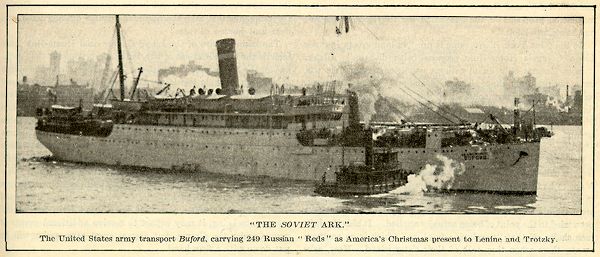
Rust Bucket UST Buford Carrying Its "Christmas Present" of Reds to Lenin and Trotsky
December 1, 1919 -- US: Alexander Berkman, Emma Goldman and 200 other anarchists, labor militants and radicals were deported to Russia on the Buford. (From the Daily Bleed)

December 1, 1955 - Rosa Parks, a 43-year-old African-American seamstress, boarded a bus in downtown Montgomery, Alabama, and refused to move to the back. She was arrested, triggering a year-long boycott of the city bus system and legal actions which ended racial segregation on municipal buses throughout the southern United States (From Workday Minnesota)

December 1, 1966 – The Youngstown General Duty Nurses Association (YGDNA) became the first nurses in Ohio to engage in a mass resignation or "strike." According to the American Nurses Association, it may have been the first concerted action by nurses in a labor dispute in the nation. (From the Daily Bleed)

Saturday, February 4, 2012

Today in Labor History—February 4


February 4, 1869 - Labor leader and Industrial Workers of the World co-founder William D. "Big Bill" Haywood was born on this date. Haywood started mining at age nine. He became secretary-treasurer of the Western Federation of Miners in 1900 and co-founded the IWW in 1905. Charged in the bombing murder of former Idaho Governor Frank Steunenberg in 1907, he was acquitted with the counsel of Clarence Darrow. His radicalism led to his dismissal from the WFM in 1918. That same year he was convicted of violating alien and sedition acts, a victim of the Red Scare, and was sentenced to 20 years in prison. However, he jumped bail and fled to the Soviet Union, where he died in 1928. (From Workday Minnesota)

February 4, 1899 – A U.S. sentry shot Filipino soldiers, leading to a revolt against the U.S. occupation. Filipino historians like Agoncillo and Constantino estimated that over 300,000 Filipinos, mostly civilians, perished as a result of the U.S. genocide. The Manila correspondent for the Philadelphia Ledger wrote in 1901, “Our men have been relentless, have killed to exterminate men, women, children, prisoners and captives, active insurgents and suspected people from lads of ten up. . .”
(From the Daily Bleed)

February 4, 1900 – Jacques Prévert was born on this date (1900-1977). Prevert was a poet, surrealist and libertarian who glorified the spirit of rebellion & revolt. (From the Daily Bleed)

February 4, 1900 -- Labor strikes in mining areas led to riots in Belgium and Germany. (From the
Daily Bleed)

February 4, 1913 – Rosa Parks was born on this date in Tuskegee, Alabama. (From the Daily Bleed)

February 4, 1921 – A massacre at San Gregorio, Chile, left 565 nitrate miners dead. 1920 was a year of brutal repression of the workers movement — many locals were burnt down, many agitators murdered, workers sent to prison, etc. The Chilean IWW led a three month long strike protesting the export of grain during a food shortage. (From the Daily Bleed)

February 4, 1956 – White students rioted at the University of Alabama against court-ordered admission of first black student. (From the Daily Bleed)

February 4, 1979 – Six workers were killed in the massacre of Cromotex, Lima Peru. (From the Daily Bleed)

February 4, 1981 – 68 campesinos were killed in the massacre of Chimaltenango, Guatemala. (From the
Daily Bleed)

Thursday, December 1, 2011

Today in Labor History—December 1


December 1, 1904 – W. A. "Tony" Boyle, future president of the United Mine Workers (UMW) was born on this date. (From the Daily Bleed)

December 1, 1908 – As Brazil and Argentina prepared for war, workers on both sides of the border protested. (From the Daily Bleed)

December 1, 1912 – The rustling card system was put into place by the Anaconda Mining and Smelter Company. Agitators were identified by spies and refused cards and jobs. (From the Daily Bleed)
Ralph Chaplin (public domain)
 December 1, 1914 – The famous labor song, "Solidarity Forever," was written on this date by IWW songwriter Ralph Chaplin. He wrote the song for a hunger march to be led by Lucy Parsons in Chicago (on January 17, 1915).
Solidarity Forever
(To the tune of Glory Glory Hallelijah)
When the union's inspiration through worker's blood shall run,
There can be no power greater anywhere beneath the sun;
Yet what force on earth is weaker than the feeble strength of one,
For the union makes us strong.
[Chorus]
Is there aught we hold in common with the greedy parasite
Who would lash us into serfdom & would crush us with his might?
is there anything left to us but to organize & fight?
For the union makes us strong
[Chorus]
In our hands is placed a power greater than their hoarded gold,
Greater than the might of armies magnified a thousand fold;
We can bring to birth a new world from the ashes of the old,
For the union makes us strong.
[Chorus]: Solidarity forever, Solidarity forever, Solidarity forever,
For the union makes us strong
(From the Daily Bleed)
Rust Bucket UST Buford Carrying Its "Christmas Present" of Reds to Lenin and Trotsky
December 1, 1919 -- US: Alexander Berkman, Emma Goldman and 200 other anarchists, labor militants and radicals were deported to Russia on the Buford. (From the Daily Bleed)

December 1, 1955 - Rosa Parks, a 43-year-old African-American seamstress, boarded a bus in downtown Montgomery, Alabama, and refused to move to the back. She was arrested, triggering a year-long boycott of the city bus system and legal actions which ended racial segregation on municipal buses throughout the southern United States (From Workday Minnesota)

December 1, 1966 – The Youngstown General Duty Nurses Association (YGDNA) became the first nurses in Ohio to engage in a mass resignation or "strike." According to the American Nurses Association, it may have been the first concerted action by nurses in a labor dispute in the nation. (From the Daily Bleed)