Showing posts with label school funding. Show all posts

Thursday, February 28, 2013

Brown’s Budget Shuffle: Something From Nothing is Still Nothing


"Equal treatment for children in unequal situations is not justice"—Gov. Jerry Brown, California (quoted in the San Francisco Chronicle)

Gov. Brown is correct—funding poor schools the same as affluent schools is not only unjust, it is pedagogically irrational.  Poor children have greater educational needs, while their parents have far less to donate to school fundraisers. Funding them equally only guarantees unequal outcomes. Yet his solution—reallocating revenues from wealthier schools to poorer school—is neither just nor rational.

None of California’s schools currently receives adequate funding. The state has slashed over $20 billion from K-12 education over the past five years and none of this will be restored under the state’s new “millionaire’s” tax. Furthermore, basic aid school districts (the so-called affluent districts that receive only the “basic” aid from the state because they have higher than average property tax bases) have already lost 90% of the funding they once received from the state. Therefore, taking away scarce resources from these schools only serves to make them more like the state’s low income schools.

While it is true that affluent schools have fewer needs than lower income schools, they were not receiving sufficient funding from the state or local property taxes even before the economic meltdown and draconian budget cuts that followed. Consequently, they have relied on fundraising to make up some of the difference, something they can do with greater ease and success than lower income schools, since the parents tend to be wealthier and have more disposable income. Yet even this hasn’t prevented basic aid schools from losing counselors, librarians and nurses; increasing class sizes to 35 students per teacher (or higher); imposing out-of-pocket fees on teachers for health insurance; and freezing or cutting wages. Furthermore, even within basic aid districts there are often low income schools with student demographics similar to poor, inner city schools. Reducing their funding because they happen to be in an “affluent” basic aid district would end up harming the lower income students Brown’s plan is intended to help.

Of course it is important to provide low income schools with additional funding, over and above what the affluent ones receive, because of their greater needs. However, this must be accomplished through increased tax revenues, not by ripping off other schools. Yet increased school funding, alone, will not solve the myriad ways in which poverty impacts educational outcomes. To really close the achievement gap, poor kids in poor schools need relief from their poverty so they aren’t coming to school hungry and suffering from stress and untreated medical conditions. Their parents need relief from poverty before they even have children, since poverty increases the chances children will be born premature, with low birth weight, and suffer from stress, malnutrition and environmental toxins, each of which contribute to cognitive impairment and learning disabilities.

Short of this, low income schools need large infusions of cash—far more than they would receive under the Brown plan. They need enough revenue to lower class sizes and hire extra teachers and reading specialists. Low income schools need full-time nurses or on-site clinics to care for uninsured children and reduce the amount of class time lost to treatable and preventable illnesses. Low income schools need staff and resources to provide adult education and English language support for parents. They need extra funding for after school programs so that children aren’t watching television or getting into trouble or hurt when classes end. They need mental health specialists to help students suffering from stress, anxiety and other common mental health problems that often go undiagnosed or treated in poor children.

If the schools truly are public, then parents should not have to pay more out of pocket for fundraisers and benefits, in addition to what they contribute through their taxes. If they were adequately funded, there would be much less need for this.

This is another major problem with school finance. Affluent families are affluent, in part, because they can shelter much of their income from taxation (e.g., deductions and write-offs) and many do not want to pay a penny for the education of other people’s children. By maintaining tax rates at their current levels (which are far lower than they were during the Reagan era and earlier), the affluent can continue amass great quantities of wealth, while getting an excellent free education for their children at the exclusive public schools in their wealthy enclaves. They can then supplement their schools’ mediocre budgets with tax deductible donations that further lower their tax liabilities, while increasing the education quality gap to the benefit of their own children. Thus, they (and their legislators) are unlikely to accept Brown’s proposal (or the tax increases necessary to put a serious dent in the problem).

Wednesday, February 29, 2012

Only Slavery Can Save a School When Funding Dries Up?


Tilden Middle School in Philadelphia lost a number of teachers to budget cuts this year, as well as a secretary, noontime aides, and money for their before- and after-school programs. Despite the cuts, they managed to add a grief-counseling program, which may have helped kids deal with the loss of favorite teachers axed as a result of the cuts. The school also was able to maintain its extracurricular mentoring and truancy-prevention programs and tutors.

How is all this possible?

According to the Philadelphia Inquirer, it was due to “robust community partnerships . . . a dedicated staff . . . [and] a principal . . . who feels that he can't let a lack of money strip Tilden of needed resources.”

What the Inquirer neglects to mention is that much of this is supported by volunteer labor, particularly by teachers agreeing to work longer hours without compensation, sometimes “even walking students home.”

Compelling people to work for free is slavery. Sure, these people are “volunteering” and it is certainly generous and compassionate for them to do so, but it is still free labor and it is necessary only because funding has been stripped from public education. It takes advantage of teachers’ tendency to go over and beyond the call of duty for their students. In many cases, such extra work is called “voluntary,” but comes with so much pressure from administrators and sometimes even parents and peers that it is virtually coerced. No one wants to look like they don’t care about their students. So if others are jumping on the bandwagon, many teachers will feel like they have to, as well.

It is not just teachers who do this. Gloria Johnson, a school secretary who was laid off from Tilden in December, still shows up every day as a volunteer. Johnson referred to Tilden as her family and argued that she wouldn’t stop helping her sister just because she didn’t have money. A school police officer who was laid off, also volunteers at Tilden.

Of course children shouldn’t suffer just because funding has been cut, but the solution is not to make other people suffering (e.g., the adults who care for them), while allowing those responsible for the budget crises to continue enjoying historically low income, business, capital gains and inheritance tax rates.

It is absurd to argue that grownups should be slaves or have to volunteer free labor so that children don’t have overcrowded classrooms and support services aren’t cut. What happens when those adults can no longer pay their rent, mortgage or food bills? What about their children? And what happens to their students when they eventually find paid work elsewhere?

The only sane solution to the underfunding of education is to demand that it be generously funded. Buying politicians, as the unions like to do, as well as voting and demonstrating at state capitals, have proven to be ineffectual. Ultimately, those who work in public schools have to take a stand and refuse to participate, withhold their labor, and engage in other forms of direct action in the workplace. On the other hand, continuing to work, or working harder, for low or no pay sends the message to administrators and politicians that we are doormats and martyrs, ready and willing to accept greater burdens and exploitation, so long as it might help our students.

Friday, August 19, 2011

No More Pencils, No More Books, ACLU Says Schools Are Crooks


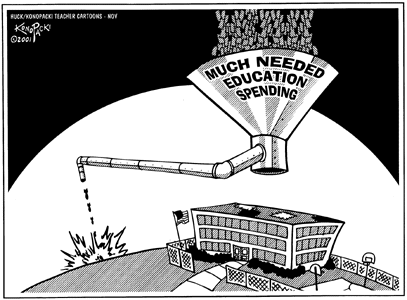
Huck/Konopacki Labor Cartoons
As the new school year begins, teachers are printing their syllabi and informing their students that their success depends on coming to class prepared each day with the basic supplies like pens, pencils, notebooks and calculators.

This expectation by teachers may now be illegal in California, as a result of an ACLU lawsuit last year which prohibits schools from charging fees for required course materials and activities.

The ACLU investigated numerous California schools and found that there were “no truly free schools” (according to their blog), as required by California law. School routinely charge fees for labs and art and shop classes, require students to purchase workbooks or gym uniforms, and make students pay for extracurricular activities.

The ACLU based its suit in part on the Hartzell v. Connell state Supreme Court ruling (1984), which said that the “financial burden which may be imposed on the right to an education [is] none.”

Taken to its literal extreme, teachers and schools would be prohibited from requiring students to purchase anything that is necessary for school, including basic supplies like binders, pens and calculators. Aside from the fact that schools can no longer afford nurses and librarians, let alone office supplies for every one of their students, the ruling could worsen the already anti-academic cultures prevalent in some schools, in which preparedness, self-discipline and organization are not only lacking but disdained by students. If schools cannot ask students to purchase binders or pens and do not provide them, some students simply won’t bring them and will sit passively or goof off rather than participating in class activities.

To their credit, the ACLU did uncover numerous egregious examples of abusive policies that would truly deny lower income students equity in educational opportunities, such as high fees for Advanced Placement supplies. They also claimed that some teachers humiliated students by ridiculing them for not buying the right supplies. Obviously, such practices should not be tolerated. However, it is not unreasonable to ask students to come to school prepared each day with basic materials like pens and notebooks. Schools routinely make these materials available for students who have trouble obtaining them. And it should not be a burden or an embarrassment for students to obtain these materials from their schools, especially when arrangements can be made nonjudgmentally, in private, and outside of class time.

While the ACLU’s website acknowledged that the problem is due in part to declining school revenue and government dysfunction, it ignored the fact that youth poverty has been growing and is the number one cause of low student achievement. Giving every child a binder will not bring up test scores or graduation rates, but ending childhood poverty will. Of course this is much harder to litigate (and legislate). Thus, teachers and schools are yet again blamed and saddled with additional burdens, while society and the politicians get another free ride.

The ACLU also correctly asserts that declining revenue does not justify schools resorting to illegal or unfair means of raising money. However, the abuses they have documented, likewise, do not justify mandating an end to reasonable expectations of student preparedness for school.