Showing posts with label National Guards. Show all posts

Friday, June 7, 2013

Today in Labor History—June 7

June 7, 1896 – A bomb exploded during a religious parade in Spain, killing a dozen people and wounding 30. The government response was to mass arrest anarchists, torturing hundreds in the Montjuich Prison. The severity of the government’s response sparked international protests. (From the Daily Bleed)
Cripple Creek under martial law, 1894
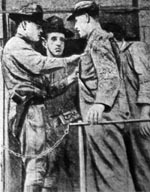
"Illegal" sheriffs' deputies under arrest, Cripple Creek, 1894
June 7, 1907 – The Colorado state militia was sent to Cripple Creek (again), to suppress a Western Federation of Miners (WFM) strike. A brutal strike occurred in Cripple Creek in 1894, the only time a state militia was called out in support of striking workers. There had been numerous firefights between striking workers and the mine owners’ private security forces, including the use of dynamite. The private cops had been terrorizing union members, their families and even local residents unaffiliated with the mines. The WFM won that strike, but it was short-lived, with the mine owners going on the offensive, particularly in 1903-1904, a period known as the Colorado Labor Wars. During this period, private detectives, goons, vigilantes, state militias and national guards were all used by the mine owners to attack the miners. On June 6, 1904, there was an explosion at the Independence mine that killed several nonunion miners. The Citizen’s Alliance brought in the National Guard, who, on June 7, shot into the WFM’s union hall. The Citizen’s Alliance also set up Kangaroo courts and convicted and deported nearly 240 miners who refused to renounce their union memberships. The Cripple Creek strike officially ended in December, 1907. However, the WFM’s struggle in Colorado helped inspire the creation of the even more radical Industrial Workers of the World (IWW), in 1905. One of the leaders of the WFM and Cripple Creek struggle, Big Bill Haywood, was also a founding member of the IWW. (From the Daily Bleed and Wikipedia)

June 7, 1929 – Striking textile workers in Gastonia, North Carolina, fought off a vigilante attack on their union hall. (From the Daily Bleed)

June 7, 1968 – Violent clashes occurred between French workers at the Renault plant and police. (From the Daily Bleed)

June 7, 1971 – The U.S. Supreme Court ruled 5-4 that clothing with the words "Fuck the Draft" was protected by the First amendment. (From the Daily Bleed)

June 7, 1991 – A three-week General Strike in Albania ended by bringing down the government. (From the Daily Bleed)

June 7, 2001 – George Bush signed a $1.35-trillion tax cut, mostly for the rich. Not long after this “stimulus” plan was put into action, the economy, went further into the tank. (From the Daily Bleed)

Saturday, September 22, 2012

Today in Labor History—September 22


(From the New York World)

September 22, 1919 - Almost 400,000 steelworkers in 50 cities struck to protest intolerable working conditions. Union leaders believed that if they could organizer the steel workers, it would lead to a massive wave of unionization across the country. Thus began the Great Steel Strike of 1919. The bosses called upon the federal troops and crushed the strike after 3½ months, killing twenty-two people in the process. (From Workday Minnesota)
Miners arriving to join in the Battle of Blair Mountain
 September 22, 1922 – Martial law was ended in Mingo County, West Virginia, after overwhelming force by mine owners’ goons, police and U.S. troops suppressed the mining strike there. (Also see the Battle of Blair Mountain)  (From the Daily Bleed)

September 22, 1934 – The United Textile Workers (UTW) strike committee ordered strikers back to work, bring to an end "the greatest single industrial conflict in the history of American organized labor." However, the Southern employers continued to try to bust the textile unions and their ongoing agitation occurring along the Eastern seaboard. 10,000 National Guardsmen were mobilized in Georgia and the Carolinas, Alabama, & Mississippi, with an additional army of 15,000 armed deputies. Despite the overwhelming show of force, it is estimated that 421,000 textile workers had joined the strike, an increase of 20,000 new strikers in just one week. In response, martial law was declared in Georgia and the National Guardsmen started to arrest and jail large numbers of strikers without charge, holding them in World War I concentration camps. 13 strikers were killed and 34 strike leaders were held incommunicado. (From the Daily Bleed and Jeremy Brecher, Strike! p176)

September 22, 1935 – 400,000 coal workers went on strike. (From the Daily Bleed)

September 22, 1946 – 4,000 workers marched in Valleyfield, Quebec to protest the arrest of Medeliene Parent, a leader of the dominion textile strike. (From the Daily Bleed)

Thursday, June 7, 2012

Today in Labor History—June 7

June 7, 1896 – A bomb exploded during a religious parade in Spain, killing a dozen people and wounding 30. The government response was to mass arrest anarchists, torturing hundreds in the Montjuich Prison. The severity of the government’s response sparked international protests. (From the Daily Bleed)


Cripple Creek under martial law, 1894
"Illegal" sheriffs' deputies under arrest, Cripple Creek, 1894
June 7, 1907 – The Colorado state militia was sent to Cripple Creek (again), to suppress a Western Federation of Miners (WFM) strike. A brutal strike occurred in Cripple Creek in 1894, the only time a state militia was called out in support of striking workers. There had been numerous firefights between striking workers and the mine owners’ private security forces, including the use of dynamite. The private cops had been terrorizing union members, their families and even local residents unaffiliated with the mines. The WFM won that strike, but it was short-lived, with the mine owners going on the offensive, particularly in 1903-1904, a period known as the Colorado Labor Wars. During this period, private detectives, goons, vigilantes, state militias and national guards were all used by the mine owners to attack the miners. On June 6, 1904, there was an explosion at the Independence mine that killed several nonunion miners. The Citizen’s Alliance brought in the National Guard, who, on June 7, shot into the WFM’s union hall. The Citizen’s Alliance also set up Kangaroo courts and convicted and deported nearly 240 miners who refused to renounce their union memberships. The Cripple Creek strike officially ended in December, 1907. However, the WFM’s struggle in Colorado helped inspire the creation of the even more radical Industrial Workers of the World (IWW), in 1905. One of the leaders of the WFM and Cripple Creek struggle, Big Bill Haywood, was also a founding member of the IWW. (From the Daily Bleed and Wikipedia)

June 7, 1929 – Striking textile workers in Gastonia, North Carolina, fought off a vigilante attack on their union hall. (From the Daily Bleed)

June 7, 1968 – Violent clashes occurred between French workers at the Renault plant and police. (From the Daily Bleed)

June 7, 1971 – The U.S. Supreme Court ruled 5-4 that clothing with the words "Fuck the Draft" was protected by the First amendment. (From the Daily Bleed)

June 7, 1991 – A three-week General Strike in Albania ended by bringing down the government. (From the Daily Bleed)

June 7, 2001 – George Bush signed a $1.35-trillion tax cut, mostly for the rich. Not long after this “stimulus” plan was put into action, the economy, went further into the tank. (From the Daily Bleed)

Thursday, September 22, 2011

Today in Labor History—September 22


(From the New York World)
September 22, 1919 - Almost 400,000 steelworkers in 50 cities struck to protest intolerable working conditions. Union leaders believed that if they could organizer the steel workers, it would lead to a massive wave of unionization across the country. Thus began the Great Steel Strike of 1919. The bosses called upon the federal troops and crushed the strike after 3½ months, killing twenty-two people in the process. (From Workday Minnesota)
Miners arriving to join in the Battle of Blair Mountain
 September 22, 1922 – Martial law was ended in Mingo County, West Virginia, after overwhelming force by mine owners’ goons, police and U.S. troops suppressed the mining strike there. (Also see the Battle of Blair Mountain)  (From the Daily Bleed)

September 22, 1934 – The United Textile Workers (UTW) strike committee ordered strikers back to work, bring to an end "the greatest single industrial conflict in the history of American organized labor." However, the Southern employers continued to try to bust the textile unions and their ongoing agitation occurring along the Eastern seaboard. 10,000 National Guardsmen were mobilized in Georgia and the Carolinas, Alabama, & Mississippi, with an additional army of 15,000 armed deputies. Despite the overwhelming show of force, it is estimated that 421,000 textile workers had joined the strike, an increase of 20,000 new strikers in just one week. In response, martial law was declared in Georgia and the National Guardsmen started to arrest and jail large numbers of strikers without charge, holding them in World War I concentration camps. 13 strikers were killed and 34 strike leaders were held incommunicado. (From the Daily Bleed and Jeremy Brecher, Strike! p176)

September 22, 1935 – 400,000 coal workers went on strike. (From the Daily Bleed)

September 22, 1946 – 4,000 workers marched in Valleyfield, Quebec to protest the arrest of Medeliene Parent, a leader of the dominion textile strike. (From the Daily Bleed)

Friday, July 1, 2011

Today In Labor History—July 1


Bakunin speaking before the International Workingmens Association, Basel Congress, 1869
July 1, 1876 – Anarchist leader Michael Bakunin died in Berne, Switzerland. (From the Daily Bleed)

July 1, 1910 – The ILGWU organized a large strike, known as the "Great Revolt" involving 50,000 cloak-makers that lasted through October. Taking their lead from the women, the mostly male cloak-makers won uniform wages, a shorter work week and paid holidays. As a result of the strikes in 1909 and 1910, the ILGWU swelled in membership. (From the
Daily Bleed)

July 1, 1922 – 1,000,000 railroad shop workers walked off their jobs, initiating what became known as the “Big Strike.” They eventually lost and many members were blacklisted. (From Workday Minnesota and the Daily Bleed)

July 1, 1937 – The Hawaiian long shore strike brought together Japanese, Filipino and other ethnic plantation workers into one labor union (ILWU). (From the Daily Bleed)

July 1, 1968 – The United Auto Workers (UAW) under the leadership of Walter Reuther, left the AFL, partly because of conflicts between Reuther and AFL president George Meany. Reuther died (was killed?) in a plane crash in 1970, and the UAW did not rejoin the AFL until 1981. (From Shmoop Labor History)

July 1, 1977 – Native American activist Leonard Peltier was sentenced to two consecutive life terms for the killing of two FBI agents who died while attacking an American Indian Movement (AIM) encampment, despite the fact that there was no evidence directly linking him to their deaths. (From the Daily Bleed)

July 1, 1983 – Copper miners began a against Phelps-Dodge in Clifton, Arizona, in which Governor Bruce Babbitt repeatedly sent in state police and National Guardsmen to suppress the laborers. (From the Daily Bleed)

Tuesday, June 7, 2011

Today in Labor History—June 7

June 7, 1896 – A bomb exploded during a religious parade in Spain, killing a dozen people and wounding 30. The government response was to mass arrest anarchists, torturing hundreds in the Montjuich Prison. The severity of the government’s response sparked international protests. (From the Daily Bleed)


Cripple Creek under martial law, 1894
"Illegal" sheriffs' deputies under arrest, Cripple Creek, 1894
June 7, 1907 – The Colorado state militia was sent to Cripple Creek (again), to suppress a Western Federation of Miners (WFM) strike. A brutal strike occurred in Cripple Creek in 1894, the only time a state militia was called out in support of striking workers. There had been numerous firefights between striking workers and the mine owners’ private security forces, including the use of dynamite. The private cops had been terrorizing union members, their families and even local residents unaffiliated with the mines. The WFM won that strike, but it was short-lived, with the mine owners going on the offensive, particularly in 1903-1904, a period known as the Colorado Labor Wars. During this period, private detectives, goons, vigilantes, state militias and national guards were all used by the mine owners to attack the miners. On June 6, 1904, there was an explosion at the Independence mine that killed several nonunion miners. The Citizen’s Alliance brought in the National Guard, who, on June 7, shot into the WFM’s union hall. The Citizen’s Alliance also set up Kangaroo courts and convicted and deported nearly 240 miners who refused to renounce their union memberships. The Cripple Creek strike officially ended in December, 1907. However, the WFM’s struggle in Colorado helped inspire the creation of the even more radical Industrial Workers of the World (IWW), in 1905. One of the leaders of the WFM and Cripple Creek struggle, Big Bill Haywood, was also a founding member of the IWW. (From the Daily Bleed and Wikipedia)

June 7, 1929 – Striking textile workers in Gastonia, North Carolina, fought off a vigilante attack on their union hall. (From the Daily Bleed)

June 7, 1968 – Violent clashes occurred between French workers at the Renault plant and police. (From the Daily Bleed)

June 7, 1971 – The U.S. Supreme Court ruled 5-4 that clothing with the words "Fuck the Draft" was protected by the First amendment. (From the Daily Bleed)

June 7, 1991 – A three-week General Strike in Albania ended by bringing down the government. (From the Daily Bleed)

June 7, 2001 – George Bush signed a $1.35-trillion tax cut, mostly for the rich. Not long after this “stimulus” plan was put into action, the economy, went further into the tank. (From the Daily Bleed)