Showing posts with label AIM. Show all posts

Wednesday, June 26, 2013

Today in Labor History—June 26

June 26, 1894 - The American Railway Union launched a boycott of all trains carrying Pullman cars, turning the Pullman strike into a national strike which was eventually crushed by federal troops and by lack of support from the more conservative American Federation of Labor. Strike leader Eugene V. Debs was imprisoned and many workers were blacklisted for their involvement. (From Workday Minnesota)
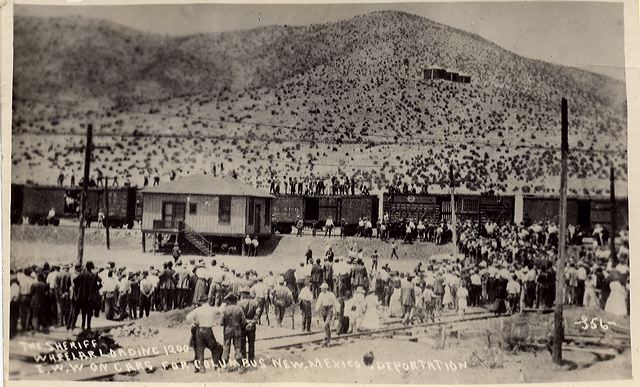
Miners, Supporters and Onlookers being deported from Bisbee
 June 26, 1917 – The Bisbee, Arizona IWW (Industrial Workers of the World) miner strike. On July 12, 1,300 strikers, their supporters, and innocent bystanders were illegally deported from Bisbee by 2,000 vigilantes—over 200 miles in cattle cars, without food or water for 16 hours. (From the Daily Bleed and Wikipedia)

June 26, 1919 – The Winnipeg General Strike, which began on May 15, came to an end as the Winnipeg Labor Council "officially" declared the strike over at 11 o'clock. (From the Daily Bleed)

June 26, 1975 – The FBI provoked a shootout with members of the American Indian Movement (AIM) at Oglala, South Dakota. The deadly firefight left two FBI agents and Lakota activist Joe Stuntz dead. Two AIM leaders were prosecuted for the FBI deaths and found innocent. A third AIM activist, Leonard Peltier, who remains in prison to this day, was later framed when much of the same evidence is disallowed in his trial.
Gay Pride march, Taipei, Taiwan, 2005
 June 26, 1977 – Gay Pride marches occurred throughout the country, with 100,000 marching in San Francisco and tens of thousands in NYC.
Pride in Haifa, Israel, 2009
 June 26, 1994 – In commemoration of the 25th anniversary of the Stonewall Rebellion, over one million people marched in New York City in support of LGBT rights.

June 26, 1997 – “The Gentle Giant," Hawaiian protest singer Israel Kamakawiwo'ole (1959-1997) died. Best known for the song "Somewhere Over the Rainbow/What a Wonderful World," Kamakawiwo’ole was also an activist for Hawaiian indigenous rights and Hawaiian independence.

Monday, May 6, 2013

Today in Labor History—May 6

May 6, 1794 – Toussaint L'Ouverture launched the Haitian revolution for independence against
France. (From the Daily Bleed) For a fantastic history of the Haitian Revolution, read “The Black Jacobins,” by C.L.R.James.

May 6, 1877 – Chief Crazy Horse surrendered to US troops, who murdered him on September 5th. Dakota Sioux Chief Sitting Bull led 5,000 of his followers into Canada seeking protection from the Queen and petitioned for land for a reserve after defeating Gen. Custer and the U.S. 7th Cavalry at the Little Big Horn. The Canadian government refused. (From the Daily Bleed)

May 6, 1882 – Congress passed the first Chinese Exclusion Act, barring Chinese laborers from entering the U.S. for the next 10 years and denying naturalized citizenship to the Chinese already here. Chinese immigration was effectively shut off for the next 60 years, as the act was extended in both 1902 and again in 1904. (From the Daily Bleed)

May 6, 1935 – The country was deep into the Great Depression. President Franklin D. Roosevelt signed Executive Order 7034 and appropriated $4.8 billion for the Works Progress Administration, which put millions to work building bridges and painting murals, among other things. (From Workday Minnesota)

May 6, 1940 – John Steinbeck's The Grapes of Wrath won the Pulitzer Prize for the most distinguished novel of 1939. He ultimately won the Nobel Prize for Literature in 1962. (From the Daily Bleed)

May 6, 1960 – In Birmingham, Alabama, 1000 children and adults were arrested, bringing the total to 2500. Arrestees included Ella Baker, Dave Dellinger, James Forman, Dick Gregory and Joan Baez. Eisenhower ordered the Alabama National Guard to be placed under Federal control. (From the Daily Bleed)

May 6, 1968 – The Paris uprising was now in full swing. Parisian Universities were shut down and demonstrations were breaking out with violent confrontations with the police. On this day, the 'Nanterre 8' passed through a police cordon singing the 'Internationale,' on their way to appear before the University Discipline Committee. Students returning from the discipline hearing were savagely attacked by the police. Students started to rip up paving stones and flip over cars to form barricades. The police flipped out and brutally attacked. The Boulevard St. Germain becomes a bloody battleground, with over 900 wounded and 422 arrested. (From the Daily Bleed)

May 6, 1970-May 20, 1970— Student strikes involving at least one million students (and possibly as many as 4 million) disrupted 448 U.S. colleges during this period. There were as many as 1,200 demonstrations against sending troops to Cambodia. 75 campuses remained closed for the rest of the school year. (From the Daily Bleed)

FBI Car, Wounded Knee, 1973
May 6, 1973 – The FBI attacked Native Americans at Wounded Knee. The town of Wounded Knee had been surrounded and cordoned off by the FBI and marshals since February 27. Members of the American Indian Movement had gone to Wounded Knee for a meeting, but were immediately locked in by FBI. Members who tried to leave were arrested. They were opposing the autocratic and corrupt rule of Oglala Tribal Chairman Dick Wilson. Throughout the 3 months of occupation, gunfire was traded between the two sides. (From the Daily Bleed and Wikipedia)

Thursday, April 18, 2013

Today in Labor History: April 18


Clarence Darrow, 1922 (Library of Congress)
April 18, 1857 - Clarence Darrow was born. Darrow was the lawyer who defended Eugene V. Debs and the Wobblies, as well as John Scopes, the teacher who was prosecuted for teaching evolution in the famous "Scopes Monkey Trial." (From Workday Minnesota)

April 18, 1888 - The 260 women laborers at Shotwell, Clerihew & Lothman walked out of the clothing factory in downtown Minneapolis to protest a pay cut. They became known as the “striking maidens of 1888,” inspiring women in the cause of social justice. (From Workday Minnesota)

April 18, 1906--The Great San Francisco earthquake struck, killing over 500 people and making over 250,000 people homeless.
 
April 18, 1908 – The IWW poem We Have Fed You All For A Thousand Years was published in the Industrial Union Bulletin. (From the Daily Bleed and the IWW)

We have fed you all for a thousand years
& you hail us still unfed
Though there's never a dollar of all your wealth
But marks the workers dead
We have yielded our best to give you rest
& you lie on crimson wool
But if blood be the price of all your wealth
Good God we have paid in full...

April 18, 1912 – The National Guard was called out against striking West Virginia coal miners, initiating one of the most violent strikes in the nation's history (50 people were killed). UMWA miners were demanding to be paid the same as other area miners in the area and to have their union recognized. (From the Daily Bleed)

April 18, 1941-- New York bus companies agreed to hire black workers following a 4-week boycott.
(From the Daily Bleed)
 
April 18, 1977 – Native American activist Leonard Peltier was found guilty of murdering two FBI agents, in a kangaroo court dead set on locking the American Indian Movement activist up for life. Government witnesses testified that he was not even present at the scene of the killings. He was framed by undercover FBI agents who were present on the reservation to conduct counterintelligence. (From the Daily Bleed and the Leonard Peltier site).

Leonard Peltier is still in prison and his health is deteriorating. There is a petition to get him transferred from prison to Mayo clinic in Minnesota.

Wednesday, February 27, 2013

Today in Labor History—February 27

Guards' cannon dragged to Montmartre During Paris Commune (contemporary sketch)

February 27, 1871 – The Paris Commune began when regular soldiers, sent to confiscate cannon from the National Guard militia in Paris, were confronted by the crowd and then decided to fraternize with them. (From the Daily Bleed)
Cartoon showing US Socialist Presidential candidate, Eugen V. Debs, who ran from in prison in the 1920 election.
 February 27, 1875 – Eugene V. Debs became a charter member and secretary of the Vigo Lodge, Brotherhood of Locomotive Firemen. By 1880, he had become grand secretary of the national Brotherhood of Locomotive Firemen and editor of the Locomotive Fireman's Magazine. He later led the bitter Pullman strike. (From the Daily Bleed)

February 27, 1902 – John Steinbeck was born on this date in Salinas, California. Steinbeck, who won the Nobel Prize for literature in 1962, wrote numerous novels from the perspective of farmers and the working class, including The Grapes of Wrath (1939), Tortilla Flats, Of Mice and Men, Cannery Row & East of Eden. (1952). (From the Daily Bleed)

February 27, 1912 – “The Times" of London published a lead story about a "conspiracy" of unions to take over ownership of British coal mines. The piece was based on a pamphlet, "The Miner's Next Step," which had been printed in Tonypandy, a scene of recent bloodshed between strikers and police. The pamphlet, written by the South Wales Miner's Federation, called for direct action and industrial solidarity. (From the Daily Bleed)

February 27, 1933 – Berlin's Reichstag parliament building was torched. The Nazi's tried to blame it on communists as a ploy in their steady consolidation of total power. (From the Daily Bleed)


Jarama Valley, Woody Guthrie
February 27, 1937 – Lincoln Brigadiers attacked Pingarrón Hill ("Suicide Hill") in Jarama Valley, Spain. Of the 500 who fought in this infamous battle, over 300 were killed or wounded. The Lincoln Brigade was made up of Americans who went to Spain (in violation of U.S. law) to help fight Franco and the fascists. (From the Daily Bleed)

February 27, 1939 - Following a decade of sit-down strikes, the U.S. Supreme Court ruled that sit-down strikes were illegal. (From Workday Minnesota)

February 27, 1942 – The Seattle School Board accepted the forced resignation of Japanese-American teachers. (From the Daily Bleed)


February 27, 1943 – A mine disaster killed 74 workers at Red Lodge, Montana. (From the Daily Bleed)

February 27, 1973 – 300 Oglala Sioux American Indian Movement (A.I.M.) activists liberated and occupied Wounded Knee, South Dakota (the site of the 1890 massacre of Sioux by the U.S. cavalry), in response to a campaign of terror by tribal and FBI officials. From the Daily Bleed)

February 27, 2001 – Seattle ACORN workers went on strike. Their office shut was down after their employer refused to recognize Public Interest Workers IU 670 union of the IWW. From the Daily Bleed)

Tuesday, June 26, 2012

Today in Labor History—June 26

June 26, 1894 - The American Railway Union launched a boycott of all trains carrying Pullman cars, turning the Pullman strike into a national strike which was eventually crushed by federal troops and by lack of support from the more conservative American Federation of Labor. Strike leader Eugene V. Debs was imprisoned and many workers were blacklisted for their involvement. (From Workday Minnesota)
Miners, Supporters and Onlookers being deported from Bisbee
 June 26, 1917 – The Bisbee, Arizona IWW (Industrial Workers of the World) miner strike. On July 12, 1,300 strikers, their supporters, and innocent bystanders were illegally deported from Bisbee by 2,000 vigilantes—over 200 miles in cattle cars, without food or water for 16 hours. (From the Daily Bleed and Wikipedia)

June 26, 1919 – The Winnipeg General Strike, which began on May 15, came to an end as the Winnipeg Labor Council "officially" declared the strike over at 11 o'clock. (From the Daily Bleed)

June 26, 1975 – The FBI provoked a shootout with members of the American Indian Movement (AIM) at Oglala, South Dakota. The deadly firefight left two FBI agents and Lakota activist Joe Stuntz dead. Two AIM leaders were prosecuted for the FBI deaths and found innocent. A third AIM activist, Leonard Peltier, who remains in prison to this day, was later framed when much of the same evidence is disallowed in his trial.
Gay Pride march, Taipei, Taiwan, 2005
 June 26, 1977 – Gay Pride marches occurred throughout the country, with 100,000 marching in San Francisco and tens of thousands in NYC.
Pride in Haifa, Israel, 2009
 June 26, 1994 – In commemoration of the 25th anniversary of the Stonewall Rebellion, over one million people marched in New York City in support of LGBT rights.

June 26, 1997 – “The Gentle Giant," Hawaiian protest singer Israel Kamakawiwo'ole (1959-1997) died. Best known for the song "Somewhere Over the Rainbow/What a Wonderful World," Kamakawiwo’ole was also an activist for Hawaiian indigenous rights and Hawaiian independence.

Sunday, May 6, 2012

Today in Labor History—May 6

May 6, 1794 – Toussaint L'Ouverture launched the Haitian revolution for independence against France. (From the Daily Bleed) For a fantastic history of the Haitian Revolution, read “The Black Jacobins,” by C.L.R.James.

May 6, 1877 – Chief Crazy Horse surrendered to US troops, who murdered him on September 5th. Dakota Sioux Chief Sitting Bull led 5,000 of his followers into Canada seeking protection from the Queen and petitioned for land for a reserve after defeating Gen. Custer and the U.S. 7th Cavalry at the Little Big Horn. The Canadian government refused. (From the Daily Bleed)

May 6, 1882 – Congress passed the first Chinese Exclusion Act, barring Chinese laborers from entering the U.S. for the next 10 years and denying naturalized citizenship to the Chinese already here. Chinese immigration was effectively shut off for the next 60 years, as the act was extended in both 1902 and again in 1904. (From the Daily Bleed)

May 6, 1935 – The country was deep into the Great Depression. President Franklin D. Roosevelt signed Executive Order 7034 and appropriated $4.8 billion for the Works Progress Administration, which put millions to work building bridges and painting murals, among other things. (From Workday Minnesota)

May 6, 1940 – John Steinbeck's The Grapes of Wrath won the Pulitzer Prize for the most distinguished novel of 1939. He ultimately won the Nobel Prize for Literature in 1962. (From the Daily Bleed)

May 6, 1960 – In Birmingham, Alabama, 1000 children and adults were arrested, bringing the total to 2500. Arrestees included Ella Baker, Dave Dellinger, James Forman, Dick Gregory and Joan Baez. Eisenhower ordered the Alabama National Guard to be placed under Federal control. (From the Daily Bleed)

May 6, 1968 – The Paris uprising was now in full swing. Parisian Universities were shut down and demonstrations were breaking out with violent confrontations with the police. On this day, the 'Nanterre 8' passed through a police cordon singing the 'Internationale,' on their way to appear before the University Discipline Committee. Students returning from the discipline hearing were savagely attacked by the police. Students started to rip up paving stones and flip over cars to form barricades. The police flipped out and brutally attacked. The Boulevard St. Germain becomes a bloody battleground, with over 900 wounded and 422 arrested. (From the Daily Bleed)

May 6, 1970-May 20, 1970— Student strikes involving at least one million students (and possibly as many as 4 million) disrupted 448 U.S. colleges during this period. There were as many as 1,200 demonstrations against sending troops to Cambodia. 75 campuses remained closed for the rest of the school year. (From the Daily Bleed)

FBI Car, Wounded Knee, 1973
May 6, 1973 – The FBI attacked Native Americans at Wounded Knee. The town of Wounded Knee had been surrounded and cordoned off by the FBI and marshals since February 27. Members of the American Indian Movement had gone to Wounded Knee for a meeting, but were immediately locked in by FBI. Members who tried to leave were arrested. They were opposing the autocratic and corrupt rule of Oglala Tribal Chairman Dick Wilson. Throughout the 3 months of occupation, gunfire was traded between the two sides. (From the Daily Bleed and Wikipedia)

Wednesday, April 18, 2012

Today in Labor History: April 18


Clarence Darrow, 1922 (Library of Congress)
April 18, 1857 - Clarence Darrow was born. Darrow was the lawyer who defended Eugene V. Debs and the Wobblies, as well as John Scopes, the teacher who was prosecuted for teaching evolution in the famous "Scopes Monkey Trial." (From Workday Minnesota)

April 18, 1888 - The 260 women laborers at Shotwell, Clerihew & Lothman walked out of the clothing factory in downtown Minneapolis to protest a pay cut. They became known as the “striking maidens of 1888,” inspiring women in the cause of social justice. (From Workday Minnesota)

April 18, 1908 – The IWW poem We Have Fed You All For A Thousand Years was published in the Industrial Union Bulletin. (From the Daily Bleed and the IWW)

We have fed you all for a thousand years
& you hail us still unfed
Though there's never a dollar of all your wealth
But marks the workers dead
We have yielded our best to give you rest
& you lie on crimson wool
But if blood be the price of all your wealth
Good God we have paid in full...

April 18, 1912 – The National Guard was called out against striking West Virginia coal miners, initiating one of the most violent strikes in the nation's history (50 people were killed). UMWA miners were demanding to be paid the same as other area miners in the area and to have their union recognized. (From the Daily Bleed)

April 18, 1977 – Native American activist Leonard Peltier was found guilty of murdering two FBI agents, in a kangaroo court dead set on locking the American Indian Movement activist up for life. Government witnesses testified that he was not even present at the scene of the killings. He was framed by undercover FBI agents who were present on the reservation to conduct counterintelligence. (From the Daily Bleed and the Leonard Peltier site).

Leonard Peltier is still in prison and his health is deteriorating. There is a petition to get him transferred from prison to Mayo clinic in Minnesota.

Monday, February 27, 2012

Today in Labor History—February 27

Guards' cannon dragged to Montmartre During Paris Commune (contemporary sketch)

February 27, 1871 – The Paris Commune began when regular soldiers, sent to confiscate cannon from the National Guard militia in Paris, were confronted by the crowd and then decided to fraternize with them. (From the Daily Bleed)
Cartoon showing US Socialist Presidential candidate, Eugen V. Debs, who ran from in prison in the 1920 election.
 February 27, 1875 – Eugene V. Debs became a charter member and secretary of the Vigo Lodge, Brotherhood of Locomotive Firemen. By 1880, he had become grand secretary of the national Brotherhood of Locomotive Firemen and editor of the Locomotive Fireman's Magazine. He later led the bitter Pullman strike. (From the Daily Bleed)

February 27, 1902 – John Steinbeck was born on this date in Salinas, California. Steinbeck, who won the Nobel Prize for literature in 1962, wrote numerous novels from the perspective of farmers and the working class, including The Grapes of Wrath (1939), Tortilla Flats, Of Mice and Men, Cannery Row & East of Eden. (1952). (From the Daily Bleed)

February 27, 1912 – “The Times" of London published a lead story about a "conspiracy" of unions to take over ownership of British coal mines. The piece was based on a pamphlet, "The Miner's Next Step," which had been printed in Tonypandy, a scene of recent bloodshed between strikers and police. The pamphlet, written by the South Wales Miner's Federation, called for direct action and industrial solidarity. (From the Daily Bleed)

February 27, 1933 – Berlin's Reichstag parliament building was torched. The Nazi's tried to blame it on communists as a ploy in their steady consolidation of total power. (From the Daily Bleed)

Jarama Valley, Woody Guthrie
February 27, 1937 – Lincoln Brigadiers attacked Pingarrón Hill ("Suicide Hill") in Jarama Valley, Spain. Of the 500 who fought in this infamous battle, over 300 were killed or wounded. The Lincoln Brigade was made up of Americans who went to Spain (in violation of U.S. law) to help fight Franco and the fascists. (From the Daily Bleed)

February 27, 1939 - Following a decade of sit-down strikes, the U.S. Supreme Court ruled that sit-down strikes were illegal. (From Workday Minnesota)

February 27, 1942 – The Seattle School Board accepted the forced resignation of Japanese-American teachers. (From the Daily Bleed)


February 27, 1943 – A mine disaster killed 74 workers at Red Lodge, Montana. (From the Daily Bleed)

February 27, 1973 – 300 Oglala Sioux American Indian Movement (A.I.M.) activists liberated and occupied Wounded Knee, South Dakota (the site of the 1890 massacre of Sioux by the U.S. cavalry), in response to a campaign of terror by tribal and FBI officials. From the Daily Bleed)

February 27, 2001 – Seattle ACORN workers went on strike. Their office shut was down after their employer refused to recognize Public Interest Workers IU 670 union of the IWW. From the Daily Bleed)

Thursday, July 14, 2011

Does America Torture Americans? Yes, Especially Native Americans.


65 year-old Native American activist Leonard Peltier, who has been in prison for more than 35 years on trumped charges of killing two FBI agents in 1975, has been placed in solitary confinement for two minor infractions, according to Democracy Now. Peltier has long maintained his innocence and is a political prisoner, being punished for his support and activism within the American Indian Movement (see here for more).

Meanwhile, prisoners in California have entered the third week of a hunger strike against deplorable living conditions. The strike began at Pelican Bay, where many of the state’s most violent prisoners live in SHUs (Security Housing Units) often confined for 23 or more hours a day, in isolation. Prisoners in the SHU are placed in 6-by-10 foot isolation cells. The strikers are calling for an end to the isolation units and the “debriefings” in which prisoners are subjected to lengthy interrogations to determine if they are in gangs. Several of the strikers’ health has deteriorated to critical levels, the San Francisco Chronicle reported today.

Friday, July 1, 2011

Today In Labor History—July 1


Bakunin speaking before the International Workingmens Association, Basel Congress, 1869
July 1, 1876 – Anarchist leader Michael Bakunin died in Berne, Switzerland. (From the Daily Bleed)

July 1, 1910 – The ILGWU organized a large strike, known as the "Great Revolt" involving 50,000 cloak-makers that lasted through October. Taking their lead from the women, the mostly male cloak-makers won uniform wages, a shorter work week and paid holidays. As a result of the strikes in 1909 and 1910, the ILGWU swelled in membership. (From the
Daily Bleed)

July 1, 1922 – 1,000,000 railroad shop workers walked off their jobs, initiating what became known as the “Big Strike.” They eventually lost and many members were blacklisted. (From Workday Minnesota and the Daily Bleed)

July 1, 1937 – The Hawaiian long shore strike brought together Japanese, Filipino and other ethnic plantation workers into one labor union (ILWU). (From the Daily Bleed)

July 1, 1968 – The United Auto Workers (UAW) under the leadership of Walter Reuther, left the AFL, partly because of conflicts between Reuther and AFL president George Meany. Reuther died (was killed?) in a plane crash in 1970, and the UAW did not rejoin the AFL until 1981. (From Shmoop Labor History)

July 1, 1977 – Native American activist Leonard Peltier was sentenced to two consecutive life terms for the killing of two FBI agents who died while attacking an American Indian Movement (AIM) encampment, despite the fact that there was no evidence directly linking him to their deaths. (From the Daily Bleed)

July 1, 1983 – Copper miners began a against Phelps-Dodge in Clifton, Arizona, in which Governor Bruce Babbitt repeatedly sent in state police and National Guardsmen to suppress the laborers. (From the Daily Bleed)