Showing posts with label Tom Mooney. Show all posts

Wednesday, March 6, 2013

Today in Labor History—March 6


Dred Scott (image from Wikipedia)
March 6, 1857 – The Dred Scott decision by the U.S. Supreme Court opened up federal territories to slavery and denied citizenship to blacks. (From the Daily Bleed)
1932 Version of the Little Red Songbook (from Wikipedia)

March 6, 1913 – Joe Hill's song "There is Power in a Union" first appeared in the IWW's Little Red Song Book. (From the Daily Bleed)

March 6, 1925 –Cape Breton, Canada, mine workers struck the British Empire Steel Corporation (BESCO). (From the Daily Bleed)

March 6, 1930 – 100,000 people demonstrated for jobs in New York City. Demonstrations by unemployed workers demanding unemployment insurance were occurring in virtually every major U.S. city. In New York, police attacked a crowd of 35,000. In Cleveland, 10,000 people battled police. In Detroit, a Communist Party organized unemployment demonstration brought out more than 50,000. Thousands took to the streets in Toledo, Flint and Pontiac. These demonstrations led to the creation of the House Un-American Activities Committee (HUAC), sponsored by Republican congressman Hamilton Fish, with the support of the American Federation of Labor (AFL), to investigate and quash radical activities. (From the Daily Bleed)

March 6, 1930 – A National Trade-Union Unity League council in Madison, Wisconsin, marching around Capitol Square, was attacked by UW students. Council leader Lottie Blumenthal was thrown to the ground, while students attacked other marchers and destroyed their banners and pamphlets. One of the athletes who was arrested said: "We are getting so damned many radical Jews here that something must be done." (From the Daily Bleed)

March 6, 1930 – Police killed four workers in Detroit who were demanding jobs. (From the Daily Bleed)

March 6, 1942 – Tom Mooney died on this date. Mooney was an Irish-American IWW organizer and 22-year political prisoner, locked up on trumped up charges for the San Francisco Preparedness Day bombing in 1916. (From the Daily Bleed. For more on Mooney, see here, here and here).

March 6, 1972 – A Wildcat strike occurred at the Lordstown, Ohio GM plant. (From the Daily Bleed)

March 6, 1978 - President Jimmy Carter invoked the Taft-Hartley law to quash the 1977-78 national contract strike by the United Mine Workers of America (UMWA). The UMWA had been striking since December 1977, but rejected a tentative contract agreement in early March 1978. Carter invoked the national emergency provision of Taft-Hartley and strikers were ordered back to work, but they ignored the order and the government did little to enforce it. Eventually a settlement was reached and ratified in late March. (From Workday Minnesota)

March 6, 1984 – A year-long coal strike began on this date in England. (From the Daily Bleed)

Thursday, February 7, 2013

Today in Labor History—February 7

February 7, 1817 – Frederick Douglass was born on this date in Tuckahoe, Maryland. (From the Daily Bleed)

February 7, 1913 – A county sheriff and his deputies on the "Bull Moose Special" (an armored train fitted with machine guns), attacked a miners' tent colony at Holly Grove in West Virginia. (From the Daily Bleed)

February 7, 1917 –
Labor organizer Tom Mooney was convicted and sentenced to hang on May 17 after being falsely accused of being responsible for San Francisco’s Preparedness Day bombing. (From the Daily Bleed)

February 7, 1923 – Striking workers on the Peking-Hankow railroad in China were shot by soldiers. (From the
Daily Bleed)

Monday, January 7, 2013

Today in Labor History—January 7

Semana Tragica

January 7, 1919 – This date marked the beginning of Argentina’s "Bloody Week" (AKA Tragic Week) in Buenos Aires. Workers (led by Italian anarchists) were demonstrating for the 8-hour work day and were fired upon by the authorities, leaving four dead and nearly 30 wounded. Clashes with the authorities on the day of the funerals left another 50 dead. A General Strike was called and strikers were attacked by trade union reformists and paramilitary groups collaborating with the police. By January 16 the strike was crushed, with as many as 700 dead and 2000 wounded, many of whom were Jewish-Russian immigrants targeted by racists and anti-Bolshevik hysteria.(From the Daily Bleed and Wikipedia)

January 7, 1939 – Tom Mooney, a labor activist wrongly convicted of murder in the San Francisco Preparedness Day bombing in July 1916, was freed after 22 ½ years in jail, granted an unconditional pardon by Governor Culbert Olson.(From the Daily Bleed)

Sunday, January 6, 2013

Today in Labor History—January 6


January 6, 1878 - Author-poet Carl Sandburg was born on this date in Galesburg, Illinois. Sandburg worked as a labor organizer, published in the International Socialist Review and later worker for the Chicago Daily News. The Feds accused him of being a Bolshevik symp, when he was actually just a working class symp. Sandburg died on July 22, 1967. (From the Daily Bleed and Workday Minnesota)

WORKING GIRLS (by Carl Sandburg)
THE working girls in the morning are going to work--
     long lines of them afoot amid the downtown stores
     and factories, thousands with little brick-shaped
     lunches wrapped in newspapers under their arms.
Each morning as I move through this river of young-
     woman life I feel a wonder about where it is all
     going, so many with a peach bloom of young years
     on them and laughter of red lips and memories in
     their eyes of dances the night before and plays and
     walks.
Green and gray streams run side by side in a river and
     so here are always the others, those who have been
     over the way, the women who know each one the
     end of life's gamble for her, the meaning and the
     clew, the how and the why of the dances and the
     arms that passed around their waists and the fingers
     that played in their hair.
Faces go by written over: "I know it all, I know where
the bloom and the laughter go and I have memories,"
     and the feet of these move slower and they
     have wisdom where the others have beauty.
So the green and the gray move in the early morning
     on the downtown streets.

January 6, 1882 - The Toronto Labor Council voted to support equal pay for equal work. (From Workday Minnesota)

January 6, 1916 – A strike was called at the Youngstown Sheet & Tube plant by its 8,000 workers. On January 7, strikers were joined by their wives and other family members on the picket line. Company guards attacked the crowd with tear gas bombs and live fire killing three strikers and wounding 25 others.(From the Daily Bleed)

January 6, 1937 – The Abraham Lincoln Brigade formed to fight fascism in the Spanish Civil War. Roughly 4,000 American men and women fought for the Republicans, most in violation of U.S. law. Nearly 2,000 of them died of wounds or disease. One of the casualties was Oliver Law, the first black man known to have commanded white U.S. troops. He led the Tom Mooney Machine-Gun Company (named for labor organizer Tom Mooney (see here,here and here), who spent years in prison on trumped up charges related to the San Francisco Preparedness Day bombing. (From the Daily Bleed)

January 6, 1970 – West Virginia miners launched a wildcat strike to protest the murder of their union reform leader Joseph "Jock" Yablonski. (From theDaily Bleed and Workday Minnesota)

January 6, 1975 – 12,000 workers struck at the Vaal Reefs gold mine in South Africa. (From the Daily Bleed)

Thursday, January 3, 2013

Today in Labor History—January 3


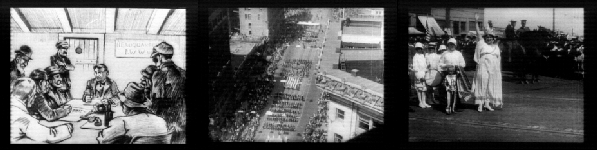
Propaganda Film on the Preparedness Day Bombing, Hearst-Pathe Film
Tom Mooney, 1910
January 3, 1917 – The trial of labor organizer Tom Mooney began in San Francisco on this date. Mooney was framed by Martin Swanson, a detective with a long history of interfering in San Francisco strikes, for the Preparedness Day bombing. Swanson maintained constant surveillance and harassment of Mooney and Warren Billings, as well as Alexander Berkman & Emma Goldman. Billings and Mooney were still convicted and imprisoned for the bombing, with Mooney serving over 22 years for a crime he did not commit. (From the Daily Bleed)

January 3, 1931 - Roughly 500 farmers marched into the business section of England, Arkansas, to demand food for their starving families after their crops were ruined by a long drought. The farmers threatened to take the food by force if it was not freely provided to them, one of scores of such incidents that occurred during the Great Depression (and surprisingly have not happened more frequently during the current one). (From Workday Minnesota)

January 3, 1964 – 450,000 public school kids went on strike in New York City to protest de facto racial segregation and poor learning conditions. (From theDaily Bleed)

Monday, October 8, 2012

Today in Labor History—October 8


October 8, 1889 - The Printing & Graphic Communications Union was created. (From Workday Minnesota)
Tom Mooney
 October 8, 1919 –A General Strike was called to demand the release of Tom Mooney and amnesty for all political prisoners.  Mooney was a labor organizer who was falsely convicted of the fatal Preparedness Day bombing. He was not released until 1939. (From the Daily Bleed)
Preparedness Day Bombing
 October 8, 1965 – The Indonesian military began massacring thousands of "suspected" Communists. The U.S. embassy provided death squads with the names of 5,000 “communists.” Overall, the reign of terror led to 500,000 civilian deaths. (From the Daily Bleed)

October 8, 1967 - Ernesto “Che” Guevara was executed in Bolivia.  (FromWorkday Minnesota)

October 8, 1969 – SDS Weathermen launched their "Days of Rage" in Chicago, during which they blew up a statue commemorating the police involved in the 1886 Haymarket tragedy bombing which resulted in the execution of innocent anarchists. The statue was replaced and blown up again in 1970. (From the Daily Bleed)

October 8, 1969 -- Disguised as a funeral procession, the Uruguayan Tupamaro urban guerrilla organization occupied the town of Pando, robbing three banks of over 40 million pesos. (From the Daily Bleed)

Tuesday, March 6, 2012

Today in Labor History—March 6


Dred Scott (image from Wikipedia)
March 6, 1857 – The Dred Scott decision by the U.S. Supreme Court opened up federal territories to slavery and denied citizenship to blacks. (From the Daily Bleed)
1932 Version of the Little Red Songbook (from Wikipedia)

March 6, 1913 – Joe Hill's song "There is Power in a Union" first appeared in the IWW's Little Red Song Book. (From the Daily Bleed)

March 6, 1925 –Cape Breton, Canada, mine workers struck the British Empire Steel Corporation (BESCO). (From the Daily Bleed)

March 6, 1930 – 100,000 people demonstrated for jobs in New York City. Demonstrations by unemployed workers demanding unemployment insurance were occurring in virtually every major U.S. city. In New York, police attacked a crowd of 35,000. In Cleveland, 10,000 people battled police. In Detroit, a Communist Party organized unemployment demonstration brought out more than 50,000. Thousands took to the streets in Toledo, Flint and Pontiac. These demonstrations led to the creation of the House Un-American Activities Committee (HUAC), sponsored by Republican congressman Hamilton Fish, with the support of the American Federation of Labor (AFL), to investigate and quash radical activities. (From the Daily Bleed)

March 6, 1930 – A National Trade-Union Unity League council in Madison, Wisconsin, marching around Capitol Square, was attacked by UW students. Council leader Lottie Blumenthal was thrown to the ground, while students attacked other marchers and destroyed their banners and pamphlets. One of the athletes who was arrested said: "We are getting so damned many radical Jews here that something must be done." (From the Daily Bleed)

March 6, 1930 – Police killed four workers in Detroit who were demanding jobs. (From the Daily Bleed)

March 6, 1942 – Tom Mooney died on this date. Mooney was an Irish-American IWW organizer and 22-year political prisoner, locked up on trumped up charges for the San Francisco Preparedness Day bombing in 1916. (From the Daily Bleed. For more on Mooney, see here, here and here).

March 6, 1972 – A Wildcat strike occurred at the Lordstown, Ohio GM plant. (From the Daily Bleed)

March 6, 1978 - President Jimmy Carter invoked the Taft-Hartley law to quash the 1977-78 national contract strike by the United Mine Workers of America (UMWA). The UMWA had been striking since December 1977, but rejected a tentative contract agreement in early March 1978. Carter invoked the national emergency provision of Taft-Hartley and strikers were ordered back to work, but they ignored the order and the government did little to enforce it. Eventually a settlement was reached and ratified in late March. (From Workday Minnesota)

March 6, 1984 – A year-long coal strike began on this date in England. (From the Daily Bleed)

Tuesday, February 7, 2012

Today in Labor History—February 7


February 7, 1817 – Frederick Douglass was born on this date in Tuckahoe, Maryland. (From the Daily Bleed)

February 7, 1913 – A county sheriff and his deputies on the "Bull Moose Special" (an armored train fitted with machine guns), attacked a miners' tent colony at Holly Grove in West Virginia. (From the Daily Bleed)

February 7, 1917 –
Labor organizer Tom Mooney was convicted and sentenced to hang on May 17 after being falsely accused of being responsible for San Francisco’s Preparedness Day bombing. (From the Daily Bleed)

February 7, 1923 – Striking workers on the Peking-Hankow railroad in China were shot by soldiers. (From the
Daily Bleed)

Saturday, January 7, 2012

Today in Labor History—January 7

Semana Tragica
January 7, 1919 – This date marked the beginning of Argentina’s "Bloody Week" (AKA Tragic Week) in Buenos Aires. Workers (led by Italian anarchists) were demonstrating for the 8-hour work day and were fired upon by the authorities, leaving four dead and nearly 30 wounded. Clashes with the authorities on the day of the funerals left another 50 dead. A General Strike was called and strikers were attacked by trade union reformists and paramilitary groups collaborating with the police. By January 16 the strike was crushed, with as many as 700 dead and 2000 wounded, many of whom were Jewish-Russian immigrants targeted by racists and anti-Bolshevik hysteria. (From the Daily Bleed and Wikipedia)

January 7, 1939 – Tom Mooney, a labor activist wrongly convicted of murder in the San Francisco Preparedness Day bombing in July 1916, was freed after 22 ½ years in jail, granted an unconditional pardon by Governor Culbert Olson. (From the Daily Bleed)

Friday, January 6, 2012

Today in Labor History—January 6


January 6, 1878 - Author-poet Carl Sandburg was born on this date in Galesburg, Illinois. Sandburg worked as a labor organizer, published in the International Socialist Review and later worker for the Chicago Daily News. The Feds accused him of being a Bolshevik symp, when he was actually just a working class symp. Sandburg died on July 22, 1967. (From the Daily Bleed and Workday Minnesota)

WORKING GIRLS (by Carl Sandburg)

THE working girls in the morning are going to work--
     long lines of them afoot amid the downtown stores
     and factories, thousands with little brick-shaped
     lunches wrapped in newspapers under their arms.
Each morning as I move through this river of young-
     woman life I feel a wonder about where it is all
     going, so many with a peach bloom of young years
     on them and laughter of red lips and memories in
     their eyes of dances the night before and plays and
     walks.
Green and gray streams run side by side in a river and
     so here are always the others, those who have been
     over the way, the women who know each one the
     end of life's gamble for her, the meaning and the
     clew, the how and the why of the dances and the
     arms that passed around their waists and the fingers
     that played in their hair.
Faces go by written over: "I know it all, I know where
the bloom and the laughter go and I have memories,"
     and the feet of these move slower and they
     have wisdom where the others have beauty.
So the green and the gray move in the early morning
     on the downtown streets.

January 6, 1882 - The Toronto Labor Council voted to support equal pay for equal work. (From
Workday Minnesota)

January 6, 1916 – A strike was called at the Youngstown Sheet & Tube plant by its 8,000 workers. On January 7, strikers were joined by their wives and other family members on the picket line. Company guards attacked the crowd with tear gas bombs and live fire killing three strikers and wounding 25 others. (From the Daily Bleed)

January 6, 1937 – The Abraham Lincoln Brigade formed to fight fascism in the Spanish Civil War. Roughly 4,000 American men and women fought for the Republicans, most in violation of U.S. law. Nearly 2,000 of them died of wounds or disease. One of the casualties was Oliver Law, the first black man known to have commanded white U.S. troops. He led the Tom Mooney Machine-Gun Company (named for labor organizer Tom Mooney (see here, here and here), who spent years in prison on trumped up charges related to the San Francisco Preparedness Day bombing. (From the Daily Bleed)

January 6, 1970 – West Virginia miners launched a wildcat strike to protest the murder of their union reform leader Joseph "Jock" Yablonski. (From the Daily Bleed and Workday Minnesota)

January 6, 1975 – 12,000 workers struck at the Vaal Reefs gold mine in South Africa.
(From the Daily Bleed)

Tuesday, January 3, 2012

Today in Labor History—January 3


Propaganda Film on the Preparedness Day Bombing, Hearst-Pathe Film
Tom Mooney, 1910
January 3, 1917 – The trial of labor organizer Tom Mooney began in San Francisco on this date. Mooney was framed by Martin Swanson, a detective with a long history of interfering in San Francisco strikes, for the Preparedness Day bombing. Swanson maintained constant surveillance and harassment of Mooney and Warren Billings, as well as Alexander Berkman & Emma Goldman. Billings and Mooney were still convicted and imprisoned for the bombing, with Mooney serving over 22 years for a crime he did not commit. (From the Daily Bleed)

January 3, 1931 - Roughly 500 farmers marched into the business section of England, Arkansas, to demand food for their starving families after their crops were ruined by a long drought. The farmers threatened to take the food by force if it was not freely provided to them, one of scores of such incidents that occurred during the Great Depression (and surprisingly have not happened more frequently during the current one). (From Workday Minnesota)

January 3, 1964 – 450,000 public school kids went on strike in New York City to protest de facto racial segregation and poor learning conditions. (From the Daily Bleed)

Saturday, October 8, 2011

Today in Labor History—October 8


October 8, 1889 - The Printing & Graphic Communications Union was created. (From Workday Minnesota)
Tom Mooney
 October 8, 1919 –A General Strike was called to demand the release of Tom Mooney and amnesty for all political prisoners.  Mooney was a labor organizer who was falsely convicted of the fatal Preparedness Day bombing. He was not released until 1939. (From the Daily Bleed)
Preparedness Day Bombing
 October 8, 1965 – The Indonesian military began massacring thousands of "suspected" Communists. The U.S. embassy provided death squads with the names of 5,000 “communists.” Overall, the reign of terror led to 500,000 civilian deaths. (From the Daily Bleed)

October 8, 1967 - Ernesto “Che” Guevara was executed in Bolivia.  (From Workday Minnesota)

October 8, 1969 – SDS Weathermen launched their "Days of Rage" in Chicago, during which they blew up a statue commemorating the police involved in the 1886 Haymarket tragedy bombing which resulted in the execution of innocent anarchists. The statue was replaced and blown up again in 1970. (From the Daily Bleed)

October 8, 1969 -- Disguised as a funeral procession, the Uruguayan Tupamaro urban guerrilla organization occupied the town of Pando, robbing three banks of over 40 million pesos. (From the Daily Bleed)