Thursday, December 6, 2012

Today in Labor History—December 6


December 6, 1810 – Miguel Hidalgo abolished slavery in Mexico. (From theDaily Bleed)


Colored National Labor Convention, Harpers 1869 (pub. dom.)
December 6, 1865 – The U.S., always the backwards, 3rd world nation, followed Mexico’s lead 55 years later by ratifying the 13th amendment and abolishing [chattel] slavery. Prisoners could (and can still) be forced to work without wages, while all workers were (and still are) subject to wage slavery. (From the Daily Bleed)

December 6, 1869 – The first national black labor group, the Colored National Labor Convention, 
met for the first time in Washington, DC. Roughly 214 delegates attended, sending a petition to Congress requesting direct intervention in the South by subdividing the public lands into forty-acre farms and providing low-interest loans to black farmers. (From Workday Minnesota)

December 6, 1888 - Heywood Broun, cofounder of The Newspaper Guild, was born in New York City. (From Workday Minnesota)

December 6, 1889 – The trial of the Chicago Haymarket anarchists began amidst national and international outrage and protest. (From the Daily Bleed)

December 6, 1907 – 361 coal workers were killed in West Virginia's Marion County when a mine explosed at the Fairmont Coal Company in Monongah. It was the worst mining disaster in American history.

December 6, 1928 – The "Ciénaga Slaughter" occurred in Columbia. After breaking a mass strike in the banana region in November, National Army troops fired on a peaceful rally of thousands of strikers, killing over one thousand workers.

December 6, 1933 – Dorothy Day cofounded the Catholic Worker newspaper, New York City

December 6, 1965 – Rose Pesotta, anarchist labor activist, died on this date. Pesotta was the only woman on the General Executive Board of the International Ladies' Garment Workers (ILGWU) from 1933-1944. She participated in a 10-year struggle to organize workers, including a turf war with a communist faction.  

December 6, 1984 – Children picketed the Mendiola Bridge in Manila, Philippines, demanding the release of their parents, who were being held as political prisoners by the U.S.-supported Marcos regime.

Wednesday, December 5, 2012

California Near Bottom, Texas Near Top in Graduation Rates—And Your Point Is?


The U.S. Department of Education has just published state-by-state high school graduation rates that are, for the first time ever, based on uniform accounting measures, according to the Los Angeles Times. California ranked 32nd in overall high school graduation rates for the 2010-2011 school year (tied with Washington, Utah and West Virginia), with only 76% of its high school students graduating on time. Iowa had the highest graduation rate, 88%, followed by Wisconsin and Vermont at 87%. Texas and Tennessee were tied for fourth with Indiana, Nebraska, New Hampshire and North Dakota, with a rate of 86%.

While California was one of ten states with worse graduation rates in 2009 than in 2002 (others were Nevada, Connecticut, New Mexico, Arizona, Utah, Nebraska, Arkansas, New Jersey and Rhode Island), the graduation rate between 1998 and 2008 actually climbed from 67.5% to 73%, according to a report in Thoughts on Public Education (TOPED). The TOPED article points out that in 2005 the state’s graduation rate was 78.1% and then suddenly dropped to 62.7% in 2007 and then was back up to 73% in 2008, suggesting that accounting methods, rather than pedagogy was at play. One notable factor that likely contributed to the drop between 2005 and 2007 was the implementation of the California High School Exit Exam (CAHSEE) in 2006 as a new graduation requirement.

The TOPED article also notes that the U.S. Department of Education has used three different formulas for calculating completion rates in recent years and that all were flawed and skewed by politics. The most recent data is being touted by the Dept. of Ed as the most consistent and reliable to date, as it relies on the same metric from state to state rather than the previous methods which relied on self-reporting data from each state that were calculated using a variety of different methods.

The new method uses a 4-year adjusted cohort graduation rate, according to the U.S. Department of Education, which is based on the number of students who graduate in four years with a regular high school diploma (in contrast to a GED) divided by the number of students who form the adjusted cohort for the graduating class. Put more simply: the number of students graduating in four years divided by the number of students who entered high school as 9th graders. The cohort is adjusted by adding students who transfer into the cohort and subtracting those who transfer out, emigrate out of the country or die.

This still leaves considerable wiggle room for states to game the system. States can boost their graduation rates by having easier exit exams (or none at all) and fewer graduation requirements. There are also numerous ways states can also subtract out students who would be likely to drop out, thus increasing the percentage of students graduating. The Texas Tribune reports that school officials in that state have reported student withdrawals using more than twelve different “leaver” codes, several of which allow students to not be counted toward the state’s graduation rate. For example, students who are removed from public school to be home schooled are no longer counted toward the four-year graduation rate.

This is not a trivial point as Texas has both an unexpectedly high graduation rate and a documented history of cheating. The majority of states with high graduation rates (80% and above) have relatively low childhood poverty rates (less than 20%), though Texas has both a high graduation rate (86%) and a high childhood poverty rate of 27%, according to data from Kids Count. In 2006, a study by Harvard, UT Austin and Rice University determined that Texas was inflating its graduation numbers by allowing districts to not count students who left school for a wide variety of reasons. After this report became publicized, the state began using the federal definition, which still allows them not count student who leave school for a variety of reasons.

It Might Be Fascist, But At Least The Kids Are On Time
Proponents credit Texas’ creativity and innovation for its four-year rise in graduation rates, particularly its emphasis on accountability. One of these “innovations” has been the adoption of radio frequency identification (RFID) tags for students by many of the state’s school districts. The RFID tags allow schools to monitor students’ every move and quickly pinpoint whether or not they are in class. This can lead to quicker and more accurate identification of truancy, one factor that contributes to students dropping out. The plan was covered by Wired's Threat Level blog, and has garnered increasing attention in light of a lawsuit by a student who was suspended for refusing to carry her RFID tag.

While the RFID tags may lead to more efficient reporting and improved attendance, resulting in increased revenue for schools that are funded based on average daily attendance (ADA), the RFID tags are unquestionably an invasion of privacy. They allow administrators to know how often students go to the restroom and how long they spend there. They also allow administrators to know how often and how long children meet with counselors or school safety advocates, meetings that are supposed to be privileged and confidential. This could cause some students to avoid emotional assistance or counsel when needed. Perhaps the most insidious and oppressive aspect of the use of RFID tags in school is that it conditions children to accept a world in which surveillance, social control and a lack of privacy and civil liberties are the norm.

What is the Significance of the New DOE Graduation Statistics?
The new federal formula for calculating high school graduation rates was intended to make graduation data collection uniform from state to state so that valid comparisons could be made. However, because the new formula still allows states to define for themselves what counts as a “drop out” or a “leaver,” and to create their own graduation requirements, valid comparisons are not possible.

The primary reason why graduation rates are even in the national spotlight is because of the general hysteria about our “failing schools”—a myth (or at least a gross exaggeration) that has been used by free market education “reformers” to justify the privatization of public education.

In reality, graduation rates have been steadily climbing across the nation, and they have been doing so for the past 140 years. In 1870, the first year in which records were kept, only 2% of students graduated from high school. By 1940, half of all students were graduating from high school. By 1969, 77% of students were earning diplomas. Since then, there have declines and rises in the graduation rate, with a general rising trend over the last decade.

Those who worry about graduation rates seldom look at the actual reasons why students drop out. In the 1940s and 1950s, many students were dropping out to enter the work force, raise families or join the military. Poverty has also played a large role, with lower income children entering school far behind their more affluent peers in pre-reading and other academic skills (see here and here). This gap grows over time as they have less access to enriching extracurricular and summer activities and increases the chances that they will drop out of school. Anti-poverty programs in the 1960s helped mitigate this to some extent, but childhood poverty rates began to rise again during the Reagan years and this likely contributed to the declines in graduation rates seen in the 1990s.

Today in Labor History—December 5


December 5, 1798—Johann Heinrich Pestalozzi was recruited to run a new orphanage in the Swiss town of Stans, after the French sacked the town, leaving many children without families or homes. This would be Pestalozzi’s first major foray into education. Pestalozzi would go on to become a major influence on later pedagogues like Friedrich Froebel (creator of the first kindergartens) and Francisco Ferrer (founder of the first Modern Schools).

December 5, 1912 – General Strikes occurred in both Germany and the U.S. (from the Daily Bleed)


December 5, 1944 – A wildcat strike occurred at the Dodge truck plant in Detroit, Michigan—one of many "illegal" wartime strikes. (from the Daily Bleed)

December 5, 1955 - The American Federation of Labor (AFL) and the Congress of Industrial Organizations (CIO) merged into a single mega-union—the AFL-CIO, ending a 20-year schism in the American trade union movement. (From Workday Minnesota)

December 5, 2008--Wall Street bankers received a gift from the taxpayers of $1.2 trillion in secret loans (on top of the $700 billion in TARP funds they already received). (from the Daily Bleed)

Tuesday, December 4, 2012

Michigan's Education Coup Attempt

Huck/Konopacki Labor Cartoons
On November 6, Michigan voters repealed Public Act 4, allowing Detroit school board to reclaim control over 15 “failing” local schools from the short-lived Education Achievement Authority. Within days of the election, GOP lawmakers introduced a bill into the Michigan House to codify the EAA into state law, in an attempt to nullify the November election results.

Advocates for the EAA argue that “real” education reform takes five to seven years to show success, according to the Detroit News, and thus the EAA should be allowed to continue, despite voters’ wishes. In reality, there is no consensus about what “real” reform even means, let alone any evidence that reforms share a five to seven year timeframe. Nevertheless, if the EAA were allowed to continue its control over these schools, we would likely never know if they “improved,” since the new legislation would exempt EAA students from the state exams that are used to compare schools and judge their success.

The EAA was a corporate coup that usurped local control of 15 Detroit schools from parents and the community and handed it over to an unaccountable cabal of business leaders. The new legislation not only keeps the schools out of the jurisdiction of Detroit Public Schools, it also allows the EAA to work outside the authority of the state superintendent and elected state school board. It would also be permitted to take over hundreds of other low performing schools throughout the state, as well as many that are not low performing, potentially making the EAA the largest school district in the state.

The EAA was never really about improving educational outcomes for low income students, as proponents have argued. Rather, it is about transferring tax dollars into the hands of private education profiteers. The agency was described by its chancellor, John Covington, as a “public body corporate,” according to an article in Counter Punch, which describes the EAA as a “for-profit” vulture seeking to take over financial control of the 50,000-student, predominantly poor and black school district. The EAA was created in 2011 as a joint venture between Eastern Michigan University’s board of regents and DPS, with the support of Gov. Rick Snyder, who hired a former GM executive to manage it. (It should be pointed out that soon after Covington left his former district, Kansas City, the district lost its accreditation). 

The EAA funnels public funds into the hands of private corporations by outsourcing many of its education services, including food concessions and maintenance. It can also profit by leasing or selling unused school buildings to private charter schools. The curriculum is heavily based on canned computer lessons purchased from Agilix and School Improvement Network, the Huffington Post reports. Each child gets an individualized learning plan ostensibly tailored to his or her needs. However, these plans are tied to the computer lessons, which students must master before advancing to the next level. Thus students are tied to their computers and the digital curriculum, while the companies that produce the curriculum are guaranteed long-term customers.

Supporters argue that the curriculum and pedagogy are “student-centered,” which is a catchy edu-babble way of saying it is superior to other pedagogies. One EAA teacher even invoked Paulo Freire’s Pedagogy of the Oppressed, suggesting that the EAA digital curriculum was a positive move away from the didactic, “banking” model of traditional public schools, according to the Counter Punch piece.

Of course this is completely absurd. While the curriculum may in fact be adaptable to the needs of each individual student, it also isolates students from their peers and denies them the social aspects of learning. Placing children in front of computers for hours at a time is not only unhealthy physically; it also undermines their development of communication and collaborative skills. But it may help them adapt more easily to a future career in an office cubicle.

The EAA’s digital pedagogy is just another form of “blended learning,” one of the many trendy national “reforms” that undermine the quality of education and the integrity of the teaching profession in order to transfer public education revenues to the private sector while weakening the public sector unions. With a uniform curriculum created by outsiders and imposed on all students, there is no longer a need for skilled, credentialed teachers. A warm body will suffice—somebody who can take attendance, make sure kids stay on task, and send them to the office when they misbehave.

The EAA’s assault on teachers goes well beyond the deskilling of the teaching profession. EAA teachers have been stripped of their collective bargaining rights and they are paid less than their peers in DPS. The EAA is also forcing them to pay for 40% of their own medical benefits, while depriving them of pensions, according to the Detroit Free Press. They are also required to work 40 more days than their colleagues in DPS.

Teachers Struggles Around the World


Croatia has been cutting its spending in order to close its deficit and improve its credit rating as it prepares to enter the European Union. It has been doing this by slashing public services like education and healthcare. In response, teachers and nurses have been striking against government plans to cut their pay. 70% of Croatia’s education workforce took part in a strike last Thursday, according to the Teacher Solidarity website.

In the German state of Saxony, teachers have begun a series of “warning” strikes for “equitable education funding” (also from the Teacher Solidarity website). More than 20,000 people (75% of Saxony’s education workers) took part in a November 16th strike, with thousands participating in rallies in Leipzig, Dresden and other cities. One of the strikers’ demands is a shorter work week for older teachers to ease their workload and provide more openings for younger teachers, who make up a minority of Saxony’s teaching staff.

Meanwhile, in Hawaii, teachers have been participating in work-to-rule actions every Thursday in an attempt to roll back concessions imposed on them by their governor two years ago (from Labor Notes). The 2011 contract, which expires in 2013, included cuts to their pay and benefits. Their union negotiated a compromise contract, which included performance pay, evaluation reforms and a two-tiered compensation system for new hires. Not surprisingly, the teachers voted this contract down.

The teachers are arriving just before classes start and leaving immediately at the end of classes, temporarily ending after school tutoring, club supervision, lesson planning and grading papers. In lieu of their normal unpaid labor before and after school, the teachers have waving signs to passersby to promote their cause. They are hoping to bring up wages (starting salaries for Hawaiian teachers are only $31,000) and resist pressure to accept performance pay.

As in many states, Hawaiian teachers are barred from striking until after negotiations have resulted in impasse. Rather than waiting until then, when it would be harder to mobilize teachers, as well as public support, they have begun their protests and outreach early. So far, teachers are saying that students and parents are supporting their actions. The key will be to maintain both high participation rates in their actions, as well as public support, until their demands are met.

Today in Labor History—December 4


December 4, 1906 – The National Federation of Postal Clerks was chartered on this date. (from the Daily Bleed)


December 4, 1951 - Walter Reuther, President of the United Auto Workers, was elected head of the Congress of Industrial Organizations (CIO). Four years later, he led the merger of the CIO and the American Federation of Labor to form the AFL-CIO. (From Workday Minnesota)

December 4, 1969--Chicago Black Panthers Fred Hampton and Mark Clark and 2 others were murdered by police, with assistance from the FBI.

December 4, 1970--Cesar Chavez was jailed for 20 days for refusing to call off the Salinas lettuce boycott. (from the Daily Bleed)

Monday, December 3, 2012

Another UTLA Sell-Out on VAM


Most people would argue that teachers should be evaluated based on how well they teach and help their students to grow academically. The problem is that there is no accurate or consistent method of measuring the teacher impact on student academic growth. High stakes state and NCLB tests are particularly ill-suited for this.

Nevertheless, a growing number of school districts across the nation are either imposing Value-Added Measures (VAM) of teacher “effectiveness” on their teaching staffs, or forcing them to accept student test scores as part of their evaluations in exchange for other concessions like raises and maintaining benefits. VAM, which attempts to calculate teachers’ impact on their students’ improvement on standardized tests, has been shown to be inaccurate and unreliable (see here, here and here).

Los Angeles Unified School District (LAUSD) has been under court order to reform its evaluation system. The ruling by Judge James Chalfant mandated that LAUSD comply with the state’s Stull Act, which requires that some measures of student academic progress be factored into the evaluations, though the law does not specify what kind of student data must be used. This has led to a protracted battle with United Teacher of Los Angeles (UTLA) over what kind of data will be used and to what extent.

Last Friday, the two sides came to an agreement on a new evaluation system that will include student test data. The evaluations will use both local and state standardized test scores, but there is no agreement yet on how much the test scores will count toward teachers’ evaluations. Superintendent John Deasy hailed the agreement as a victory for labor-management collaboration, while UTLA President Warren Fletcher was simply grateful the accord didn’t give LAUSD more than it did, according to John Fensterwald, writing for Ed Source. The agreement must still be approved by the school board and ratified by the UTLA membership.

Deasy had been pushing for a method called Academic Growth Over Time (AGT), a type of VAM that supposedly controls for external factors like students’ past test results and background. UTLA rightly opposed AGT as unsound, which it is. The agreement does not permit the AGT scores of individuals to be used in their evaluations, though school-level AGT can be used as one of several factors. Additionally, individual AGT scores will become part of teachers’ confidential personnel files, no longer accessible to the public or the press.

While this latter stipulation could be spun as a win for teachers, the fact that student test data is being used to evaluate teachers at all should be seen as a serious blow to both students and teachers. The use of student test data to evaluate teachers is terrible for students precisely because it does nothing to improve teacher quality, while potentially forcing many good teachers out of the profession because of its unreliability and inconsistency. Furthermore, it encourages the continued use of high stakes standardized exams, which take away class time from real learning, encourage teaching to the test, and unnecessarily increase the stress and anxiety children already face at school.

Today in Labor History—December 3


December 3, 1866 – Textile strikers won a 10-hour work day, Fall River, Massachusetts. (from the Daily Bleed)


December 3, 1910 – The Industrial Workers of the World (IWW) Brotherhood of Timber Workers Union was organized on this date.
December 3, 1916 – Seven Australian Wobblies (IWW members) were sentenced to 15 years in prison for their anti-war efforts during the "Great" War that Ended All Wars. Other IWWs were sentenced to five and 10 years. In August 1917 the IWW was outlawed in Australia and its membership rolls were made available to employers who blacklisted anyone on the lists. 

December 3, 1946 – Female retail clerks launched the great Oakland General Strike. Other workers joined in, with over 100,000 walking off the job.

Sunday, December 2, 2012

Today in Labor History—December 2


The Last Moments of John Brown, by Thomas Hovenden (1840–1895)
December 2, 1859 – Abolitionist John Brown was hanged on this date in Charleston, Virginia for his leadership of a plot to incite slave rebellion. (From the Daily Bleed)
The Very Hungry Caterpillar Corporation Preparing to Eat Its Workers (image from Flickr, ozmafan)
 December 2, 1995 – UAW members rejected an offer from Caterpillar, but their central bargaining committee ignored their vote and ended the strike. (From the Daily Bleed)

Saturday, December 1, 2012

Today in Labor History—December 1


December 1, 1904 – W. A. "Tony" Boyle, future president of the United Mine Workers (UMW) was born on this date. (From the Daily Bleed)


December 1, 1908 – As Brazil and Argentina prepared for war, workers on both sides of the border protested. (From the Daily Bleed)

December 1, 1912 – The rustling card system was put into place by the Anaconda Mining and Smelter Company. Agitators were identified by spies and refused cards and jobs. (From the Daily Bleed)
Ralph Chaplin (public domain)
 December 1, 1914 – The famous labor song, "Solidarity Forever," was written on this date by IWW songwriter Ralph Chaplin. He wrote the song for a hunger march to be led by Lucy Parsons in Chicago (on January 17, 1915).
Solidarity Forever
(To the tune of Glory Glory Hallelijah)
When the union's inspiration through worker's blood shall run,
There can be no power greater anywhere beneath the sun;
Yet what force on earth is weaker than the feeble strength of one,
For the union makes us strong.
[Chorus]
Is there aught we hold in common with the greedy parasite
Who would lash us into serfdom & would crush us with his might?
is there anything left to us but to organize & fight?
For the union makes us strong
[Chorus]
In our hands is placed a power greater than their hoarded gold,
Greater than the might of armies magnified a thousand fold;
We can bring to birth a new world from the ashes of the old,
For the union makes us strong.
[Chorus]: Solidarity forever, Solidarity forever, Solidarity forever,
For the union makes us strong 
(From the Daily Bleed)
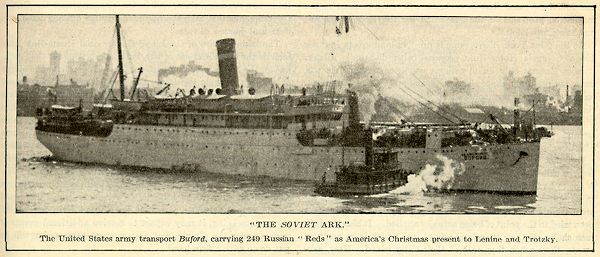
Rust Bucket UST Buford Carrying Its "Christmas Present" of Reds to Lenin and Trotsky
December 1, 1919 -- US: Alexander Berkman, Emma Goldman and 200 other anarchists, labor militants and radicals were deported to Russia on the Buford. (From the Daily Bleed)

December 1, 1955 - Rosa Parks, a 43-year-old African-American seamstress, boarded a bus in downtown Montgomery, Alabama, and refused to move to the back. She was arrested, triggering a year-long boycott of the city bus system and legal actions which ended racial segregation on municipal buses throughout the southern United States (From Workday Minnesota)

December 1, 1966 – The Youngstown General Duty Nurses Association (YGDNA) became the first nurses in Ohio to engage in a mass resignation or "strike." According to the American Nurses Association, it may have been the first concerted action by nurses in a labor dispute in the nation. (From the Daily Bleed)