Showing posts with label Chicago. Show all posts

Tuesday, January 8, 2013

11,000 Educators Fired in December

Clean Up Your Act Teachers or You're Out! (Image from Flickr, by  emilydickensonridesabmx)

The Great Recession has been officially over for more than three years, but the plunder of the public sector and middle class wealth continues. According to the Department of Labor, more than 13,000 public sector workers were laid off in December, more than 11,000 of whom were teachers or other school employees (see WSWS).

This is unusual. Typically, teacher layoff notices go out in February or March in anticipation of coming budget shortfalls, giving teachers the summer to look for work (or to be rehired, as often occurs when revenue picks up). Mid-year layoffs are an indication just how desperate many school districts are, with states continuing to have large deficits and the feds continuing to do nothing about it.

Indeed, by ignoring the problem, state and federal governments facilitate the deterioration of public education, making it easier to argue that it is broken beyond repair, or that it can only be repaired through privatization. Since 2008, the private sector has hired about 725,000 new workers, while the public sector has lost almost the same number of jobs (again, see WSWS)—a statistic that is largely due to the divestment of tax dollars from the public sector. Obama, despite receiving early endorsements and massive support from the NEA and AFT, has made no indication that he intends to help struggling school districts.

Many cities are shuttering their schools and selling off their facilities or the operation of their schools to private for-profit education management organizations (EMOs). According to the WSWS, Philadelphia plans to close 36 schools. Detroit has closed dozens of schools over the past few years, with former financial manager Robert Bobb attempting to close half the city’s schools in 2011. Many of the closed schools were sold or rented to private charter school operators. Recently, secret leaked documents revealed that Chicago has been planning to close or consolidate as many as 95 schools, with many of them going to private charter operators. New Orleans already has 70% of its students attending charter schools.

As schools close and teachers are let go, the teachers unions lose members and strength, something they seem unwilling or unable to fight. In fact, the social contract union leaders have made with the bosses to keep their members on the job at all costs (not to mention the no-strike clauses in many of their contracts and state prohibitions against public sector strikes) has effectively stymied the unions and is leading to their own downfall. The laid off teachers, however, are free to sell their labor to the highest bidder—Increasingly nonunionized private charter school operators that pay less and require far more work than the traditional public schools.

Monday, December 17, 2012

Chicago Teachers Tell the Rich to Back Off


The Chicago Teachers Union (CTU) is calling for a march and protest on December 18 to “Tell the Fat Cats:  Get Your Paws Off Our Public Schools.

While I could make many of the same criticisms of this that I have of the Occupy Movement (see here and here), I would rather call this a step in the right direction. (Plus, I really like their graphic for the protest).
(From the CTU website)
Certainly this is a reformist demand that lacks a meaningful critique of capitalism or public education’s role in bolstering it. Yet a mainstream craft union is unlikely to ever do this anyway. At least the CTU is placing some of the responsibility for their district’s crumbling infrastructure and their members’ declining working conditions directly on the backs of the rich—who have been tripping all over themselves and Chicago’s children in the race to convert CPS school sites into charter schools—rather than the usual vague union complaints about poor funding and belt-tightening by everyone.

The biggest problems with public education are not due to any defect in the schools or teachers. Rather, poverty and the wealth gap are the primary causes of the achievement gap. No reform that is currently on the table even attempts to address this. Certain social reforms, like those of the New Deal and the Great Society served to reduce poverty and close the wealth gap, and graduation rates climbed to their highest levels in response. But these economic gains have largely been reversed over the past 40 years, with an accompanying decline in wages and living standards for the majority of Americans.

Much of this decline has been due to a restructuring of the tax code, allowing the wealthy to keep a greater percentage of their wealth, causing a net decline in the revenue available for social services, like public education.

We are not likely to see the unions demanding an end to capitalism or even a reduction in poverty (though this reform would likely do far more to solve public education’s myriad problems than all the other current pseudo-reforms combined). However, it is not unreasonable to think that other teachers unions might start following the CTU’s lead and at least push back against the corporate-led “reforms” that are weakening the unions, deskilling the teaching profession and undermining the quality of education just so they can make a quick buck.

Wednesday, October 17, 2012

Chicago Schools CEO Brizard Out After 17 Months

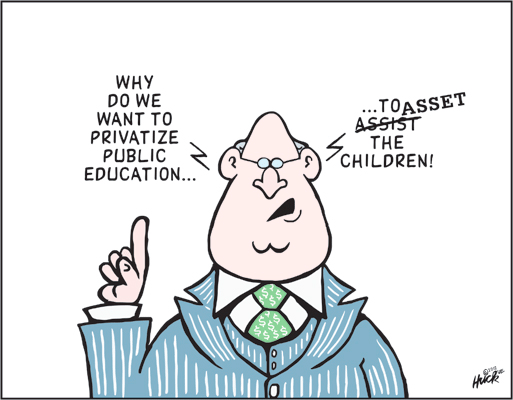
Huck/Konopacki Labor Cartoons

Just like the CEO of a private company that fails to act aggressively enough to maximize profits or to suppress worker discontent, Chicago Public Schools CEO, Jean-Claude Brizard, is out after only 17 months on the job. He is leaving by “mutual agreement,” the Chicago Sun-Times reports. In all likelihood, however, he saw the writing on the wall (the mayor was pissed off) and, like a good capitalist soldier, took a dive for the team.

Brizard had been handpicked by Emanuel to push through the his corporate education agenda, including the massive conversion of public schools into private charters, the unilateral imposition of a longer workday without commensurate pay, evaluations based on student test scores and merit pay. The teachers, not surprisingly, resisted, launching the city’s first teacher strike in 25 years and successfully rolled back some of these reforms. In short, Brizard failed the mayor and made him look the fool.

Brizard will be replaced by Barbara Byrd-Bennett, a former teacher, principal and Cleveland schools CEO. She had also been filling in as Chicago’s interim chief education officer for the past six months, helping to negotiate the deal with the Chicago Teachers Union (CTU) that ultimately got the teachers to return to the classroom. The final terms of Brizard’s departure have not yet been disclosed, but are expected to include a year’s salary of $250,000, according to the Sun-Times.

The Chicago Tribune reports that business leaders told Brizard that the mayor would blame him if the struggle with the CTU got out of hand (i.e., not crushed quickly with a decisive victory for CPS). Not only did Brizard fail in this, but he enraged the mayor by going on a family vacation just prior to the strike and he was absent during much of the contract negotiations. The teachers’ ability to spin the strike as a struggle against standardized testing and privatization was certainly an embarrassment to the mayor and he likely blamed this on Brizard, as well.

Byrd-Bennett is not planning on filling the position she vacated to become CEO and is expected to serve both roles, thus consolidating her power and sending the message to the teachers that her rule will be autocratic and decisive. This is important for CPS and Emanuel, as many teachers are already grousing about the rotten deal they got with their new contract (e.g., the raise doesn’t cover the extra hours they’re being required to work and 25% of their evaluations will now be based on unreliable and inconsistent student test data). Furthermore, the district has been withholding pay from teachers who participated in the strike and it is doing little about the dilapidated facilities, including many schools that lack air conditioning. The new contract also gives principals greater leeway in hiring outsiders and ignoring the pool of recently laid off CTU members.

The last thing Emanuel wants is a renewed strike or an escalation of discontent. Yet he is setting the teachers up for this with his new pension plan (see accompanying article below), which would cut benefits, delay the retirement age and increase employee contributions, thus further eroding teachers’ take-home pay and living standards.

Emanuel to Slash Teacher Pensions


In his annual budget address last week, Chicago Mayor Rahm Emanuel launched a campaign attacking the pensions of teachers and other public sector workers. In the speech, he threatened that property taxes would have to rise 150% if pensions were not reigned in, as pension costs would soon eat up 22% of the city’s budget, the WSWS reported this week.

Emanuel did not release any concrete details about the plan, but his Roadmap to Retirement Security, released in May, included a ten-year freeze on cost of living increases, a 5% increase in employee contributions, a five-year increase in the retirement age, the imposition of private plans (like 401Ks) for new hires, and no increase in the city’s contributions until the system is “reformed.”

Illinois state legislators are in agreement that pension costs must be slashed, but have been unable to enact any changes due to political fighting and maneuvering.  The Democrats want to transfer financial responsibility to local school districts, something Emanuel has supported since Chicago is currently the only city that funds its own teachers’ pensions (the Chicago Teachers’ Pension Fund). Thus, Chicago taxpayers currently pay twice, once for their local teachers’ pension fund and again, through state taxes, toward the state fund.

Republicans oppose this plan because it would shift the burden to suburban and rural districts, many of which they control. According to the Illinois Policy Institute, shifting the pension costs onto the districts would increase their expenditures by 3.7%. This could lead to massive spending cuts, which would likely result in layoffs, increased class sizes, reduced course offerings and other cutbacks that directly affect children.

Emanuel’s plan is part of a larger national movement to impose austerity on working people by increasing their share of the tax burden and decreasing the services and benefits they receive in return. Illinois is one of the battleground states for this movement. The credit ratings agencies have given the state the 2nd lowest rating in the U.S. (after California) and have demanded pension “reforms” as a necessary step toward restoring their credit rating. According to the WSWS, the Chicago Board of Education also had its credit rating lowered because of pension costs.

Sunday, September 16, 2012

Chicago Teachers, Just Say No


The Chicago Teachers Union (CTU) and Chicago Public Schools (CPS) are were very near a deal by the end of last week. Last minute negotiating today, it is hoped, will lead to a compromise that both sides can accept, allowing teachers and students back in the classroom by Monday. The 800 members of the CTU House of Delegates would have to approve the contract and then teachers would have to ratify it.

The details of the proposal have not yet been made public, but speculation by the mainstream press suggest that it will include the use of student test data in teacher evaluations, but these scores will not count as much toward teachers’ overall scores as CPS had hoped. If this is true, then it is a terrible contract and Chicago teachers should just say no to it.

The test scores are an inconsistent and unreliable proxy for teacher quality. They lead to many false positives and false negatives (also see here, for more on the unreliability of Value Added models). Teachers who are doing everything right in the classroom can still have students who do not progress sufficiently in their test scores, which are correlated far more strongly with students’ socioeconomic backgrounds than with their teachers (see herehere and here). Furthermore, any use of test scores to evaluate teachers will encourage teaching to the test, while also giving tacit approval to the state’s wrongheaded mania for testing.

For all of these reasons, teachers unions across the nation must oppose the use of high stakes tests, period. They are virtually worthless as a tool for assessing teachers and they are destructive of the learning process for children.

Wednesday, September 12, 2012

Chicago Teachers Strike Update


  • Support by parents is still fairly strong. A Chicago Sun Times opinion poll on Monday found that nearly half of parents support the teachers, while only 39% oppose the strike. This could change, of course, particularly if the strike drags on and parents are forced to hire babysitters or stay home from work to care for children.
  • Custodians plan on joining the strike this week, KOAM TV reported. The more classified (non-credentialed staff) that join the strike, the greater the pressure on the board and CPS and the more likely they are to cave.
  • CPS is planning on extending the length of time the 147 scab “Drop off” centers will be open from 4 hours to six starting on Thursday. These schools are being kept open ostensibly to provide lunch and other services for low income students. However, they are staffed with uncredentialed district staff and volunteers from religious organizations who have little or no training in education or childcare. The scabs have been told by CPS (See Fred Klonsky’s Scab Toolkit) to bring pencils, stickers, puzzles, games and magazines (so the kids have something “productive” to do during the day), be firm and respectful to students and don’t yell at them, as well as other useful tidbits of guidance. They have also been told to be prepared for classrooms without A/C or functioning clocks, which ought to make the scabs want to join the strike if only to help teachers fight for safe and functional classrooms for the children.
  • Though Illinois law currently prohibits teachers from striking over the recall of laid-off teachers and compensation for a longer school year, CTU does not intend to sign an agreement until these matters are addressed, according to union president, Karen Lewis.
  • Jesse Jackson tried to mediate today, but gave up, claiming both sides were too "dug in" to even "hear each other," which is to say he expects the teachers to compromise and believes that CPS has valid or reasonable expectations (which they do not).

Tuesday, September 11, 2012

Why the Chicago Teachers Strike Should Matter to You


The Chicago Teachers Union (CTU) and Chicago Public Schools (CPS) were pretty close to agreement on salaries. CPS backed down on forcing teachers to work an additional 90 minutes without pay, agreeing to rehire laid off teachers to cover the extra time in the school day. The remaining big negotiable issue is evaluations, with CPS demanding that student standardized test scores be a significant factor.

This is terrible for both teachers and students. Student test scores depend far more on students’ socioeconomic backgrounds and other factors outside of school than on teacher skill. Furthermore, even the small influence teachers have on student test data is difficult to measure accurately and requires three or more consecutive years of data to provide consistent results. And even then, the data is only reliable for teachers at the extremes (i.e., very poor and superb teachers). Results are unreliable for the vast majority, who fall somewhere in the middle. Thus, the use of such data will likely result in many good teachers getting bad reviews and being laid off, which is both unfair to them and their students. Many mediocre or incompetent teachers, likewise, could slip through the cracks, particularly if the data is used yearly, instead of every three years.

Many teachers unions have already caved in to similar demands to use student test data to evaluate teachers. Randi Weingarten, head of the AFT, has helped broker deals in which student test scores play a significant role in teachers’ evaluations. The CTA has embraced a deal in California that requires student performance data be used to evaluate teachers, in a sellout compromise they have called a victory because the locals get to collectively bargain how such data will be used (but not whether such data will be used). Therefore, it is inspiring that the CTU has taken on this fight, when its brethren across the nation have given in.

CTU is also asking for smaller class sizes, another battle that many unions have long since given up. In California, classes of 35 or more have become the norm. In Chicago, teachers have been demanding reductions down to 23. It is perplexing why anyone would think that a class of 35 is acceptable, safe or good for children, yet it has not only become the new normal, but some districts have tried to increase class sizes well above this (e.g. Detroit’s financial manager imposed a contract allowing class sizes of 61).

A loss for Chicago teachers will embolden districts and states throughout the U.S. to mandate that student test data be used to evaluate teachers. Indeed, it is already a part of Obama’s education plan and a carrot for those states hoping to win one of his Race to the Trough grants. Similarly, a loss in Chicago could harm teachers in other regions fighting for smaller class sizes.

The battle lines have been drawn and the teachers have some powerful enemies. The Obama administration not only has strong ties to the Chicago establishment, but also has large stake in tying student test data to teacher evaluations. Obama cannot afford to lose this fight, as it will make him look weak on education and labor. Furthermore, he has already taken the union vote for granted and the unions have, for the most part, embraced his candidacy, despite his numerous anti-labor policies. Mayor Rahm Emanuel, who some see as a future presidential candidate, likewise has a lot riding on this struggle. Meanwhile, Mitt Romney is already coming down hard on the CTU and attempting to connect Obama with the selfish, greedy teachers, essentially egging him on to intervene on behalf of Emanuel and the Chicago school board.

According to KPFA (Letters and Politics, 9/10/12), CPS has already enlisted scabs. In this case, members of religious organizations were volunteering to work at some of the 140 schools that remained open for low income students to take advantage of the free and reduced lunch program. While this could be seen as merciful to low income students it is also an indication of the readiness of some to sabotage the wellbeing of the majority of students (and teachers) for the illusion of helping the needy. Indeed, some teachers are calling these schools holding pens, which is essentially what they are since they do not have credentialed or trained teachers and the students are not getting any type of meaningful education. They are basically fed and corralled there for half a day to make the district look like it has things under control.

Monday, September 10, 2012

Chicago Teachers Strike is On


The Chicago teachers strike is officially on, with thousands of teachers walking off the job today in Chicago’s first teacher strike in 25 years. It is also the first major American teacher strike in years.

The stakes are high for all sides. In some ways, the strike is a test case for the labor movement, particularly among public sector workers. A loss for the teachers would motivate anti-union officials across the country to increase their attacks on public sector workers, giving them the confidence that the unions are just too weak to mount an effective counterattack. There is also a lot at stake for Democrats, particularly Obama, as the strike is in his old stomping grounds. Republicans would certainly take advantage of a teacher victory to claim that Obama and Rahm’s education and labor policies have been a disaster.

Emanuel called the strike “wrong, avoidable and unnecessary,” according to the Seattle Post Intelligencer. Of course the strike would be unnecessary if CPS had bargained in good faith, offered a decent raise, lowered class sizes, and abandoned their abusive evaluation policy. However, considering the district’s recalcitrance, the strike is not wrong for teachers or students. Low pay and abuse evaluation systems will drive away the best teachers, thus harming students, while the overwhelming majority of studies indicate that students benefit from smaller class sizes.

The new teacher evaluation system relies heavily on student test scores, something that measure students’ knowledge and test taking abilities, not teachers’ skill in the classroom. The test scores are influenced far more by factors external to school (e.g., students’ socioeconomic backgrounds) than by teachers. CTU President Karen Lewis said the new evaluation system could cause 6,000 teachers to lose their jobs over the next 2 years. Many critics have accused the district of implementing the system to get rid of its most experienced and highest paid teachers in order to save money and weed out its most vocal opponents.

Most Chicago schools were closed, but the district vowed to keep 140 open to provide food for low income students in need. The police chief vowed to take officers off of “desk duty” and place them out at the schools, to “protect” the children and to “deal” with teacher protests.

Thursday, September 6, 2012

Chicago Teachers to Strike on Sep 10

Chicago Public Schools has made another offer to the Chicago Teachers Union and the union has rejected it, saying that the strike set for September 10 is still on, according to the Chicago Sun Times.

CPS have moved away from their demand that raises be linked to merit pay, a small concession to the union. However, they are still only offering 2%, which is not enough to keep up with inflation and rising health care costs. Thus, even with a "raise" on paper, the teachers would be accepting declining take-home pay and spending power in the long run. CPS is also still holding strong to their plan to end step increases for experience.

Monday, July 16, 2012

Arbitrator Recommends 20% Raise, CTU Likely To Reject


Chicago Public Schools (CPS) imposed a longer school day on teachers in violation of their contract. The Chicago Teachers Union (CTU) demanded a 30% raise over the course of the next two years to compensate their members for all the extra work. An arbitrator has recommended that CPS increase teachers’ salaries by 15-20% for the first year of the new contract (the Chicago Tribune reported today), which both sides are likely to reject since the only way CPS can afford to do this is by laying off teachers and increasing class sizes. (CPS has a $665 million deficit next school year that will deplete its cash reserves).

CPS originally offered a 2% raise for working a 20% longer day. In January, CTU took a strike authorization vote in response. The Chicago Tribune article has implied that CTU now has the difficult task of convincing its members to reject a raise that is ten times greater than CPS had offered.

Yet what is so difficult about it? The plan would lead to mass layoffs and who wants to lose their job, particularly with the job market still in such terrible shape? It would lead to larger class sizes and probably a decline in course offerings, as well. This would not only cause teachers’ working days to be longer, but it would force them to do considerably more work per hour, as they would have increases in student interactions, assignments and tests to grade, and parent contacts. It would also be terrible for students, as they would get less one-on-one attention from their teachers and more canned assignments, while safety would be compromised by having too many students sharing lab and shop equipment. Teachers care passionately about their students’ safety, wellbeing and learning environment, often making large personal sacrifices to improve these things. Few teachers will voluntarily accept larger class sizes.

While the arbitrator’s recommendation is nonbinding, both sides must consider and accept the recommendation to move forward. If either side rejects the raise, they must still continue to hold talks for another 30 days before a strike can legally occur.

Members of the consortium of private businesses and district administrators that crafted the longer school day “reform” had insisted on having an arbitrator involved in the process, assuming that an arbitrator would necessarily sympathize with their perspective. Ironically, many now feel betrayed.

CPS has suggested that the arbitrator has ignored the fiscal reality of the district (i.e., the $665 million deficit). Yet CPS does not have to go forward with its plan to lengthen the school day. This is, in fact, the only simple way to resolve the conflict. Dumping its plan to unilaterally impose a longer work day and returning to the status quo would end the district’s attempt to eviscerate the teachers’ contract (which requires negotiation and mutual agreement on increases to the work day). It would also end the district’s attempt to force its employees to work these longer hours for a negligible stipend (i.e., 2% raise for 20% longer hours).

If they push through the longer school day with only a 2% raise, a strike will be the teachers’ best option and one that would hopefully be supported by mass support and solidarity by other educators and workers as the struggle has deep implication for all workers.

Forcing people to work 20% longer while providing only 2% more in compensation is tantamount to forced servitude—teachers would be working 18% more without any compensation at all. While most workers in the U.S., including teachers, have been experiencing increasing workloads and productivity as their real wages have declined, this would be a disturbing escalation in that trend. All a public sector employer would have to do to justify unpaid labor is to say it’s in the public interest and the money for compensation is not available.

It is also union busting, plain and simple. If the city of Chicago can impose longer working hours on teachers in violation of their contract, then their contract is virtually worthless and could easily be violated in numerous other ways, too.

Monday, March 14, 2011

Union Busting Redux? Old School History of Teachers Unions


Margaret Haley (from the Walter P. Reuther Library)
Sherman Dorn recently made an interesting comparison between Wisconsin Gov. Walker’s attacks on public sector workers and the Loeb Rule, which was used in the 1910s to attack the fledgling Chicago Teachers Federation, the nation’s first successful teachers union and the first member of the AFT (see The Loeb Rule and pugilistic anti-unionism circa 2011).

The CFT, under Vice President Margaret Haley’s organizing efforts, tried to affiliate with Chicago’s blue collar workers and joined the Chicago Federation of Labor, the city’s largest labor organization. Terrified that Chicago’s already militant labor movement would suddenly swell with thousands of new members, the Chicago Board of Education implemented the Loeb Rule, prohibiting any alliance between teachers and organized labor. The board also fired 68 teachers, including 38 members of the CTF. The Loeb Ruling effectively killed teachers unions for decades, resulting in routine arbitrary firings, unequal pay, and terrible working conditions that lasted until the modern teachers union movement grew in the 1960s.

Dorn argues that Walker’s bill is NOT the new Loeb Rule of today, correctly pointing out that conditions today in Wisconsin and throughout the nation are very different than they were in 1910s Chicago. However, he doesn’t really explain how these conditions differ and he leaves out some important similarities. Perhaps the biggest difference is that the labor movement then was large and influential. Chicago at that time was the center of strong anarchist, socialist and union movements. The IWW was formed there in 1905. The Haymarket tragedy was just a few decades old and the struggle for the 8-hour work day continued to be an important part of Chicago organizing efforts until the Adamson Act was established in 1916.

Union solidarity, however, did not protect the teachers. Indeed, there was considerable sexist and class bias against the teachers, who were mostly female and entirely white collar, by the predominantly male blue collar unionists. At the same time, Haley refused to align herself with Chicago’s more radical groups, like the anarchists and the IWW, who were very much interested in organizing women and minorities. She also shunned African American groups, another important potential ally.

Another reason for Haley’s failure (i.e., the success of the Loeb Rule) stems from an important similarity between then and now: like today’s teachers unions, the CTF tied its fortunes to local politics, supporting the mayoral bid of Edward Dunne. In return, Haley became part of Dunne’s “kitchen cabinet.” By focusing on building fickle political alliances, rather than organizing workers and building alliances with other workers, labor leaders risk alienating their constituency and weakening labor’s power. Furthermore, no union concessions or political compromises will ever win the support of the ruling class or end the attacks on workers’ living standards or their organizing efforts. Dorn hits this one on the head: “Events in Wisconsin will suggest to many union activists that there is absolutely no value for a union in trying to work with state policymakers, because no matter what you do, you'll be seen as the enemy.”

Friday, February 4, 2011

Accountability for Legislators


A Small Victory for Teachers and a Big Loss for Billionaire Ed Deformers.
Illinois legislators, with the backing of billionaire Ed Deformers, tried to kill tenure and teachers’ right to strike with their Performance Counts Act. However, the union-crushing bill was killed in January, thanks to strong resistance by Illinois teachers.

Legislators received large donations to support the law, some receiving checks as high as $175,000, from Stand for Children (SFC) an organization based in Portland, Oregon, with affiliates in seven states. Their largest funder is Bill Gates. In total, SFC pumped $600,000 into key Illinois legislative races. While SFC started as a grassroots organization, headed by Marian Wright Edelman (Children’s Defense Fund), and initially had the backing of many teachers, they are now clearly in cahoots with corporate interests that want to profit off the billions of tax dollars spent each year on education.

Had it passed, the Performance Counts Act would have:
Linked teachers’ evaluations to student test scores
Fired or demoted teachers after a single unsatisfactory evaluation
Blocked unions from bargaining over layoffs, school closures, class size, staffing, length of school day, or use of technology
Banned teachers from striking

Unions Continue to Pursue Anti-Teacher Policies
Illinois teachers unions should be celebrating the victory and moving on to more proactive issues, like abolishing NCLB or booting the corporate interests completely out of the game. Instead, they are continuing to pursue their own alternative plan, Accountability for All, which still gives up some seniority and tenure rights (See Left Wing Sell Out).

Monday, January 24, 2011

Subpoenas Envy In Chicago Redux


On Tuesday, January 25, union members will stand in “solidarity” outside Chicago’s federal court house with activists who are resisting grand jury subpoenas being used as fishing expeditions against the anti-war movement. All of those subpoenaed had been involved in completely legal activities in support of the anti-war effort. At least 18 unions or labor councils have passed resolutions supporting those resisting the subpoenas, including the 30,000-member Chicago Teachers Union.

The action by unions, while largely symbolic, nevertheless indicates their clear understanding of how national security laws are being used to intimidate people from expressing their rights to free expression and assembly. True solidarity would involve taking some risk, like going on strike until the subpoenas are withdrawn. Nevertheless, the fact that some unions have taken an anti-war stance in the first place could be considered progress. During the Viet Nam war, many unions were outright hostile to protesters and some served as goon squads that beat up and intimidated activists.

Some union members are among those subpoenaed and refusing to cooperate. Stephanie Weiner and her husband Joe Losbaker, both SEIU members, had their home raided and computers and personal items confiscated. They are refusing to cooperate with the subpoenas. The SEIU Illinois is likening the subpoenas to the Palmer Raids and McCarthy hearings.

The use of subpoenas to intimidate and stifle dissent is an old, but effective tactic. Refusal to cooperate can result in contempt charges and prison time. You cannot plead the fifth to avoid self-incrimination during grand jury investigations.

Chicago is no stranger to the political subpoena. HUAC issued subpoenas for Jerry Rubin and Abbie Hoffman following the 1968 Democratic National Convention demonstrations. Activists who weren’t subpoenaed suddenly came down with Subpoenas Envy. Hoffman and Ruben made a mockery of the process, attending in a Santa Claus outfit and draped in the American flag, respectively.