Showing posts with label martial law. Show all posts

Saturday, September 22, 2012

Today in Labor History—September 22


(From the New York World)

September 22, 1919 - Almost 400,000 steelworkers in 50 cities struck to protest intolerable working conditions. Union leaders believed that if they could organizer the steel workers, it would lead to a massive wave of unionization across the country. Thus began the Great Steel Strike of 1919. The bosses called upon the federal troops and crushed the strike after 3½ months, killing twenty-two people in the process. (From Workday Minnesota)
Miners arriving to join in the Battle of Blair Mountain
 September 22, 1922 – Martial law was ended in Mingo County, West Virginia, after overwhelming force by mine owners’ goons, police and U.S. troops suppressed the mining strike there. (Also see the Battle of Blair Mountain)  (From the Daily Bleed)

September 22, 1934 – The United Textile Workers (UTW) strike committee ordered strikers back to work, bring to an end "the greatest single industrial conflict in the history of American organized labor." However, the Southern employers continued to try to bust the textile unions and their ongoing agitation occurring along the Eastern seaboard. 10,000 National Guardsmen were mobilized in Georgia and the Carolinas, Alabama, & Mississippi, with an additional army of 15,000 armed deputies. Despite the overwhelming show of force, it is estimated that 421,000 textile workers had joined the strike, an increase of 20,000 new strikers in just one week. In response, martial law was declared in Georgia and the National Guardsmen started to arrest and jail large numbers of strikers without charge, holding them in World War I concentration camps. 13 strikers were killed and 34 strike leaders were held incommunicado. (From the Daily Bleed and Jeremy Brecher, Strike! p176)

September 22, 1935 – 400,000 coal workers went on strike. (From the Daily Bleed)

September 22, 1946 – 4,000 workers marched in Valleyfield, Quebec to protest the arrest of Medeliene Parent, a leader of the dominion textile strike. (From the Daily Bleed)

Thursday, July 26, 2012

Today in Labor History—July 26

July 26, 1877 – 30 workers were killed by federal troops at the "Battle of the Viaduct", Chicago, during the Great Upheaval (AKA Greet Strike). During the battle U.S. troops and police attacked about 5,000 workers at Halsted & 16th Street in Chicago.  A judge later found the police guilty of preventing the workers from exercising their right to freedom of speech and assembly. (From the Daily Bleed)

July 26, 1894 - A Strike Committee was created by President Grover Cleveland to investigate the causes of the Pullman strike and the subsequent walkout by the American Railway Union. After four months, the commission absolved the strikers and placed the blame entirely on Pullman and the railroads for the conflict. (From Workday Minnesota)
Police rounding up workers and activists during Tragic Week, Barcelona

Francisco Ferrer, founder of the Modern Schoo
July 26, 1909 – The Tragic Week, la Semena Tragica, began in Barcelona, with a General Strike and protests by regionalists, anarchists, radicals and angry workers protesting the government mobilization of troops to fight in Morocco and the government’s terrible labor policies. Churches and convents were attacked and burned, priests wounded and killed, along with police. Martial law was declared, lasting months. Rather than reform, the government assaulted Barcelona with the full force of the military, with mass arrests and killings. Francisco Ferrer, founder of the Escuela Moderna (Modern School), namesake of this blog, was executed. (From the Daily Bleed)

Thursday, September 22, 2011

Today in Labor History—September 22


(From the New York World)
September 22, 1919 - Almost 400,000 steelworkers in 50 cities struck to protest intolerable working conditions. Union leaders believed that if they could organizer the steel workers, it would lead to a massive wave of unionization across the country. Thus began the Great Steel Strike of 1919. The bosses called upon the federal troops and crushed the strike after 3½ months, killing twenty-two people in the process. (From Workday Minnesota)
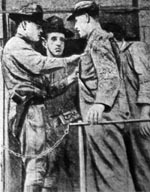
Miners arriving to join in the Battle of Blair Mountain
 September 22, 1922 – Martial law was ended in Mingo County, West Virginia, after overwhelming force by mine owners’ goons, police and U.S. troops suppressed the mining strike there. (Also see the Battle of Blair Mountain(From the Daily Bleed)

September 22, 1934 – The United Textile Workers (UTW) strike committee ordered strikers back to work, bring to an end "the greatest single industrial conflict in the history of American organized labor." However, the Southern employers continued to try to bust the textile unions and their ongoing agitation occurring along the Eastern seaboard. 10,000 National Guardsmen were mobilized in Georgia and the Carolinas, Alabama, & Mississippi, with an additional army of 15,000 armed deputies. Despite the overwhelming show of force, it is estimated that 421,000 textile workers had joined the strike, an increase of 20,000 new strikers in just one week. In response, martial law was declared in Georgia and the National Guardsmen started to arrest and jail large numbers of strikers without charge, holding them in World War I concentration camps. 13 strikers were killed and 34 strike leaders were held incommunicado. (From the Daily Bleed and Jeremy Brecher, Strike! p176)

September 22, 1935 – 400,000 coal workers went on strike. (From the Daily Bleed)

September 22, 1946 – 4,000 workers marched in Valleyfield, Quebec to protest the arrest of Medeliene Parent, a leader of the dominion textile strike. (From the Daily Bleed)

Tuesday, July 26, 2011

Today in Labor History—July 26


July 26, 1877 – 30 workers were killed by federal troops at the "Battle of the Viaduct", Chicago, during the Great Upheaval (AKA Greet Strike). During the battle U.S. troops and police attacked about 5,000 workers at Halsted & 16th Street in Chicago.  A judge later found the police guilty of preventing the workers from exercising their right to freedom of speech and assembly. (From the Daily Bleed)

July 26, 1894 - A Strike Committee was created by President Grover Cleveland to investigate the causes of the Pullman strike and the subsequent walkout by the American Railway Union. After four months, the commission absolved the strikers and placed the blame entirely on Pullman and the railroads for the conflict. (From Workday Minnesota)
Police rounding up workers and activists during Tragic Week, Barcelona

Francisco Ferrer, founder of the Modern Schoo
July 26, 1909 – The Tragic Week, la Semena Tragica, began in Barcelona, with a General Strike and protests by regionalists, anarchists, radicals and angry workers protesting the government mobilization of troops to fight in Morocco and the government’s terrible labor policies. Churches and convents were attacked and burned, priests wounded and killed, along with police. Martial law was declared, lasting months. Rather than reform, the government assaulted Barcelona with the full force of the military, with mass arrests and killings. Francisco Ferrer, founder of the Escuela Moderna (Modern School), namesake of this blog, was executed. (From the Daily Bleed)