Tuesday, December 4, 2012

Today in Labor History—December 4


December 4, 1906 – The National Federation of Postal Clerks was chartered on this date. (from the Daily Bleed)


December 4, 1951 - Walter Reuther, President of the United Auto Workers, was elected head of the Congress of Industrial Organizations (CIO). Four years later, he led the merger of the CIO and the American Federation of Labor to form the AFL-CIO. (From Workday Minnesota)

December 4, 1969--Chicago Black Panthers Fred Hampton and Mark Clark and 2 others were murdered by police, with assistance from the FBI.

December 4, 1970--Cesar Chavez was jailed for 20 days for refusing to call off the Salinas lettuce boycott. (from the Daily Bleed)

Monday, December 3, 2012

Another UTLA Sell-Out on VAM


Most people would argue that teachers should be evaluated based on how well they teach and help their students to grow academically. The problem is that there is no accurate or consistent method of measuring the teacher impact on student academic growth. High stakes state and NCLB tests are particularly ill-suited for this.

Nevertheless, a growing number of school districts across the nation are either imposing Value-Added Measures (VAM) of teacher “effectiveness” on their teaching staffs, or forcing them to accept student test scores as part of their evaluations in exchange for other concessions like raises and maintaining benefits. VAM, which attempts to calculate teachers’ impact on their students’ improvement on standardized tests, has been shown to be inaccurate and unreliable (see here, here and here).

Los Angeles Unified School District (LAUSD) has been under court order to reform its evaluation system. The ruling by Judge James Chalfant mandated that LAUSD comply with the state’s Stull Act, which requires that some measures of student academic progress be factored into the evaluations, though the law does not specify what kind of student data must be used. This has led to a protracted battle with United Teacher of Los Angeles (UTLA) over what kind of data will be used and to what extent.

Last Friday, the two sides came to an agreement on a new evaluation system that will include student test data. The evaluations will use both local and state standardized test scores, but there is no agreement yet on how much the test scores will count toward teachers’ evaluations. Superintendent John Deasy hailed the agreement as a victory for labor-management collaboration, while UTLA President Warren Fletcher was simply grateful the accord didn’t give LAUSD more than it did, according to John Fensterwald, writing for Ed Source. The agreement must still be approved by the school board and ratified by the UTLA membership.

Deasy had been pushing for a method called Academic Growth Over Time (AGT), a type of VAM that supposedly controls for external factors like students’ past test results and background. UTLA rightly opposed AGT as unsound, which it is. The agreement does not permit the AGT scores of individuals to be used in their evaluations, though school-level AGT can be used as one of several factors. Additionally, individual AGT scores will become part of teachers’ confidential personnel files, no longer accessible to the public or the press.

While this latter stipulation could be spun as a win for teachers, the fact that student test data is being used to evaluate teachers at all should be seen as a serious blow to both students and teachers. The use of student test data to evaluate teachers is terrible for students precisely because it does nothing to improve teacher quality, while potentially forcing many good teachers out of the profession because of its unreliability and inconsistency. Furthermore, it encourages the continued use of high stakes standardized exams, which take away class time from real learning, encourage teaching to the test, and unnecessarily increase the stress and anxiety children already face at school.

Today in Labor History—December 3


December 3, 1866 – Textile strikers won a 10-hour work day, Fall River, Massachusetts. (from the Daily Bleed)


December 3, 1910 – The Industrial Workers of the World (IWW) Brotherhood of Timber Workers Union was organized on this date.
December 3, 1916 – Seven Australian Wobblies (IWW members) were sentenced to 15 years in prison for their anti-war efforts during the "Great" War that Ended All Wars. Other IWWs were sentenced to five and 10 years. In August 1917 the IWW was outlawed in Australia and its membership rolls were made available to employers who blacklisted anyone on the lists. 

December 3, 1946 – Female retail clerks launched the great Oakland General Strike. Other workers joined in, with over 100,000 walking off the job.

Sunday, December 2, 2012

Today in Labor History—December 2


The Last Moments of John Brown, by Thomas Hovenden (1840–1895)
December 2, 1859 – Abolitionist John Brown was hanged on this date in Charleston, Virginia for his leadership of a plot to incite slave rebellion. (From the Daily Bleed)
The Very Hungry Caterpillar Corporation Preparing to Eat Its Workers (image from Flickr, ozmafan)
 December 2, 1995 – UAW members rejected an offer from Caterpillar, but their central bargaining committee ignored their vote and ended the strike. (From the Daily Bleed)

Saturday, December 1, 2012

Today in Labor History—December 1


December 1, 1904 – W. A. "Tony" Boyle, future president of the United Mine Workers (UMW) was born on this date. (From the Daily Bleed)


December 1, 1908 – As Brazil and Argentina prepared for war, workers on both sides of the border protested. (From the Daily Bleed)

December 1, 1912 – The rustling card system was put into place by the Anaconda Mining and Smelter Company. Agitators were identified by spies and refused cards and jobs. (From the Daily Bleed)
Ralph Chaplin (public domain)
 December 1, 1914 – The famous labor song, "Solidarity Forever," was written on this date by IWW songwriter Ralph Chaplin. He wrote the song for a hunger march to be led by Lucy Parsons in Chicago (on January 17, 1915).
Solidarity Forever
(To the tune of Glory Glory Hallelijah)
When the union's inspiration through worker's blood shall run,
There can be no power greater anywhere beneath the sun;
Yet what force on earth is weaker than the feeble strength of one,
For the union makes us strong.
[Chorus]
Is there aught we hold in common with the greedy parasite
Who would lash us into serfdom & would crush us with his might?
is there anything left to us but to organize & fight?
For the union makes us strong
[Chorus]
In our hands is placed a power greater than their hoarded gold,
Greater than the might of armies magnified a thousand fold;
We can bring to birth a new world from the ashes of the old,
For the union makes us strong.
[Chorus]: Solidarity forever, Solidarity forever, Solidarity forever,
For the union makes us strong 
(From the Daily Bleed)
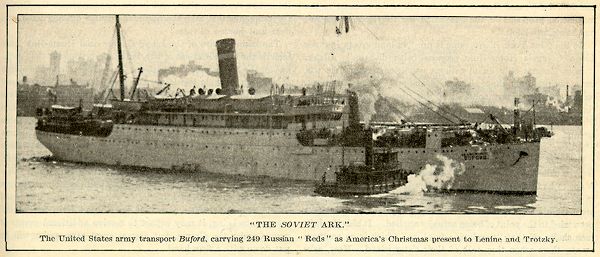
Rust Bucket UST Buford Carrying Its "Christmas Present" of Reds to Lenin and Trotsky
December 1, 1919 -- US: Alexander Berkman, Emma Goldman and 200 other anarchists, labor militants and radicals were deported to Russia on the Buford. (From the Daily Bleed)

December 1, 1955 - Rosa Parks, a 43-year-old African-American seamstress, boarded a bus in downtown Montgomery, Alabama, and refused to move to the back. She was arrested, triggering a year-long boycott of the city bus system and legal actions which ended racial segregation on municipal buses throughout the southern United States (From Workday Minnesota)

December 1, 1966 – The Youngstown General Duty Nurses Association (YGDNA) became the first nurses in Ohio to engage in a mass resignation or "strike." According to the American Nurses Association, it may have been the first concerted action by nurses in a labor dispute in the nation. (From the Daily Bleed)

Friday, November 30, 2012

Today in Labor History—November 30

November 30, 1830 – Agricultural laborers rioted at Shaftesbury, Dorset, in England, to win the release of five imprisoned comrades. Simultaneously, in Banwell, Somerset, paupers rioted at the poorhouse, then launched an attack on the prison, releasing its prisoners. (From the Daily Bleed)

November 30, 1854 - "Fighting Mary" Eliza McDowell was born on this date. In 1902, McDowell helped organize the first women's local union of the Amalgamated Meat Cutters, which was made up mostly of the low-paid women working in packinghouse canning and labeling operations. (FromWorkday Minnesota)

November 30, 1930 – Mother Jones died, age 100, Silver Spring, Maryland. Jones was an organizer or "walking delegate" for the United Mine Workers (UMW), famous for her bravado. When she and 3,000 women were released by a militia after being held all night in McAdoo, Pennsylvania, they marched straight to the hotel housing the soldiers and ate their breakfast. Even well into her 90s, she still roamed through the hills of West Virginia, encouraging miners to organize. (From the Daily Bleed)
Dorothy Day, 1916 

November 30, 1980 –Anarchist, pacifist, and co-founder of the Catholic Worker movement, Dorothy Day, died on this date in New York City.  (From theDaily Bleed)

Thursday, November 29, 2012

Today in Labor History—November 29


November 29, 1832 - Louisa May Alcott, author, nurse and abolitionist, was born on this date. While she was most famous for her book, “Little Women,” Alcott also wrote “Work,” an autobiographical novel that exposed the exploitation of women workers. (From Workday Minnesota)

November 29, 1870 – England initiated state-run compulsory education.(From the Daily Bleed)

November 29, 1934 – Retail workers at Boston Stores in Milwaukee launched a strike at the beginning of the Christmas rush. The strike was a united effort between three unions, including clerks, teamsters & building-service employees. An extremely cold winter and the store's willingness to hold out through the holiday season eventually broke the strike. For the next 60 years, none of the city's major department stores were unionized. (From theDaily Bleed)


November 29, 1999 - Thousands of activists, students, union members, environmentalists and others shut down the World Trade Organization (WTO) summit in Seattle. It was the first large-scale demonstration in the United States to protest the “corporate agenda” and “globalization” and the beginning of many similar protests, including the current OWS movement. The WTO protest, like the OWS movement, was effective at raising awareness of corporate greed while simultaneously promoting the delusion that, with a few reforms, capitalism and democracy would serve the needs of the people. (From Workday Minnesota)

Wednesday, November 28, 2012

UC’s Secret Lover. . . Wall Street . . . Students and Employees Get Screwed

Huck/Konopacki Labor Cartoons

California voters recently approved Proposition 30, which would temporarily raise taxes slightly on the wealthiest state residents while also imposing a regressive sales tax hike on the poorest residents. The measure is expected to help close California’s current $16 billion deficit, but not to restore the tens of billions in revenues that have been slashed over the past few years.

I recently wrote that despite the increased revenues from Prop 30, both of the state’s major university systems (CSU and UC) will be increasing fees and tuition for some students. In the case of UC, tuition for certain graduate programs could increase as much as 35%.

It is not simply that Prop 30 doesn’t come close to restoring pre-recession funding levels. It doesn’t. There is a deeper, institutional problem that Prop 30 merely covers up and plays into: The tax system and the political system are both designed to maximize the profits and bolster the economic interests of the employing class. Consider that Prop 30 did not touch capital gains, inheritance, corporate or property taxes. It did nothing to bring oil royalties up to the fairly low rates charged by Texas and Alaska. It essentially left the filthy rich filthy rich and the moderately rich still comfortably rich.

Even some of the increased revenues from Prop 30 that are earmarked for education will go directly into the hands of Wall Street bankers, rather than toward tuition reductions, increased course offerings or raises for professors. According to a recent report by UC Berkeley researchers, the UC Board of regents has made risky deals with Wall Street banks over the past decade known as interest rate swaps. They supposedly did this as a hedge against rising interest rates on variable rate bonds, but the swaps turned out to be a losing bet because interest rates dropped in the wake of the 2008 financial meltdown and have remained low since then.

These swap deals have already cost UC almost $57 million, according to the San Francisco Chronicle. However, another $200 million in losses are anticipated over the next 30 years (the university is currently paying Wall Street close to $750,000 per month according to the Nation). UC is expected to receive $250 million from Prop 30, which is not even enough to cover its Wall Street debts, let alone provide any financial relief for its students or employees.  Nevertheless, the university plans on spending $10 million a year from Prop 30 to service its Wall Street debt, leaving little for tuition relief, increased course offerings, student services or wage increases for employees. Tuition has tripled over the past few years, while salaries for professors and other employees have remained stagnant. Indeed, the regents are warning of more cuts and tuition increases, despite Prop 30, including a 24% across-the-board tuition hike over the next four years.

One might reasonably wonder how the regents made such a blunder. After all, it is well known among gamblers that, in the end, the House always comes out on top. But this wasn’t simply a matter of some naïve regents making a bad gamble. Rather, the regents ARE Wall Street insiders. They not only knew exactly what they were doing, but likely did it to enrich themselves and their cronies at the expense of taxpayers, students and employees. For example, the regent’s chief financial officer, Peter Taylor, came from Lehman Bros, where he had been managing director for public finance at a time when Lehman Bros. had been hired to help expand UC's debt load. Taylor continued to work for Lehman Bros while he was a regent. UC’s interest rate swap with Lehman ultimately cost the university over $23 million.

Similarly, UC Regent Monica Lozano has earned $1.5 million serving on the Board of Bank of America at the same time the university negotiated interest rate swaps with BofA worth a potential $28 million in profits to the bank. UC Executive Vice President Nathan Brostrom—a former managing director for public finance at JP Morgan—worked on financing for UC at a time when his former company was hired as a bond broker and swap counterparty for the UC Davis Medical Center, a deal in which the university ultimately lost $22.5 million. And UC Regent Russell Gould, who chaired the finance committee from 2008 to 2009 and the full board from 2009 to 2010, was receiving a salary from Wachovia/Wells Fargo from 1996 to 2009. (The regents’ biographies have been excerpted from the UC report)

The UC Berkeley report notes that the university obtained the interest rate swaps in order to finance the development of medical centers on three of its campuses (UCLA, UCD and UCSF). Since the medical centers are money-making enterprises for the university and since student tuition was used as collateral for the interest rate swaps, there was a financial incentive for the regents to jack up tuition. However, the university never had a chance to win on its gambles as the interest rate swaps were all based on rates determined by
LIBOR, rates that were rigged in one of the largest banking scandals in history. (BofA is one of the banks currently under investigation in the LIBOR scandal).

Some have argued that the swaps made sense at the time and that the regents, despite the conflict of interest, had the university’s best interests in mind. However, if this was true, one might expect them to re-negotiate their loans or sue the banks, as have many other large institutions that have been screwed by similar deals. So far, they have made no indication that either plan is in the works. On the contrary, some regents are arguing that the swaps are still good deals, since the bonds don’t mature until 2047.

Meanwhile, the university will continue to transfer three quarters of a million dollars per month from the taxpayers to Wall Street banks to service their loans, thus keeping the bankers comfortable and their employees and students ever more stretched.

Today in Labor History—November 28


November 28, 1891 - The International Brotherhood of Electrical Workers was founded on this date. The IBEW currently represents approximately 750,000 members in utilities, construction, telecommunications, broadcasting, manufacturing, railroads and government. (From Workday Minnesota)


November 28, 1944 – 400 people in Rotterdam attacked a coal warehouse. The Nazis executed 40 Dutch men in retaliation. (From the Daily Bleed)

November 28, 1953 – A photoengravers strike shut down New York City’s newspapers for 11 days. (From the Daily Bleed)

November 28, 1994 – In the wake of years of outsourcing and downsizing, Bell-Atlantic announced another 5,600 lay-offs. In response, 1,200 employees in Pennsylvania came to work in T-shirts that portrayed themselves as road kill on the information superhighway. Management suspended them all without pay when they refused to remove the shirts. (From the Daily Bleed)

Tuesday, November 27, 2012

America’s Class War Against Youth

Huck/Konopacki Labor Cartoons

If the Occupy Wall Street (OWS) movement accomplished anything it was to focus public anger on America’s extreme and growing wealth gap, portraying it as the product of the greed and selfishness of the richest 1%.

This overly simplistic view obscures the actual socioeconomic relationships that are responsible for the transfer of wealth from the majority to the few, as well as who comprises this “few.”

The wealth gap is actually the by-product and goal of capitalism and the sociopolitical institutions that bolster it. All bosses in private businesses, regardless of how rich they may be, make their profits by paying their employees less than the value of their labor and pocketing this surplus value as profits (i.e., exploitation). The owner and employer classes transfer additional wealth to themselves through a taxation system that allows them to pay a lower effective tax rate than their employees pay, and through a legislative and legal system that facilitates their acquisition of more capital, sometimes even if it injures, sickens or kills others.

Exploitation of workers is the primary source of the wealth gap, particularly between employers and employees and the source of the so-called obscene wealth we see among the “1%.” However, wealth is also transferred from the young to the old, resulting in a growing wealth gap between older Americans and the young.

The wealth gap between younger and older Americans is currently the widest on record. In 1984 Americans who were sixty-five and over made ten times as much as those under the age of thirty-five. By 2008, older Americans were earning nearly forty-seven times as much as the younger age group. (For more, see the following articles in Esquire and Newsweek).

This wealth gap is not small, either. The median net worth of households headed by someone 65 or older has increased 42% since 1984, to a comfortable $170,494, while the median net worth for younger households has declined 68% to a desperate $3,662, according to the Pew Research Center.


The Pew study attributes some of the wealth transfer to timing: The older generation benefited from living and working in a strong economy and a long rise in housing prices. Conversely, older Americans have suffered far less under the current recession, with the median net worth of those under 35 falling 37% between 2005 and 2010, while falling only 13% for those over the age of 65. The recession has also forced many older Americans to continue working longer than they would have in the past, squeezing many younger workers out of jobs. The percentage of the workforce under the age of 25 has declined 13.2% since 2008, while rising 7.6% for those over 55.

However, the trend began decades before the current recession and has been facilitated by changes in government policy, which have been promoted by an aging politician class (today’s Congress is the oldest since World War II). For example, the federal government now spends $480 billion on Medicare, but only $68 billion on education, according to the Esquire article. As a whole, the U.S. government spends 7 times as much on its seniors as it does on its children, per capita, according to a 2009 Brookings Institution study. Mike Males writes that younger workers are currently contributing 15% of their payroll income to pay for Social Security and Medicare payments for seniors, since Congress gutted the Social Security Trust Fund (originally designed to cover future generation’s benefits) to pay for current government needs.

The transfer of wealth from young to old has been a hallmark of the Republican Party and would have been taken to new extremes under the Ryan tax plan. According to Males, younger Americans would have suffered under this plan in direct proportion to how young they are. Virtually every federal program designed to benefit the young and the poor would have been gutted or eliminated, including food stamps, Medicaid and job training. Federal spending on education would have been slashed by one-third. But Social Security and Medicare for today’s seniors would have been preserved. At the same time, median-income households headed by people 55-65 would have received tax breaks of roughly $1,200, while median-income households headed by people under 25 would have lost hundreds of dollars.

However, the Democrats have also contributed to the generational wealth transfer. Under Obama’s 2012 budget, for example, Medicare and Social Security were left alone, while the Adolescent Family Life Program and the Career Pathways Innovation Fund were ended. Likewise, the AmeriCorps program was slashed and had to turn away 75% of applicants last year, while recent changes to the Pell grant program will cost students an estimated $100 billion over the next ten years, according to the Esquire article. Similarly, Obama’s plan for avoiding the “fiscal cliff” involves raising the age of eligibility for Medicare benefits and cutting benefits for future recipients of Medicare and Social Security. In other words, the benefits of today’s seniors would be preserved and subsidized on the backs of today’s youth.

So far I have only discussed the tangible, present-day ways younger Americans have been screwed. They have also been saddled with an enormous debt they will be paying well into the future through higher taxes, reduced benefits and services, and delayed retirement (or no retirement). The per capita debt in the U.S. is now $50,000, with much of it going toward paying for the longest wars in U.S. history (i.e., Iraq and Afghanistan) and huge tax breaks for the wealthy. Yet, the average student also owes $12,700 to the credit card companies and will owe $27,000 to college loans creditors, according to the Newsweek article. And despite incurring all this debt, college graduates’ income has dropped 11% over the last decade for men and 7.6% for women.

While some of this wealth transfer has merely helped middle class baby boomers live comfortable middle class retirements, much of it is really about helping banks, Wall Street investors, and large businesses reap ever larger profits on the backs of youths. Skyrocketing student debt, for example, contributes to the poverty of younger Americans. Yet, Obama’s student debt repayment plan may actually increase debt payments for many students, while his plan to cut spending on higher education by $10 billion could increase student need for loans, thus increasing profits for lenders and the hedge funds that trade students loans.