Showing posts with label CTU. Show all posts

Tuesday, February 19, 2013

NY Mayor Buys LA School Board Race, Starts Arms Race With UTLA


Huck/Konopacki Labor Cartoons

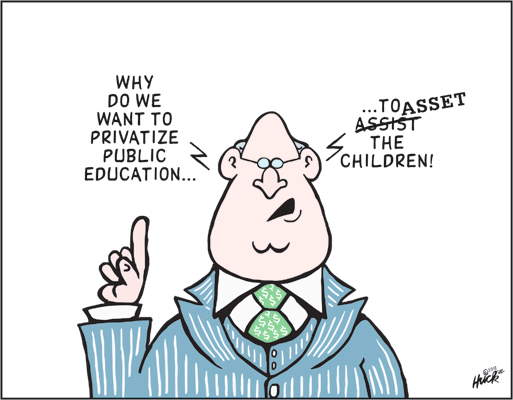
One might well wonder why New York Mayor Michael Bloomberg is spending $1 million of his own hard-(hardly)-earned cash to influence the Los Angeles school board race (the largest donation yet in this hotly contested race). Yet it is not just Bloomberg—several other billionaire outsiders have also ponied up large sums to help their favorite candidates win and it is not because they care about the wellbeing of LA’s children. Los Angeles Unified (like New York) is a battleground school district in the quest by wealthy investors and entrepreneurs to siphon off tax dollars from public education and crush their biggest enemy—the unions. What goes down in LA, they hope, will soon follow throughout the country, aiding their ability to weaken or destroy public sector unions, while increasing their share of the profits.

Bloomberg’s donation to Coalition for School Reform was meant to aid incumbent L.A. school board president Monica Garcia, in District 2, challenger Kate Anderson, in District 4, and Antonio Sanchez, who is fighting for an open seat in District 6. Each of these candidates has been a strong supporter of Superintendent Deasy’s reform agenda and two (Garcia and Anderson) have been vocal critics of the teachers union, United Teachers of Los Angeles (UTLA).

While Bloomberg’s $1 million has been the largest single donation, Coalition for School Reform (CSR) has also raised more than $1.5 million in smaller donations, according to the LA Times, from other billionaires ($250,000 each from veteran free market education “reformer” Eli Broad and former Univision chief A. Jerrold Perenchio). CSR also includes Megan Chernin, who runs a nonprofit formed by Deasy to raise funds for LAUSD schools and who used to head L.A.’s Promise, which managed three LAUSD charter schools. A smaller donation of $10,000 was made by Steven Prough, the current head of L.A.’s Promise.

The coalition has also received six-figure donations from Lynda Resnick, creator of POM Wonderful juice, and journalist Jamie Alter Lynton, who is on the board of Deasy’s nonprofit and who is married to Michael Lynton, chairman and chief executive of Sony Pictures Entertainment. Lynton has used her journalism connections as a bully pulpit to criticize UTLA and its defense of due process rights for its members. Former New York City schools Chancellor Joel Klein has also ponied up $25,000 to support the cause.

The Coalition for School Reform is a pro-charter and pro-accountability outfit that Mayor Villagairosa set up to fund his pro-privatization candidates back in 2011. In that election, the coalition raised over $1 million from right wing billionaire Phillip Anshutz (a “reactionary that makes the fascist-friendly Koch Brothers look moderate” wrote Robert Skeels), as well as billionaires Eli Broad, Jerrold Perenchio and others. Skeels, an education and social justice activist who writes for Schools Matter and Solidaridad, is also running against Garcia, but has raised his comparatively infinitesimal funding entirely through small donations and community organizing.

So who are the candidates the coalition is supporting in this current election and what is their agenda? Let’s start with current Board President Monica Garcia, a raving union-buster, who said that if she were president of UTLA she would go on a rampage and fire all “ineffective” teachers and eliminate seniority. This only shows that she has no clue how school districts actually operate (e.g., the district is the boss, with the power to hire and fire; the union is the employee of the teachers, with the responsibility to defend their interests and no ability to fire teachers). More significantly, it implies that she despises teachers, presuming great numbers of them to be incompetent, or at least an expensive burden, who should be replaced en-masse by lower-paid and more compliant novices.

The coalition’s candidate for District 4, one of LAUSD’s more affluent districts, is Kate Anderson, an attorney who once worked for Munger, Tolles & Olson, a high-powered law firm with members who are currently working in President Obama’s cabinet and who have served (or who currently serve) as CEO’s and directors of large investment firms, like Salomon Brothers and Berkshire Hathaway. One of the coalition’s priorities for District 4 is “stand[ing] up to special interest groups that make it impossible to remove poorly performing teachers.” In other words, they are counting on Anderson to attack collective bargaining and weaken the union by eviscerating teachers’ due process rights. Anderson’s supporters include Ben Austin, founder of Parent Revolution, the astroturf group behind most of LAUSD’s Parent Trigger battles, and another charter school advocate and profiteer.

Anderson, like Garcia, has publicly expressed ignorance about how the school district operates, calling into question her credibility as a future board member. She was quoted in the L.A. Weekly saying “I’m really frustrated by the lack of a teacher evaluation system. . .” though LAUSD does in fact have a teacher evaluation system, one that was negotiated by the district with the union and signed into a contract by both parties. Like Garcia, she, too, is disdainful of teachers, saying “We need a system that. . . when appropriate, helps teachers gracefully exit from the system.” This is essentially a euphemism for, “we need a more efficient way to get rid of teachers.” It is probably safe to presume she is referring to expensive veterans, union organizers, student advocates, charter school critics, and others who stand in the way of CSR’s privatization schemes. Ironically, Anderson’s opponent, Steve Zimmer, is a Teach for America alumnus who is supported by both UTLA and several charter schools.

In response to the large donation by Bloomberg, UTLA has asked for outside funds from the state and national teachers unions to help it support its own favorite candidates for the L.A. school board and has said it planned to spend several million dollars on the election.  As of last week, the NEA was unwilling to get involved, but the California Teachers Association and AFT have left the possibility open, according to the LA School Report. Regardless, it is unlikely that UTLA will be able to keep up the coalition’s spending, as it has no billionaire supporters.

The third candidate being pushed by CSR is Antonio Sanchez, another Villaraigosa ally, who also once worked for the County Federation of Labor, making him seem like a pro-union (rather than pro-privatization) candidate. Indeed, the Daily News reports that several unions have endorsed Sanchez, including UTLA and SEIU. However, despite his labor credentials, Sanchez supports much of Villaraigosa’s “reform” agenda, according to the L.A. School Report, saying that he wants to “break” the divide between unions and school choice and accountability advocates. This ought to give UTLA pause, as “breaking the divide” means getting the union to accept harmful concessions. For example, Sanchez supports the use of student performance data in teacher evaluations.

“Breaking the divide” between teachers’ unions and “reform” advocates is one of the main goals of CSR and its billionaire funders. As the reform movement sees it, the unions’ opposition to evaluation reform, Value Added Measures (VAM) and charter schools is irrational, selfish and meritless—and something that can be whittled away with persistence and finesse. They have good reason to believe this. UTLA—as well as CTU, in Chicago, and UFT, in New York—have all acquiesced to the use of student performance data or actual test scores to evaluate their teachers, despite the fact that such data is inconsistent, unreliable and correlates more strongly with students’ socioeconomic backgrounds than with teacher quality.

Monday, December 17, 2012

Chicago Teachers Tell the Rich to Back Off


The Chicago Teachers Union (CTU) is calling for a march and protest on December 18 to “Tell the Fat Cats:  Get Your Paws Off Our Public Schools.

While I could make many of the same criticisms of this that I have of the Occupy Movement (see here and here), I would rather call this a step in the right direction. (Plus, I really like their graphic for the protest).
(From the CTU website)
Certainly this is a reformist demand that lacks a meaningful critique of capitalism or public education’s role in bolstering it. Yet a mainstream craft union is unlikely to ever do this anyway. At least the CTU is placing some of the responsibility for their district’s crumbling infrastructure and their members’ declining working conditions directly on the backs of the rich—who have been tripping all over themselves and Chicago’s children in the race to convert CPS school sites into charter schools—rather than the usual vague union complaints about poor funding and belt-tightening by everyone.

The biggest problems with public education are not due to any defect in the schools or teachers. Rather, poverty and the wealth gap are the primary causes of the achievement gap. No reform that is currently on the table even attempts to address this. Certain social reforms, like those of the New Deal and the Great Society served to reduce poverty and close the wealth gap, and graduation rates climbed to their highest levels in response. But these economic gains have largely been reversed over the past 40 years, with an accompanying decline in wages and living standards for the majority of Americans.

Much of this decline has been due to a restructuring of the tax code, allowing the wealthy to keep a greater percentage of their wealth, causing a net decline in the revenue available for social services, like public education.

We are not likely to see the unions demanding an end to capitalism or even a reduction in poverty (though this reform would likely do far more to solve public education’s myriad problems than all the other current pseudo-reforms combined). However, it is not unreasonable to think that other teachers unions might start following the CTU’s lead and at least push back against the corporate-led “reforms” that are weakening the unions, deskilling the teaching profession and undermining the quality of education just so they can make a quick buck.

Wednesday, October 17, 2012

Chicago Schools CEO Brizard Out After 17 Months

Huck/Konopacki Labor Cartoons

Just like the CEO of a private company that fails to act aggressively enough to maximize profits or to suppress worker discontent, Chicago Public Schools CEO, Jean-Claude Brizard, is out after only 17 months on the job. He is leaving by “mutual agreement,” the Chicago Sun-Times reports. In all likelihood, however, he saw the writing on the wall (the mayor was pissed off) and, like a good capitalist soldier, took a dive for the team.

Brizard had been handpicked by Emanuel to push through the his corporate education agenda, including the massive conversion of public schools into private charters, the unilateral imposition of a longer workday without commensurate pay, evaluations based on student test scores and merit pay. The teachers, not surprisingly, resisted, launching the city’s first teacher strike in 25 years and successfully rolled back some of these reforms. In short, Brizard failed the mayor and made him look the fool.

Brizard will be replaced by Barbara Byrd-Bennett, a former teacher, principal and Cleveland schools CEO. She had also been filling in as Chicago’s interim chief education officer for the past six months, helping to negotiate the deal with the Chicago Teachers Union (CTU) that ultimately got the teachers to return to the classroom. The final terms of Brizard’s departure have not yet been disclosed, but are expected to include a year’s salary of $250,000, according to the Sun-Times.

The Chicago Tribune reports that business leaders told Brizard that the mayor would blame him if the struggle with the CTU got out of hand (i.e., not crushed quickly with a decisive victory for CPS). Not only did Brizard fail in this, but he enraged the mayor by going on a family vacation just prior to the strike and he was absent during much of the contract negotiations. The teachers’ ability to spin the strike as a struggle against standardized testing and privatization was certainly an embarrassment to the mayor and he likely blamed this on Brizard, as well.

Byrd-Bennett is not planning on filling the position she vacated to become CEO and is expected to serve both roles, thus consolidating her power and sending the message to the teachers that her rule will be autocratic and decisive. This is important for CPS and Emanuel, as many teachers are already grousing about the rotten deal they got with their new contract (e.g., the raise doesn’t cover the extra hours they’re being required to work and 25% of their evaluations will now be based on unreliable and inconsistent student test data). Furthermore, the district has been withholding pay from teachers who participated in the strike and it is doing little about the dilapidated facilities, including many schools that lack air conditioning. The new contract also gives principals greater leeway in hiring outsiders and ignoring the pool of recently laid off CTU members.

The last thing Emanuel wants is a renewed strike or an escalation of discontent. Yet he is setting the teachers up for this with his new pension plan (see accompanying article below), which would cut benefits, delay the retirement age and increase employee contributions, thus further eroding teachers’ take-home pay and living standards.

Wednesday, October 10, 2012

Chicago Teachers Penalized by CPS and CTU

Huck/Konopacki Labor Cartoons

Teachers who participated in the recent 10-day strike in Chicago saw smaller October 5 paychecks. Some received no pay at all. Yet the Chicago Teachers Union (CTU), which did not extend strike benefits to the teachers, continued to collect full dues from them, according to the WSWS.

While many hailed the strike as a victory, noting that Chicago Public Schools (CPS) dropped its demand for merit pay and did give the teachers a raise, the new contract accepts student test scores as a substantial portion of teachers’ evaluations. Considering that these test scores have little to do with teacher quality and that they provide unreliable and inconsistent data, they have no place at all in teacher evaluations. The new contract also accepts a longer school day without compensating teachers fully for the extra time they will be required to work.

According to the WSWS, the CTU told members they “will pay a temporary penalty this week . . . For now, however, they will continue their sacrifice in defense of quality public education, as they draw from the savings they set aside in preparation for the strike.” The CTU also told members they “may” be eligible for personal loans from the United Credit Union. During the strike, instead of offering strike pay, the union’s parent organization, the American Federation of Teachers (AFT), offered low-interest loans.

It is noteworthy that the Chicago teachers went on strike at all and that they were initially opposing the corporate reform agenda, including merit pay and the use of student test scores to evaluate teachers. It was particularly significant because unions have all but given up labor actions such as strikes as a means of achieving their goals, focusing more and more on lobbying and political campaign funding, which are far more expensive and less effective than job actions. It is interesting, but sad, to observe that the AFT was unwilling to support the Chicago strike or to use members’ dues to provide strike pay, yet they readily coughed up $31 million on electoral campaigns last year.

Tuesday, September 18, 2012

Chicago Teachers Strike Ends in Defeat for Teachers and Unions


The Chicago Teachers Union (CTU) voted today to end their strike. 98% of the 800 delegates voted in favor of ending the strike, according to the New York Times, though the union’s 26,000 members would still have to ratify the new contract, which could take several weeks.

The new contract would give teachers a modest raise and prohibit merit pay, but it would also lengthen the work day by 90 minutes and require that 30% of teachers’ evaluations be based on their students’ test scores. The new contract would also reserve half of new job openings for laid off teachers, but only if they had strong ratings based on these test scores.

Virtually everyone is reveling and calling it a victory for teachers and a defeat for corporate Ed Reform. Mike Klonsky called it a “Big victory for teachers.” His brother, Fred Klonsky, said “Most thought it was a win. Few of those I talked to were satisfied. None thought the strike should continue. All mistrust the Mayor. Most know that the fight doesn’t stop here.

Am I missing something?

How is it a victory for teachers (or students), or a defeat for the corporate ed reform agenda, to accept that 30% of teacher evaluations will be based on unreliable and inconsistent student test data (see here, here and here)? Considering that student test data, also known as Value Added Measures, or VAM, is almost entirely worthless as a measure of teacher effectiveness, it should not be allowed at all. Furthermore, the 30% rule will only encourage more teaching to the test, dumbing down and narrowing of the curriculum, and laying off of perfectly good teachers because they happen to work in low income schools, where student test scores and gains on those scores tend to be lower.

Likewise, how is it a victory for teachers if only half of new job openings go to laid off teachers and only to those who have high VAM scores? What about the good teachers who were laid off from low income, low performing schools? What about all those current teachers who will be laid off over the next five years as Chicago shuts down another 120 schools and converts 60 more to private charter schools? How is it a victory for the union, if they will lose thousands of members as a result of these layoffs? How is it a defeat for the corporate ed reform agenda when they will get another 60 charter schools and a weakening of the union as a result?

Yes, a prolonged strike would have been difficult to maintain and could have cost the union millions of dollars in fines and legal fees if the injunction sought by Mayor Emanuel were to go through, which it likely would. Yes, it would have been difficult to maintain public support. And yes, according to Illinois state law (SB 7), teachers are forbidden from bargaining anything less than the 30% floor they won for the percentage of their evaluations that will be based on student test scores. So, yes, this 30% is certainly better than 50%.

Nevertheless, SB 7 was an attack on collective bargaining and union power. Therefore, by accepting the 30%, CTU is capitulating to state-mandated restrictions on union activities. For the rest of the nation, the message is clear: Collective bargaining does not have to be banned outright, as it was in Wisconsin. It can simply be so hamstrung by legislatively-imposed pseudoscientific mumbo jumbo (e.g., VAM) that it becomes an impotent and meaningless endeavor.

Ending the strike may have been the most expedient tactic under the current circumstances. It certainly is easier, cheaper and less fraught than continuing to fight. And the teachers did halt some of the most onerous concessions that were being sought. However, the 30% should be seen as a defeat, not only because it will cause many good teachers to receive bad evaluations and potentially lose their jobs, but because it will encourage further legislative and legal attacks on union power.

Report Calls for More Teacher Support and Less Testing

Huck/Konopacki Labor Cartoons
If California wants to improve student academic performance, it needs to emphasize recruiting, educating and retaining teachers, according to a new report by a state task force, the Los Angeles Times reported on September 9. The task force also rejected making any links between teacher evaluations and students’ standardized test scores.

This latter finding is particularly salient in light of the recent Chicago teachers’ strike, in which the union (CTU) aggressively resisted attempts by Chicago Public Schools (CPS) to require a substantial portion of teachers’ evaluations be based on such test scores. Disturbingly, just days before this study was released, the CTA (the state’s largest teachers union) and state legislators agreed on an evaluation “reform” bill that would require student performance data be used to evaluate teachers. The agreement does not exclude the use of student standardized test scores, though it does give local bargaining units the right to collectively bargain what portion of teachers’ evaluations, if any, will be based on the scores, thus opening the way for many more battles like the one in Chicago.

While the task force’s findings regarding teacher recruitment and training make a lot of sense, the state has been moving in the opposite direction through budget cuts that have forced districts to slash or freeze wages, add furloughs, increase class sizes, decrease benefits, increase workloads, and numerous other “stopgaps.” These may help close budget deficits, but they also reduce the ability to recruit and retain the best quality teachers by deteriorating their working conditions and remuneration.

The Task Force, which was created by Superintendent of Public Instruction Tom Torlakson and the state Commission on Teacher Credentialing, was co-chaired by Stanford professor Linda Darling-Hammond and included researchers, academics, elected officials, district officials, labor leaders, parents, teachers and principals. Its report repeatedly emphasized that more and better support for teachers was needed throughout their careers, not only to improve their effectiveness, but to decrease attrition and improve recruiting potential. It also called for new laws that would ensure schools have “expert principals who provide support for instruction, time for collaboration and planning, collaborative leadership, reasonable class sizes, a trusting collegial environment and involvement in decision-making at the school.”

Many principals are already doing some of these things. However, the collaboration time is often taken up with unproven snake oil reforms and pet projects of district administrators that are imposed on teachers, rather than allowing teachers themselves to decide how to collaborate. Furthermore, to really be effective, teachers need more than an hour or two per month, which seems to be the norm in the districts that have built-in collaboration time.

Teachers’ Working Conditions are Students’ Learning Conditions
While all of the above factors would dramatically improve the working conditions for teachers, improve their status, and decrease their job stress, they would also vastly improve the quality of education for children. For example, the report called for smaller class sizes, noting this is in the best interests of the students. Fewer students decreases the workload for teachers by decreasing the number of assignments to read and grade, giving them more time to provide meaningful feedback on the ones they do assign. Fewer students allow teachers more time to provide one on one attention to children during class time. Smaller classes are easier to manage, allowing teachers to better monitor and intervene in the case of accidents, injuries, teasing or disruptive behavior, thus improving safety.

Despite these obvious advantages of smaller class sizes, most districts have been increasing class sizes due to budget cuts that have forced them to lay off teachers. Additionally, the task force noted that lower salary school districts had 20% larger class sizes on average than higher salary districts, again highlighting the positive correlation between teachers’ pay and working conditions and students’ learning conditions.

With respect to test scores, the task force was not simply buckling to pressure by teachers unions or the influence of the teachers on the task force. Rather, its report identified studies showing that student test data, when used to evaluate teachers, produce results that “are very unreliable and often inaccurate at the individual teacher level.” Yet when pundits, business leaders, philanthropists and politicians like Obama, Arne Duncan and Rahm Emanuel demand that evaluations include such unreliable or meaningless data, they not only demean teachers and undermine their status as professionals, thus harming districts’ ability to attract and retain the best teachers, but they force districts into the untenable position of having to layoff teachers en masse, thus harming students and districts’ very existence. In Chicago, for example, CTU president Karen Lewis has argued that the new evaluation system Emanuel wants to impose on teachers could result in 6,000 teachers, or 30% of the entire teaching staff, could lose their jobs over the next two years.

Monday, September 17, 2012

Chicago Teachers Vote to Continue Strike

Huck/Konopacki Labor Cartoons

The Chicago Teachers Union (CTU) House of Delegates voted Sunday to reject the latest contract proposal and continue their strike, in a challenge to both the leadership of the Chicago Public Schools (CPS) and the leadership of their own union, who had negotiated the tentative agreement.

The leadership of CTU is seen by many as a progressive, fighting leadership, willing to go toe to toe with their powerful parent organization, the American Federation of Teachers (AFT), led by Randi Weingarten, as well as powerful Democratic Party leaders like Rahm Emanuel and even President Obama. Indeed, the CTU leadership challenged all of these individuals with their initial rejection of the use of student test scores to evaluate teachers.

Yet their most recent compromise tentative contract agreement with CPS sold their members out by permitting student test data to account for as much as 30% of teachers’ evaluations, the WSWS reported today. Any use of student test data is unacceptable, even as little as 1%, because student test data is an unreliable and inconsistent proxy for teacher ability. It can lead to false positives and false negatives, and result in good teachers getting bad reviews and possibly even laid off as a result.

The tentative agreement also gives principals considerable discretion over hiring, eviscerating recall rights for recently laid off teachers, while also slashing layoff benefits in half. (The details of agreement were released Sunday evening).

Bargaining teams and unions often justify compromises with bosses or legislators that harm former or future employees, arguing that their role is to protect the interests of their existing dues-paying members. Not only does this strategy lack compassion, it is also stupid since it undermines the union’s own power. Thousands more Chicago teachers will be laid off in the next five years under the city’s plan to shut down up to 120 schools, resulting in fewer union members. Of those who get rehired by one of the 60 new privately-run charter schools slated to open in that time, most, if not all, will lose union representation.

In an indication of just how far the CTU leadership is willing to go to end the strike and make peace with the bosses, CTU President Karen Lewis plans to force through another vote on the same tentative agreement this Tuesday, without engaging in any further negotiations with CPS. This implies that she intends to ignore the delegates’ concerns and criticisms of the tentative agreement and pressure them to vote against their members’ own interests. She is counting on mounting criticism by the press and the threat of fines and jail to coerce delegates into accepting a bad deal.

Mayor Emanuel responded to the rejection vote by threatening court action against the teachers. According to the WSWS, he said he would “not stand by while the children of Chicago are played as pawns in an internal dispute within a union,” implying that both CPS and the union leadership are the only reasonable parties in the dispute, while the House of Delegates and general membership are crazy for rejecting the tentative agreement. His threat to obtain a court injunction against the teachers suggests that he has lost faith in CTU President Karen Lewis’ ability to keep her members in line.

Emanuel has called the strike illegal (teachers in Illinois can strike on wage issues, but not evaluations) and a threat to the safety of children. This latter argument is particularly cynical considering the district has done little to repair dilapidated facilities and broken air conditioning or to reduce class sizes to a safe and healthy level. He has overseen and encouraged school closures that have only exacerbated staffing and class size problems, thus jeopardizing the safety of children.

His argument that the strike is illegal is only partly true. They are striking over wages, and they happen to be unwilling to make any compromises on that issue as long as the district plays hardball on other working conditions and safety matters.

The issue of the strike’s legality has much broader significance. The ruling class can take away workers’ rights any time they think they can get away with it, as they did in Wisconsin and continue to attempt throughout the nation. Workers’ power lies entirely in their ability to withhold their labor, not in making alliances and compromises with politicians, particularly considering that the politicians are members of the ruling class and have far more in common with other wealthy members of the ruling elite than they do with workers.

Not long ago, unions had no legal standing and any strike could be declared illegal. Workers were often imprisoned, beaten or killed for participating in strikes, yet they continued to use this tactic and win improvements in working conditions. Workers today have the choice to disobey unjust laws and resist oppressive demands by their bosses or continue to see their wages and working conditions deteriorate.

Unions today, however, have a great distaste for strikes and the risks they entail. There have been very few large teacher strikes in the last few decades. The CTU strike is unique in this respect. Still, the CTU leadership has an interest in ending the strike quickly. The leaders do not want to spend time in jail or receive fines or lose their status and influence. They do not want to challenge unjust laws or corporate giveaways or the district’s “right” to shut down schools and give them away to private charter school operators, even if these undermine the union’s power in the long term. Furthermore, they do not want to burn their bridges with their allies in the Democratic Party or their parent organization, the AFT, even if that means accepting less power as a result of privatization and layoffs.

Sunday, September 16, 2012

Chicago Teachers, Just Say No


The Chicago Teachers Union (CTU) and Chicago Public Schools (CPS) are were very near a deal by the end of last week. Last minute negotiating today, it is hoped, will lead to a compromise that both sides can accept, allowing teachers and students back in the classroom by Monday. The 800 members of the CTU House of Delegates would have to approve the contract and then teachers would have to ratify it.

The details of the proposal have not yet been made public, but speculation by the mainstream press suggest that it will include the use of student test data in teacher evaluations, but these scores will not count as much toward teachers’ overall scores as CPS had hoped. If this is true, then it is a terrible contract and Chicago teachers should just say no to it.

The test scores are an inconsistent and unreliable proxy for teacher quality. They lead to many false positives and false negatives (also see here, for more on the unreliability of Value Added models). Teachers who are doing everything right in the classroom can still have students who do not progress sufficiently in their test scores, which are correlated far more strongly with students’ socioeconomic backgrounds than with their teachers (see herehere and here). Furthermore, any use of test scores to evaluate teachers will encourage teaching to the test, while also giving tacit approval to the state’s wrongheaded mania for testing.

For all of these reasons, teachers unions across the nation must oppose the use of high stakes tests, period. They are virtually worthless as a tool for assessing teachers and they are destructive of the learning process for children.

Thursday, September 13, 2012

The Chicago Strike and the Rebirth (or Death) of Unionism


The current Chicago teachers strike is the first major teachers strike in years. Indeed, there have been few major strikes in any industry over the past decade, with a general trend of declining job actions and union membership over the past thirty years and a corresponding downward spiral in wages and living conditions. In Michigan, for example, there were 454 teacher strikes between 1967 and 1980 (an average of 35 per year), resulting in substantial wages gains, but only 18 per year in the 1980s, according to William Boyd, David Plank, and Gary Sykes. The National Educators Association (NEA) has lost over 100,000 members since 2010.

In contrast, during the post-World War II era, strikes were common in the U.S. In the period from 1945-1946, 400,000 miners and 750,000 steel workers went on strike in the largest strike wave in U.S. history. At one point during this period there were 1.6 million workers simultaneously on strike. By the end of the year, more than 4.5 million workers had engaged in strike actions. (Sources: Daily Kos, New York Times, Marxists.org, Counter Punch). The Chicago strike is the largest strike in the past year.

The “death” of unionism, or its declining membership and influence, is generally blamed on union busting politicians (e.g., Scott Walker, Wisconsin, or Reagan’s mass firing of the PATCO air traffic controllers), or outsourcing and downsizing by the bosses, (which reduce the number of union jobs and thus the number of unionized workers). Indeed, the Taft-Hartley Act (1947), which made the General Strike illegal, was a serious blow to workers’ power (there hasn’t been an effective General Strike in the U.S. since then). However, another major cause is the unions themselves, which have, for the most part, relinquished their most powerful weapon—withholding labor—in exchange for increasing reliance on political action (e.g., lobbying, initiatives, phone-banking for candidates) and behind-the-scenes deals with the bosses.

It is important to recognize that job actions are a form of direct action in which the workers have direct control over the action, how long to continue, how aggressively to pursue it, and what kinds of compromises (if any) to accept. Political action, in contrast, requires that they give up their power and control to second and third parties. The union bosses, not the rank and file, generally determine which campaigns and candidates to support, even though the campaigns are funded with the dues paid by the rank and file. Once a candidate has been chosen, it is not a sure thing that that candidate will win and, even if he does, there is no guarantee he will do anything the union wants. In fact, because the politicians’ interests are more closely aligned with those of the capitalist class, it is unlikely the politicians will do much at all in support of workers other than a few modest reforms that allow them to maintain social and economic hegemony and continue reaping huge profits.

One particularly refreshing aspect of the CTU strike is that teachers are not just fighting for increased pay (which they certainly deserve). They are also fighting against deplorable working conditions (dilapidated and unsafe facilities, large class sizes, inadequate health and social services for their students) and an abusive evaluation system which would cause teachers to be laid off en masse because their students’ test scores didn’t rise sufficiently. And they are engaging in this fight even though the president of their parent union, Randi Weingarten of the American Federation of Teachers, has cut deals with politicians to allow similar evaluation “reforms” in other school districts.

Likewise, the fight against using student standardized tests to evaluate teachers is a direct challenge to the Obama Administration, which has been pushing for similar “reforms” across the nation, and to the leadership of both the NEA and AFT, which both gave early support to Obama’s 2012 presidential campaign, despite his support of high stakes exams, privatization and charter schools.

Strikes are, of course, a risky endeavor. If you lose, you could find yourself worse off than before or even jobless. They are difficult to organize and maintain (e.g., strike funds generally cannot sustain workers for long; scabs might be brought in to do the work and keep the system functioning, thus undermining the effects of walking off the job). Public sentiment can be manipulated to oppose the workers and support the bosses’ goals.

This is particularly challenging for those in the “helping” fields, like teachers and nurses, where walking off the job can easily be spun to seem like a selfish and greedy act that harms their constituents (i.e., students and patients). Indeed, many in the “helping” fields, particularly teachers, see themselves first as advocates and benefactors for their students and only secondarily, if at all, as workers. This tendency makes it very hard to get teachers to walk off the job and it leads many to accept declining pay, benefits and working conditions so long as the bosses claim these concessions are necessary for the wellbeing of the students.

Yet teachers are workers. The overwhelming majority rely on their paychecks to put food on the table for their families. They do not go to work solely because they want to help children, though this may be why they teach rather than something else. Teachers, like all workers, necessarily have an adversarial relationship with their bosses, even when those bosses seem nice or appear to have similar interests (e.g., the wellbeing of children).

This is because they do not truly have the same interests. For one, the administrators have the power to fire teachers and to impose demands on them. Teachers do not have this power and must make considerable sacrifices and compromises to appease their administrators or risk losing their jobs and the ability to feed their families. Teachers are, like all other workers, dependent on their salaries for their own survival and thus are wage slaves.

Our Working Conditions Are Your Children’s Learning Conditions
  • While teachers’ interests often do not coincide with those of their administrators and school boards, they often do coincide with those of their students. Here are just a few:
  • Decent pay helps attract and retain the best quality teachers, which is certainly in the best interests of students. While everyone wants to get the best deal for their money, including the taxpayers, one needs to consider the quality they are getting. Better quality almost always costs more. If teachers are not paid a decent wage they will look for work elsewhere.
  • Evaluation “reforms” that emphasize using student test data are terrible for kids since the scores have almost no meaningful or consistent correlation with teacher quality. Teachers who work with low income, special education and ELD students tend to get lower average student test scores. According to Karen Lewis, president of the CTU, the Chicago plan for making student test scores worth 25% of teachers’ evaluations could result in 6,000 teachers losing their jobs over the next two years. By anyone’s calculations, this would be a disaster for kids. How can CPS find 6,000 highly qualified teachers in two years?
  • Smaller class sizes make it easier for teachers to give individualized one on one attention to students. Smaller classes means fewer papers to grade, which means teachers can put more time into each paper, providing more detailed and useful comments. Smaller classes are easier to manage and thus are safer for students. This is particularly important in physical education, science and some of the industrial arts course.
There's a lot at stake for teachers and other workers with the current strike in Chicago. A victory could provide the confidence and momentum for other unions to start resisting the standardized test mania, demanding wage increases, and fighting for better working conditions through job actions. A loss for the CTU would likely lead to even fewer teacher strikes in the future and a further evisceration of the teachers unions.

Wednesday, September 12, 2012

Chicago Teachers Strike Update


  • Support by parents is still fairly strong. A Chicago Sun Times opinion poll on Monday found that nearly half of parents support the teachers, while only 39% oppose the strike. This could change, of course, particularly if the strike drags on and parents are forced to hire babysitters or stay home from work to care for children.
  • Custodians plan on joining the strike this week, KOAM TV reported. The more classified (non-credentialed staff) that join the strike, the greater the pressure on the board and CPS and the more likely they are to cave.
  • CPS is planning on extending the length of time the 147 scab “Drop off” centers will be open from 4 hours to six starting on Thursday. These schools are being kept open ostensibly to provide lunch and other services for low income students. However, they are staffed with uncredentialed district staff and volunteers from religious organizations who have little or no training in education or childcare. The scabs have been told by CPS (See Fred Klonsky’s Scab Toolkit) to bring pencils, stickers, puzzles, games and magazines (so the kids have something “productive” to do during the day), be firm and respectful to students and don’t yell at them, as well as other useful tidbits of guidance. They have also been told to be prepared for classrooms without A/C or functioning clocks, which ought to make the scabs want to join the strike if only to help teachers fight for safe and functional classrooms for the children.
  • Though Illinois law currently prohibits teachers from striking over the recall of laid-off teachers and compensation for a longer school year, CTU does not intend to sign an agreement until these matters are addressed, according to union president, Karen Lewis.
  • Jesse Jackson tried to mediate today, but gave up, claiming both sides were too "dug in" to even "hear each other," which is to say he expects the teachers to compromise and believes that CPS has valid or reasonable expectations (which they do not).

Tuesday, September 11, 2012

Chicago Strike Update


Yesterday, the first day of Chicago’s teacher strike, 35,000 teachers and their supporters (including hundreds of students) picketed in front of their schools and Chicago Public Schools (CPS) headquarters. 578 schools held pickets, according to “On The Line,” the CTU’s strike website. Today, CTU asked all members to picket at one of the 144 school sites that CPS is trying to keep open. These sites are being run by people from the district office, with scab support from members of religious organizations.

What are the Issues?
  1. The proposed contract put forth by CPS provides a nominal pay increase that does not adequately compensate teachers for the extra work required by the implementation of the Common Core Standards (CCS) and the new evaluation system, let alone cover the cost of inflation. Furthermore, CPS is not offering sufficient teacher training to implement the new curriculum, forcing the teachers to do all the training on their own and at their own expense.
  2. A new evaluation system is being imposed from the top down that is based heavily (25%) on student standardized test scores. This system could result in 6,000 layoffs over the next two years, causing a severe teacher shortage and the loss of thousands of excellent teachers.  Student test data correlates very weakly with teacher ability and even then it is only consistent when averaged over three years and only for teachers at the extremes of quality (the very best and the very worst). For the majority of teachers the data is inconsistent and meaningless. If used yearly or every two years it would likewise lead to inaccurate results, causing many good teachers to get bad reviews and some mediocre teachers to get good ones.]
  3. The contract provides no additional resources for the health and safety of the children. The board has disregarded teacher concerns about air-conditioning and inadequate staffing levels. It should be remembered that 750 people died from dehydration and heat stroke during the Chicago heat wave of 1988. Some Chicago teachers have documented classroom temperatures soaring into the 90s.
  4.  A fair recall procedure needs to be codified in the new contract so that teachers who were laid off over the past few years get rehired to cover the longer school day. CPS imposed a 90 minute longer school day and backed off demands that existing teachers work those extra 90 minutes without compensation. Instead, they agreed to rehire laid off teachers, but have yet to propose a fair and reasonable system for doing this.

Why the Chicago Teachers Strike Should Matter to You


The Chicago Teachers Union (CTU) and Chicago Public Schools (CPS) were pretty close to agreement on salaries. CPS backed down on forcing teachers to work an additional 90 minutes without pay, agreeing to rehire laid off teachers to cover the extra time in the school day. The remaining big negotiable issue is evaluations, with CPS demanding that student standardized test scores be a significant factor.

This is terrible for both teachers and students. Student test scores depend far more on students’ socioeconomic backgrounds and other factors outside of school than on teacher skill. Furthermore, even the small influence teachers have on student test data is difficult to measure accurately and requires three or more consecutive years of data to provide consistent results. And even then, the data is only reliable for teachers at the extremes (i.e., very poor and superb teachers). Results are unreliable for the vast majority, who fall somewhere in the middle. Thus, the use of such data will likely result in many good teachers getting bad reviews and being laid off, which is both unfair to them and their students. Many mediocre or incompetent teachers, likewise, could slip through the cracks, particularly if the data is used yearly, instead of every three years.

Many teachers unions have already caved in to similar demands to use student test data to evaluate teachers. Randi Weingarten, head of the AFT, has helped broker deals in which student test scores play a significant role in teachers’ evaluations. The CTA has embraced a deal in California that requires student performance data be used to evaluate teachers, in a sellout compromise they have called a victory because the locals get to collectively bargain how such data will be used (but not whether such data will be used). Therefore, it is inspiring that the CTU has taken on this fight, when its brethren across the nation have given in.

CTU is also asking for smaller class sizes, another battle that many unions have long since given up. In California, classes of 35 or more have become the norm. In Chicago, teachers have been demanding reductions down to 23. It is perplexing why anyone would think that a class of 35 is acceptable, safe or good for children, yet it has not only become the new normal, but some districts have tried to increase class sizes well above this (e.g. Detroit’s financial manager imposed a contract allowing class sizes of 61).

A loss for Chicago teachers will embolden districts and states throughout the U.S. to mandate that student test data be used to evaluate teachers. Indeed, it is already a part of Obama’s education plan and a carrot for those states hoping to win one of his Race to the Trough grants. Similarly, a loss in Chicago could harm teachers in other regions fighting for smaller class sizes.

The battle lines have been drawn and the teachers have some powerful enemies. The Obama administration not only has strong ties to the Chicago establishment, but also has large stake in tying student test data to teacher evaluations. Obama cannot afford to lose this fight, as it will make him look weak on education and labor. Furthermore, he has already taken the union vote for granted and the unions have, for the most part, embraced his candidacy, despite his numerous anti-labor policies. Mayor Rahm Emanuel, who some see as a future presidential candidate, likewise has a lot riding on this struggle. Meanwhile, Mitt Romney is already coming down hard on the CTU and attempting to connect Obama with the selfish, greedy teachers, essentially egging him on to intervene on behalf of Emanuel and the Chicago school board.

According to KPFA (Letters and Politics, 9/10/12), CPS has already enlisted scabs. In this case, members of religious organizations were volunteering to work at some of the 140 schools that remained open for low income students to take advantage of the free and reduced lunch program. While this could be seen as merciful to low income students it is also an indication of the readiness of some to sabotage the wellbeing of the majority of students (and teachers) for the illusion of helping the needy. Indeed, some teachers are calling these schools holding pens, which is essentially what they are since they do not have credentialed or trained teachers and the students are not getting any type of meaningful education. They are basically fed and corralled there for half a day to make the district look like it has things under control.

Monday, September 10, 2012

Chicago Teachers Strike is On


The Chicago teachers strike is officially on, with thousands of teachers walking off the job today in Chicago’s first teacher strike in 25 years. It is also the first major American teacher strike in years.

The stakes are high for all sides. In some ways, the strike is a test case for the labor movement, particularly among public sector workers. A loss for the teachers would motivate anti-union officials across the country to increase their attacks on public sector workers, giving them the confidence that the unions are just too weak to mount an effective counterattack. There is also a lot at stake for Democrats, particularly Obama, as the strike is in his old stomping grounds. Republicans would certainly take advantage of a teacher victory to claim that Obama and Rahm’s education and labor policies have been a disaster.

Emanuel called the strike “wrong, avoidable and unnecessary,” according to the Seattle Post Intelligencer. Of course the strike would be unnecessary if CPS had bargained in good faith, offered a decent raise, lowered class sizes, and abandoned their abusive evaluation policy. However, considering the district’s recalcitrance, the strike is not wrong for teachers or students. Low pay and abuse evaluation systems will drive away the best teachers, thus harming students, while the overwhelming majority of studies indicate that students benefit from smaller class sizes.

The new teacher evaluation system relies heavily on student test scores, something that measure students’ knowledge and test taking abilities, not teachers’ skill in the classroom. The test scores are influenced far more by factors external to school (e.g., students’ socioeconomic backgrounds) than by teachers. CTU President Karen Lewis said the new evaluation system could cause 6,000 teachers to lose their jobs over the next 2 years. Many critics have accused the district of implementing the system to get rid of its most experienced and highest paid teachers in order to save money and weed out its most vocal opponents.

Most Chicago schools were closed, but the district vowed to keep 140 open to provide food for low income students in need. The police chief vowed to take officers off of “desk duty” and place them out at the schools, to “protect” the children and to “deal” with teacher protests.