Showing posts with label teachers strike. Show all posts

Monday, April 29, 2013

Terrorist Teachers Threatened in Mexico


The U.S. may have initiated the absurd propagandistic ploy of equating teachers with terrorists back when Bush’s Education Secretary, Reid Lyon, called the National Educators Association a terrorist organization. However, the Mexican state has taken it a step further, issuing arrest orders against Minervino Morán and Gonzalo Juárez, leaders of the Guerrero Teachers Union (Coordinadora Estatal de Trabajadores de la Educación en Guerrero, CETEG).

The arrest order was issued by Angel Aguirre Rivero, governor of the state of Guerrero, charging the two as instigators of the uprising of teachers who are opposing President Enrique Peña Nieto’s free market reform agenda. Aguirre has accused the two of being “vandals” and “delinquents,” and, more alarmingly, with being connected to the ERPI guerrilla movement, according to the WSWS.

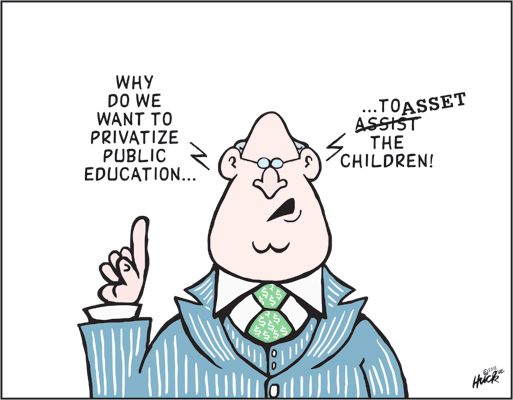
The strike began in February as a protest against Nieto’s free market education reforms, including privatization of public schools, teacher evaluations based on student test scores and a restricting of union rights. In March, the Guerrero government seemed to have conceded to the teachers, signing an agreement with the CETEG that would have preserved free public education and “democratic” teacher evaluations, as well as agreeing to pay back wages lost during the strike.

When the government appeared to be going back on their word, the teachers resumed their protests. Joined by members of the union of public employees (Sindicato Único de Trabajadores Públicos, SUSPEG) and the United Front of Teaching Schools (Frente Único de Escuelas Normales, FUNPEG), the teachers blocked the highway connecting Acapulco with México City in early April. The subsequent police assault resulted in five arrests and three injured teachers.

The strikes shut down numerous schools—20%, according to the Aguirre administration, which threatened to replace teachers with scabs if they did not return immediately to work. On April   10,   legislators met to discuss changes to the Guerrero Education Code. On April 24, according to the WSWS, the legislature rejected union demands, including its demand to be part of the teacher evaluation process. However, the legislature did agree to abolish student fees and keep public education free in Guerrero.

Meanwhile, at the same time legislators were meeting to discuss the changes, vandals attacked the headquarters of all the major parties in the city of Chilpancingo, according to the WSWS, while the police sat idly and did nothing, suggesting that the vandals may have been agents provocateur and not teachers or unionists, though CETEG President Moran suggested that militant factions of his union were involved. The Mexico City weekly Proceso magazine, reported that the vandals also attacked and insulted female reporters.

Regardless of whether the CETEG was behind the vandalism or the assaults, the union is clearly more militant than its counterparts in the U.S., as their highway blockade indicates. However, one should not confuse this militancy with any fundamental philosophical or strategic differences. The union leaders’ primary goals are to maintain their “seat at the table” with the legislators and their elevated status and pay as union bosses. They are not interested in any sort of radical reforms of the Mexican education system. For example, their demand for “democratic evaluations” is merely a call for CETEG to be a “partner” with the Aguirre administration, a vague plea that leaves open the use of student test scores and other arbitrary and unreliable metrics that could be used to punish or fire teachers vindictively, in response to their advocacy or union activities, or in order to cull higher paid veterans.

Likewise, the protests against the privatization of the Mexican education system, like those by their counterparts in the U.S. and elsewhere, never call into question the primary role of public education as a subsidy to the employers which provides them a sufficiently educated and obedient workforce and ample consumers for their goods and services. Whether or not the schools are privatized, the students are still treated as commodities and the teachers are still exploited workers. The main difference is that privatization weakens the size and power of the large national teachers unions and the job security of their leaders.

Sunday, November 25, 2012

Today in Labor History—November 25


America, Love It or Leave It (By Force)
November 25, 1919 – A strike for union recognition by 395,000 steelworkers continued throughout November. The strike began on September 22 and collapsed on January 8, 1920. The strike was used by the feds as an excuse to deport approximately 250 anarchists, communists and labor agitators to Russia on November 24, marking the beginning of the so-called "Red Scare." (from the Daily Bleed)

November 25, 1946 - St. Paul teachers, led mostly by women, walked out of their classrooms in American’s first organized teachers’ strike. 1,165 teachers and principals (all represented by the same union) remained out until Dec. 27 in what they called the “strike for better schools.” (From Workday Minnesota)

Wednesday, October 17, 2012

Chicago Schools CEO Brizard Out After 17 Months

Huck/Konopacki Labor Cartoons

Just like the CEO of a private company that fails to act aggressively enough to maximize profits or to suppress worker discontent, Chicago Public Schools CEO, Jean-Claude Brizard, is out after only 17 months on the job. He is leaving by “mutual agreement,” the Chicago Sun-Times reports. In all likelihood, however, he saw the writing on the wall (the mayor was pissed off) and, like a good capitalist soldier, took a dive for the team.

Brizard had been handpicked by Emanuel to push through the his corporate education agenda, including the massive conversion of public schools into private charters, the unilateral imposition of a longer workday without commensurate pay, evaluations based on student test scores and merit pay. The teachers, not surprisingly, resisted, launching the city’s first teacher strike in 25 years and successfully rolled back some of these reforms. In short, Brizard failed the mayor and made him look the fool.

Brizard will be replaced by Barbara Byrd-Bennett, a former teacher, principal and Cleveland schools CEO. She had also been filling in as Chicago’s interim chief education officer for the past six months, helping to negotiate the deal with the Chicago Teachers Union (CTU) that ultimately got the teachers to return to the classroom. The final terms of Brizard’s departure have not yet been disclosed, but are expected to include a year’s salary of $250,000, according to the Sun-Times.

The Chicago Tribune reports that business leaders told Brizard that the mayor would blame him if the struggle with the CTU got out of hand (i.e., not crushed quickly with a decisive victory for CPS). Not only did Brizard fail in this, but he enraged the mayor by going on a family vacation just prior to the strike and he was absent during much of the contract negotiations. The teachers’ ability to spin the strike as a struggle against standardized testing and privatization was certainly an embarrassment to the mayor and he likely blamed this on Brizard, as well.

Byrd-Bennett is not planning on filling the position she vacated to become CEO and is expected to serve both roles, thus consolidating her power and sending the message to the teachers that her rule will be autocratic and decisive. This is important for CPS and Emanuel, as many teachers are already grousing about the rotten deal they got with their new contract (e.g., the raise doesn’t cover the extra hours they’re being required to work and 25% of their evaluations will now be based on unreliable and inconsistent student test data). Furthermore, the district has been withholding pay from teachers who participated in the strike and it is doing little about the dilapidated facilities, including many schools that lack air conditioning. The new contract also gives principals greater leeway in hiring outsiders and ignoring the pool of recently laid off CTU members.

The last thing Emanuel wants is a renewed strike or an escalation of discontent. Yet he is setting the teachers up for this with his new pension plan (see accompanying article below), which would cut benefits, delay the retirement age and increase employee contributions, thus further eroding teachers’ take-home pay and living standards.

Wednesday, October 10, 2012

Chicago Teachers Penalized by CPS and CTU

Huck/Konopacki Labor Cartoons

Teachers who participated in the recent 10-day strike in Chicago saw smaller October 5 paychecks. Some received no pay at all. Yet the Chicago Teachers Union (CTU), which did not extend strike benefits to the teachers, continued to collect full dues from them, according to the WSWS.

While many hailed the strike as a victory, noting that Chicago Public Schools (CPS) dropped its demand for merit pay and did give the teachers a raise, the new contract accepts student test scores as a substantial portion of teachers’ evaluations. Considering that these test scores have little to do with teacher quality and that they provide unreliable and inconsistent data, they have no place at all in teacher evaluations. The new contract also accepts a longer school day without compensating teachers fully for the extra time they will be required to work.

According to the WSWS, the CTU told members they “will pay a temporary penalty this week . . . For now, however, they will continue their sacrifice in defense of quality public education, as they draw from the savings they set aside in preparation for the strike.” The CTU also told members they “may” be eligible for personal loans from the United Credit Union. During the strike, instead of offering strike pay, the union’s parent organization, the American Federation of Teachers (AFT), offered low-interest loans.

It is noteworthy that the Chicago teachers went on strike at all and that they were initially opposing the corporate reform agenda, including merit pay and the use of student test scores to evaluate teachers. It was particularly significant because unions have all but given up labor actions such as strikes as a means of achieving their goals, focusing more and more on lobbying and political campaign funding, which are far more expensive and less effective than job actions. It is interesting, but sad, to observe that the AFT was unwilling to support the Chicago strike or to use members’ dues to provide strike pay, yet they readily coughed up $31 million on electoral campaigns last year.

Tuesday, September 18, 2012

Chicago Teachers Strike Ends in Defeat for Teachers and Unions


The Chicago Teachers Union (CTU) voted today to end their strike. 98% of the 800 delegates voted in favor of ending the strike, according to the New York Times, though the union’s 26,000 members would still have to ratify the new contract, which could take several weeks.

The new contract would give teachers a modest raise and prohibit merit pay, but it would also lengthen the work day by 90 minutes and require that 30% of teachers’ evaluations be based on their students’ test scores. The new contract would also reserve half of new job openings for laid off teachers, but only if they had strong ratings based on these test scores.

Virtually everyone is reveling and calling it a victory for teachers and a defeat for corporate Ed Reform. Mike Klonsky called it a “Big victory for teachers.” His brother, Fred Klonsky, said “Most thought it was a win. Few of those I talked to were satisfied. None thought the strike should continue. All mistrust the Mayor. Most know that the fight doesn’t stop here.

Am I missing something?

How is it a victory for teachers (or students), or a defeat for the corporate ed reform agenda, to accept that 30% of teacher evaluations will be based on unreliable and inconsistent student test data (see here, here and here)? Considering that student test data, also known as Value Added Measures, or VAM, is almost entirely worthless as a measure of teacher effectiveness, it should not be allowed at all. Furthermore, the 30% rule will only encourage more teaching to the test, dumbing down and narrowing of the curriculum, and laying off of perfectly good teachers because they happen to work in low income schools, where student test scores and gains on those scores tend to be lower.

Likewise, how is it a victory for teachers if only half of new job openings go to laid off teachers and only to those who have high VAM scores? What about the good teachers who were laid off from low income, low performing schools? What about all those current teachers who will be laid off over the next five years as Chicago shuts down another 120 schools and converts 60 more to private charter schools? How is it a victory for the union, if they will lose thousands of members as a result of these layoffs? How is it a defeat for the corporate ed reform agenda when they will get another 60 charter schools and a weakening of the union as a result?

Yes, a prolonged strike would have been difficult to maintain and could have cost the union millions of dollars in fines and legal fees if the injunction sought by Mayor Emanuel were to go through, which it likely would. Yes, it would have been difficult to maintain public support. And yes, according to Illinois state law (SB 7), teachers are forbidden from bargaining anything less than the 30% floor they won for the percentage of their evaluations that will be based on student test scores. So, yes, this 30% is certainly better than 50%.

Nevertheless, SB 7 was an attack on collective bargaining and union power. Therefore, by accepting the 30%, CTU is capitulating to state-mandated restrictions on union activities. For the rest of the nation, the message is clear: Collective bargaining does not have to be banned outright, as it was in Wisconsin. It can simply be so hamstrung by legislatively-imposed pseudoscientific mumbo jumbo (e.g., VAM) that it becomes an impotent and meaningless endeavor.

Ending the strike may have been the most expedient tactic under the current circumstances. It certainly is easier, cheaper and less fraught than continuing to fight. And the teachers did halt some of the most onerous concessions that were being sought. However, the 30% should be seen as a defeat, not only because it will cause many good teachers to receive bad evaluations and potentially lose their jobs, but because it will encourage further legislative and legal attacks on union power.

Tuesday, September 11, 2012

Why the Chicago Teachers Strike Should Matter to You


The Chicago Teachers Union (CTU) and Chicago Public Schools (CPS) were pretty close to agreement on salaries. CPS backed down on forcing teachers to work an additional 90 minutes without pay, agreeing to rehire laid off teachers to cover the extra time in the school day. The remaining big negotiable issue is evaluations, with CPS demanding that student standardized test scores be a significant factor.

This is terrible for both teachers and students. Student test scores depend far more on students’ socioeconomic backgrounds and other factors outside of school than on teacher skill. Furthermore, even the small influence teachers have on student test data is difficult to measure accurately and requires three or more consecutive years of data to provide consistent results. And even then, the data is only reliable for teachers at the extremes (i.e., very poor and superb teachers). Results are unreliable for the vast majority, who fall somewhere in the middle. Thus, the use of such data will likely result in many good teachers getting bad reviews and being laid off, which is both unfair to them and their students. Many mediocre or incompetent teachers, likewise, could slip through the cracks, particularly if the data is used yearly, instead of every three years.

Many teachers unions have already caved in to similar demands to use student test data to evaluate teachers. Randi Weingarten, head of the AFT, has helped broker deals in which student test scores play a significant role in teachers’ evaluations. The CTA has embraced a deal in California that requires student performance data be used to evaluate teachers, in a sellout compromise they have called a victory because the locals get to collectively bargain how such data will be used (but not whether such data will be used). Therefore, it is inspiring that the CTU has taken on this fight, when its brethren across the nation have given in.

CTU is also asking for smaller class sizes, another battle that many unions have long since given up. In California, classes of 35 or more have become the norm. In Chicago, teachers have been demanding reductions down to 23. It is perplexing why anyone would think that a class of 35 is acceptable, safe or good for children, yet it has not only become the new normal, but some districts have tried to increase class sizes well above this (e.g. Detroit’s financial manager imposed a contract allowing class sizes of 61).

A loss for Chicago teachers will embolden districts and states throughout the U.S. to mandate that student test data be used to evaluate teachers. Indeed, it is already a part of Obama’s education plan and a carrot for those states hoping to win one of his Race to the Trough grants. Similarly, a loss in Chicago could harm teachers in other regions fighting for smaller class sizes.

The battle lines have been drawn and the teachers have some powerful enemies. The Obama administration not only has strong ties to the Chicago establishment, but also has large stake in tying student test data to teacher evaluations. Obama cannot afford to lose this fight, as it will make him look weak on education and labor. Furthermore, he has already taken the union vote for granted and the unions have, for the most part, embraced his candidacy, despite his numerous anti-labor policies. Mayor Rahm Emanuel, who some see as a future presidential candidate, likewise has a lot riding on this struggle. Meanwhile, Mitt Romney is already coming down hard on the CTU and attempting to connect Obama with the selfish, greedy teachers, essentially egging him on to intervene on behalf of Emanuel and the Chicago school board.

According to KPFA (Letters and Politics, 9/10/12), CPS has already enlisted scabs. In this case, members of religious organizations were volunteering to work at some of the 140 schools that remained open for low income students to take advantage of the free and reduced lunch program. While this could be seen as merciful to low income students it is also an indication of the readiness of some to sabotage the wellbeing of the majority of students (and teachers) for the illusion of helping the needy. Indeed, some teachers are calling these schools holding pens, which is essentially what they are since they do not have credentialed or trained teachers and the students are not getting any type of meaningful education. They are basically fed and corralled there for half a day to make the district look like it has things under control.

Monday, September 10, 2012

Chicago Teachers Strike is On


The Chicago teachers strike is officially on, with thousands of teachers walking off the job today in Chicago’s first teacher strike in 25 years. It is also the first major American teacher strike in years.

The stakes are high for all sides. In some ways, the strike is a test case for the labor movement, particularly among public sector workers. A loss for the teachers would motivate anti-union officials across the country to increase their attacks on public sector workers, giving them the confidence that the unions are just too weak to mount an effective counterattack. There is also a lot at stake for Democrats, particularly Obama, as the strike is in his old stomping grounds. Republicans would certainly take advantage of a teacher victory to claim that Obama and Rahm’s education and labor policies have been a disaster.

Emanuel called the strike “wrong, avoidable and unnecessary,” according to the Seattle Post Intelligencer. Of course the strike would be unnecessary if CPS had bargained in good faith, offered a decent raise, lowered class sizes, and abandoned their abusive evaluation policy. However, considering the district’s recalcitrance, the strike is not wrong for teachers or students. Low pay and abuse evaluation systems will drive away the best teachers, thus harming students, while the overwhelming majority of studies indicate that students benefit from smaller class sizes.

The new teacher evaluation system relies heavily on student test scores, something that measure students’ knowledge and test taking abilities, not teachers’ skill in the classroom. The test scores are influenced far more by factors external to school (e.g., students’ socioeconomic backgrounds) than by teachers. CTU President Karen Lewis said the new evaluation system could cause 6,000 teachers to lose their jobs over the next 2 years. Many critics have accused the district of implementing the system to get rid of its most experienced and highest paid teachers in order to save money and weed out its most vocal opponents.

Most Chicago schools were closed, but the district vowed to keep 140 open to provide food for low income students in need. The police chief vowed to take officers off of “desk duty” and place them out at the schools, to “protect” the children and to “deal” with teacher protests.

Friday, November 25, 2011

Today in Labor History—November 25


America, Love It or Leave It (By Force)
November 25, 1919 – A strike for union recognition by 395,000 steelworkers continued throughout November. The strike began on September 22 and collapsed on January 8, 1920. The strike was used by the feds as an excuse to deport approximately 250 anarchists, communists and labor agitators to Russia on November 24, marking the beginning of the so-called "Red Scare." (from the Daily Bleed)

November 25, 1946 - St. Paul teachers, led mostly by women, walked out of their classrooms in American’s first organized teachers’ strike. 1,165 teachers and principals (all represented by the same union) remained out until Dec. 27 in what they called the “strike for better schools.” (From Workday Minnesota)

Tuesday, September 20, 2011

Tacoma Teachers Strike Continues Into Day 7


Huck/Konopacki Labor Cartoons
Many people wonder what the point is of going on strike. Job actions of any sort are risky. If they continue too long, workers lose pay and sometimes risk punitive measures, including the possibility of losing their jobs. Furthermore, it’s hard work to organize and mobilize large numbers of workers, particularly when they are service workers like teachers and nurses who care deeply about their clients’ wellbeing.

On the other hand, strikes are the most effective tool for pressuring bosses to concede to workers’ demands. In the case of the Tacoma teachers, who are still currently on strike, their initial efforts have already paid off with a few small concessions by their bosses.

On Sunday, Tacoma Public Schools officials said they would remove some of the contract language on teacher transfers and reassignments that the union opposed, according to the News Tribune. They also agreed to leave the current seniority-based system intact for one more year.

It is certainly not a victory, not even close, as administrators continue to fight for greater control over teacher placements and their demand to end seniority the following school year. They also continue to insist that teachers give up pay for three days.

Fortunately, the teachers realize they can do better and that they are currently in the position of power. Consequently, they have continued their strike into this week, despite the minor concessions by their bosses. On Monday, many pedaled around the city on a “bike strike.”

Meanwhile, Pierce County Judge Bryan Chushcoff threatened to authorize the hiring of replacement workers. However, the school district said they did not make this request and didn’t want replacement workers.

Of course they shouldn’t want replacement workers as they would most likely be uncredentialed substitutes who have little or no training in actual teaching, which would be a terrible disservice to students. Furthermore, the district only has around 600 substitutes, which is nowhere near sufficient to cover all the empty classrooms.

Chushcoff has also issued contempt of court notices to all striking teachers for violating the no-strike order he issued on Friday, Reuters reported today. However, negotiations have still not yielded anything that both sides are willing to accept and teachers are expected to stay off the job again Wednesday. The Seattle Post Intelligencer reported tonight that the school district has already cancelled classes for Wednesday in anticipation, marking the 7th day of the strike.