Showing posts with label Eugene Debs. Show all posts

Sunday, June 30, 2013

Today In Labor History—June 30


June 30, 1839 – Cinque led a successful slave revolt on the ship Amistad.

June 30, 1885 – The Chicago Streetcar Strike began on this day and continued through July 7.

June 30, 1912 – A Modern School, modeled after the ones started by Francisco Ferer in Spain, was created by the Grupo Luz in Mexico City.

June 30 1918Eugene Debs was arrested in Cleveland for interfering with army and navy recruiting.

June 30, 1922 – One million railway shop men struck.
(All from the Daily Bleed)

Wednesday, June 26, 2013

Today in Labor History—June 26

June 26, 1894 - The American Railway Union launched a boycott of all trains carrying Pullman cars, turning the Pullman strike into a national strike which was eventually crushed by federal troops and by lack of support from the more conservative American Federation of Labor. Strike leader Eugene V. Debs was imprisoned and many workers were blacklisted for their involvement. (From Workday Minnesota)
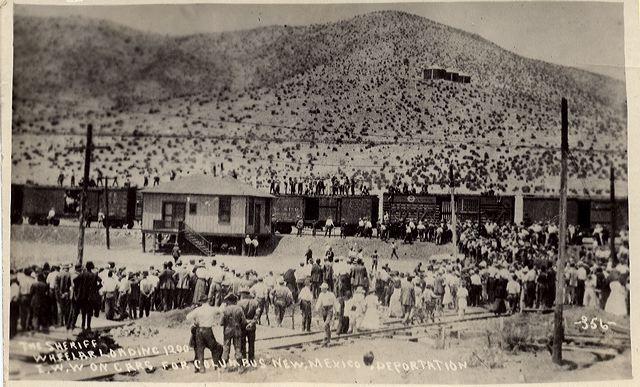
Miners, Supporters and Onlookers being deported from Bisbee
 June 26, 1917 – The Bisbee, Arizona IWW (Industrial Workers of the World) miner strike. On July 12, 1,300 strikers, their supporters, and innocent bystanders were illegally deported from Bisbee by 2,000 vigilantes—over 200 miles in cattle cars, without food or water for 16 hours. (From the Daily Bleed and Wikipedia)

June 26, 1919 – The Winnipeg General Strike, which began on May 15, came to an end as the Winnipeg Labor Council "officially" declared the strike over at 11 o'clock. (From the Daily Bleed)

June 26, 1975 – The FBI provoked a shootout with members of the American Indian Movement (AIM) at Oglala, South Dakota. The deadly firefight left two FBI agents and Lakota activist Joe Stuntz dead. Two AIM leaders were prosecuted for the FBI deaths and found innocent. A third AIM activist, Leonard Peltier, who remains in prison to this day, was later framed when much of the same evidence is disallowed in his trial.
Gay Pride march, Taipei, Taiwan, 2005
 June 26, 1977 – Gay Pride marches occurred throughout the country, with 100,000 marching in San Francisco and tens of thousands in NYC.
Pride in Haifa, Israel, 2009
 June 26, 1994 – In commemoration of the 25th anniversary of the Stonewall Rebellion, over one million people marched in New York City in support of LGBT rights.

June 26, 1997 – “The Gentle Giant," Hawaiian protest singer Israel Kamakawiwo'ole (1959-1997) died. Best known for the song "Somewhere Over the Rainbow/What a Wonderful World," Kamakawiwo’ole was also an activist for Hawaiian indigenous rights and Hawaiian independence.

Tuesday, June 25, 2013

Today in Labor History—June 25

June 25, 1825 – U.S. troops captured Bob Forbes, leader of the Maroons (blacks resisting slavery) in Virginia. (From the Daily Bleed)
A dramatization (1905) of Sitting Bull stabbing Custer (library of Congress)
 June 25, 1876 – Lakota, Cheyenne and Arapahoe tribes defeated Custer and the U.S. Army at Little Big Horn, Montana. (From the Daily Bleed)
June 25, 1878 – Despite mass protests, Ezra Heywood was sentenced to two years hard labor for advocating free love and sexual emancipation as part of women's rights. Heywood was an anarchist, feminist and abolitionist who was hounded and harassed by the moralist vigilante Anthony Comstock. His wife, Angela Tilton, was considered by many to be even more radical than he was. (From the Daily Bleed)
Haymarket Memorial
June 25, 1893 - The Haymarket Martyrs Monument was dedicated at Forest Home Cemetery, Chicago, to honor the 8 anarchists who were framed and executed for the bombing at Haymarket Square on May 4, 1886. More than 8,000 people attended. At the base of the monument are Haymarket martyr August Spies’ last words: “The day will come when our silence will be more powerful than the voices you are throttling today.” (From Workday Minnesota and the Daily Bleed)
Striking Pullman workers confront National Guard troops in Chicago, 1894
June 25, 1894Eugene Debs and his American Railway Union called for a boycott of all Pullman railway cars during the now-famous Pullman Strike. Within days, 50,000 rail workers were participating, halting all railroad traffic out of Chicago. (From the Daily Bleed)
Robots in rebellion in 1922 performance of R.U.R.
June 25, 1921 -- Czech author Karel Capek's introduces the term robot in his play R.U.R. (Rossum's Universal Robots) in which robots, fed up with lousy work and pay, organize and rebel. The term comes from the Czech word “robota,” which referred to days in which peasants were forced to leave their own fields to work for free on the lands of the nobility. Even after feudalism had ended, the term was used to describe labor that was coerced, boring or uninteresting. (From the Daily Bleed)

June 25, 1938 - The Wages and Hours (later Fair Labor Standards) act was passed, which banned child labor, set the 40-hour work week and set a national minimum wage. (From Workday Minnesota and Shmoop Labor History)

June 25, 1941 - A. Philip Randolph (president Brotherhood of Sleeping Car Porters) called off the Negro march on Washington that had been planned for July 1 when President Roosevelt agreed to issue Executive Order 8802 banning racial discrimination in defense industries and government employment (creating the Fair Employment Practices Committee). (From Workday Minnesota and the Daily Bleed)

June 25, 1943—Congress passed the Smith-Connally Act allowing the government to take over critical industries affected by strikes, overriding President Roosevelt's veto. It also prevented unions from contributing to political campaigns. (From Shmoop Labor History)

June 25, 1968 – The 50,000 strong Poor People's Campaign March from Georgia to Washington D.C., concluded.

June 25, 1975 – Mozambique achieved independence from Portugal.

Thursday, June 20, 2013

Today in Labor History—June 20


Caricature of the 3rd estate carrying the 2nd (clergy) and 1st (nobility) estates on its back
June 20, 1791 – A French mob invaded the Tuileries and King Louis XVI tried (unsuccessfully) to flee the French Revolution. (From the Daily Bleed)
Albert Parsons
 June 20, 1848 – Albert Parson, Anarchist labor leader and Haymarket martyr, was born in Montgomery, Alabama. (From the Daily Bleed)

June 20, 1893Eugene Debs formed the American Railway Union (ARU), one of the earliest unions to organize by industry and regardless of race or ethnicity (see Knights of Labor and IWW) . Within a few months the union was leading an 18-day strike against the Great Northern Railroad, successfully forcing management to reverse three wage cuts, despite the fact that the nation was in the midst of a terrible depression. The victory set the union on a remarkable course in which it averaged 2,000 new members a day.. (From Workday Minnesota and the Daily Bleed)

June 20, 1909 – Méxican rebel forces led by the anarchist Flores Magón brothers attacked Casas Grandes, Chih. (From the Daily Bleed)
Voltairine de Cleyre, 1891
 June 20, 1912Voltairine de Cleyre, one of the earliest feminist anarchists, died at the age 45, following a long illness. Two thousand supporters attended her funeral at Waldheim cemetery, where she was buried next to the Haymarket Martyrs. (From the Daily Bleed)

June 20, 1920 – Police shot 14 Wobblies (members of the Industrial Workers of the World) during a labor clash in Butte, Montana. In April, company guards at the Anaconda mine fired on striking Wobblies, killing one. Vigilantes or company goons lynched IWW organizer Frank Little in Butte in 1917. (From the Daily Bleed)

June 20, 1927 – A newspaper strike halted publication of "The Butte Miner," "Anaconda Standard," & "Butte Daily Post" (until July 4). (From the Daily Bleed)

June 20, 1941 – The first United Auto Workers (UAW) contract ever was signed with Henry Ford, who recognizes the UAW. (From the Daily Bleed)

June 20, 1943 – Striking African American auto workers were attacked by the National Workers League, KKK and armed white workers at Detroit's Bell Isle amusement park. 34 people killed and 1,300 arrested in these race riots. (From the Daily Bleed)

June 20, 1982 – 2,500 protesters were arrested in two days of anti-nuclear demonstrations and  blockades of Lawrence Livermore labs, California. (From the Daily Bleed)

Sunday, June 16, 2013

Today in Labor History—June 16


Chartist riot, 1838
June 16, 1836 – The London Working Men's Association was formed, launching the Chartist movement.The Chartists took their name from the People's Charter, which demanded universal suffrage for men, regardless of social class. (From the Daily Bleed)
Berlin Revolutionaries
June 16, 1848 – The Berlin arsenal was captured by rebellious citizens. The "German Revolutions" of 1848 swept across 50 European states, mostly affiliated with the German Confederation and Austria. While the middle classes were fighting for a unified German state and increased civil liberties, the working class had more revolutionary aspirations. Participants in the revolution included communist and anarchist revolutionaries like Marx, Engels and Mikhail Bakunin, as well as the composer Wagner. (From the Daily Bleed)

June 16, 1869 – In the small mining town of Ricamarie, France, troops were called in to suppress a workers' strike, opening fire on demonstrators protesting the arrest of 40 workers, killing 14 (including a 17-month-old girl in her mother’s arms) and wounding 60 others (including 10 children). (From the Daily Bleed)
Susan Anthony
 June 16, 1873 – Susan B. Anthony was arrested for voting. (From the Daily Bleed)


Eugene V. Debs delivering his Canton, Ohio speech.
June 16, 1918 –Eugene Debs delivered his famous Canton, Ohio anti-war Speech. America was at war with Germany, at the time, and radicals were being routinely rounded up and jailed, often illegally, when Debs gave this speech. The new Espionage Act was being used to prosecute people for their opposition to the war and Deb’s speech was used to make the case that he had violated the Act. (From the Daily Bleed)

June 16, 1920 – The U.S. Marines began fighting in Haiti to defend U.S. “interests” there. (From the Daily Bleed)

June 16, 1933 - President Franklin D. Roosevelt signed the National Industrial Recovery Act, which recognized the right of workers to organize and bargain collectively through unions. The legislation was later found unconstitutional by the U.S. Supreme Court. However, it helped inspire a wave of union organizing and pave the way for the National Labor Relations Act, which was passed in 1935. (From Workday Minnesota)
International Brigadiers at the Battle of Belchite
 June 16, 1937 – The Trotskyist POUM, a significant constituent of the Spanish Republican forces (and the group with which George Orwell fought) was outlawed and its militants persecuted by the counter-revolutionary Stalinists and the Republic's police, thus making the Republic and the Stalinists more vulnerable to the fascists. (From the Daily Bleed). For a good fictionalization of the Spanish war against the fascists, and the POUM's and anarchist's betrayal by the Stalinists, see Ken Loach's Tierra y Libertad.

June 16, 1953 – Jack Hall of the ILWU and six others (the "Hawai‘i Seven") were convicted under the Smith Act for being communists. (From the Daily Bleed)

June 16, 1976 – 10,000 students demonstrated in Soweto South Africa, protesting against the requirement that they learn the Afrikaans language in their schools. The uprising spread to seven other black townships. In the end, 128 were killed and 1,112 injured. By the end of the year, thousands had died in demonstrations throughout the country including 700 black children. (From the Daily Bleed)

June 16, 1986 – Despite arrests, millions stayed home in a black trade union strike commemorating the 10th anniversary of the Soweto uprising. (From the Daily Bleed)

June 16, 1987 – Paper workers struck near Portland, Maine. (From the Daily Bleed)

June 16, 1991 – A General Strike began in Madagascar. (From the Daily Bleed)

June 16, 1992 – Millions of workers struck in India to protest government reforms. (From the Daily Bleed)

June 16, 1993 – 400 nude prostitutes protest police abuse, Matamoros, Mexico. (From the Daily Bleed)

Wednesday, May 22, 2013

Today in Labor History—May 22


Versaille generals being shot during the Paris Commune
May 22, 1871 –The "Bloody Week" continued in France for the second day, as government forces brutally suppressed the Paris Commune. (From the Daily Bleed)

May 22, 1895 – Eugene Debs was thrown in prison for his role in the Pullman Railway Strike (also known as the "Debs Rebellion"). (From the Daily Bleed)

May 22, 1930 – Harvey Milk, gay rights activist and San Francisco city Supervisor, was born. He was assassinated by a former supervisor (and current lunatic) Dan White, who only got a couple years in jail using the famous Twinkie defense., resulting in rioting in San Francisco. (From the Daily Bleed)

May 22, 1968 –New York police busted through the barricades at Columbia University, busting the student occupations there, resulting in 998 arrested, over 200 injuries. They were demanding a black studies program and an end to military recruitment and ROTC on campus. (From the Daily Bleed)

May 22, 1969 –The first strike by Chicago teachers began on this day and lasted for three days. (From the Daily Bleed)

Saturday, May 11, 2013

Today in Labor History—May 11


Max Hoedel
May 11, 1878 – Emil Heinrich Maximilian Hoedel, a 21-year-old worker-anarchist, shot Emperor Guillaume I of Prussia to publicize the plight of the workers. He was executed July 16, 1878, with the following last words: "Vive la commune." (From the Daily Bleed)
May 11, 1891 – There was a national building-trades strike on this date in 1891. (From the Daily Bleed)
Pullman Strikers and National Guard Troops Outside Arcade Building, Chicago
May 11, 1894The Pullman Railroad Strike began in Chicago, Illinois. This was she largest industrial strike to date in the U.S. Eugene Debs rose to prominence as a labor leader during this strike, which was eventually broken by federal troops. At least 24 strikers were killed. (From the Daily Bleed)
Daniel De Leon, 1902
May 11, 1914 – Marxist theorist, socialist labor party and union organizer Daniel De Leon died on this date in New York City. De Leon was also a founding member of the Industrial Workers of the World (IWW) in 1904. (From the Daily Bleed)
May 11, 1968 – The Parisian "Night of the Barricades," occurred from May 10-11, with intense fighting between students and police. Students and workers called for a General Strike on May 13. (From the Daily Bleed)
May 11, 1968 – Poor People’s Campaign caravans arrived in Washington, D.C., with Ralph Abernathy and the Southern Christian Leadership Corps being granted a permit for an encampment on the Mall. (From the Daily Bleed)
May 11, 1968 – 4,500 British Columbia lumber workers ended a 7-month strike on this date. (From the Daily Bleed)
May 11, 1983 – A General Strike was called in Chile, in support of textile workers who had been on strike since 1982. The police attacked protestors with tear gas. Two people were killed in La Victoria; 600 were arrested. (From the Daily Bleed)

Saturday, April 13, 2013

Today in Labor History--April 13

April 13, 1892 – The Johnson County War was fought between Wyoming homesteaders and an army of mercenaries hired by cattle interests out to monopolize Wyoming land for their own private profit. The war was ended when the US Cavalry rescued the rancher's troops from the settler's dynamite-laden wagon, dubbed the "Ark of Vengeance."  (From The Daily Bleed)
April 13, 1894 - The Great Northern rail strike began in Helena, Montana, spreading to St. Paul within a few days. The strike was led Eugene V. Debs, president of the American Railway Union, and succeeded in shutting down critical rail links, resulting in a settlement giving in to nearly all of the union’s demands. The successful strike led to thousands of rail workers joining the new union. http://www.workdayminnesota.org/index.php?history_9_04_11_2011
Eugene V. Debs Run for Office from Prison (Library of Congress)
 April 13, 1919Eugene Debs was imprisoned for his opposition to World War One. Despite being in prison, he still received over one million votes for President in 1920. (From The Daily Bleed)

April 13, 1919 – The military attempted a coup against the Bavarian Republic of the Workers Councils. Anarchists led a successful counter attack. (From The Daily Bleed)

Wednesday, February 27, 2013

Today in Labor History—February 27

Guards' cannon dragged to Montmartre During Paris Commune (contemporary sketch)

February 27, 1871 – The Paris Commune began when regular soldiers, sent to confiscate cannon from the National Guard militia in Paris, were confronted by the crowd and then decided to fraternize with them. (From the Daily Bleed)
Cartoon showing US Socialist Presidential candidate, Eugen V. Debs, who ran from in prison in the 1920 election.
 February 27, 1875 – Eugene V. Debs became a charter member and secretary of the Vigo Lodge, Brotherhood of Locomotive Firemen. By 1880, he had become grand secretary of the national Brotherhood of Locomotive Firemen and editor of the Locomotive Fireman's Magazine. He later led the bitter Pullman strike. (From the Daily Bleed)

February 27, 1902 – John Steinbeck was born on this date in Salinas, California. Steinbeck, who won the Nobel Prize for literature in 1962, wrote numerous novels from the perspective of farmers and the working class, including The Grapes of Wrath (1939), Tortilla Flats, Of Mice and Men, Cannery Row & East of Eden. (1952). (From the Daily Bleed)

February 27, 1912 – “The Times" of London published a lead story about a "conspiracy" of unions to take over ownership of British coal mines. The piece was based on a pamphlet, "The Miner's Next Step," which had been printed in Tonypandy, a scene of recent bloodshed between strikers and police. The pamphlet, written by the South Wales Miner's Federation, called for direct action and industrial solidarity. (From the Daily Bleed)

February 27, 1933 – Berlin's Reichstag parliament building was torched. The Nazi's tried to blame it on communists as a ploy in their steady consolidation of total power. (From the Daily Bleed)


Jarama Valley, Woody Guthrie
February 27, 1937 – Lincoln Brigadiers attacked Pingarrón Hill ("Suicide Hill") in Jarama Valley, Spain. Of the 500 who fought in this infamous battle, over 300 were killed or wounded. The Lincoln Brigade was made up of Americans who went to Spain (in violation of U.S. law) to help fight Franco and the fascists. (From the Daily Bleed)

February 27, 1939 - Following a decade of sit-down strikes, the U.S. Supreme Court ruled that sit-down strikes were illegal. (From Workday Minnesota)

February 27, 1942 – The Seattle School Board accepted the forced resignation of Japanese-American teachers. (From the Daily Bleed)


February 27, 1943 – A mine disaster killed 74 workers at Red Lodge, Montana. (From the Daily Bleed)

February 27, 1973 – 300 Oglala Sioux American Indian Movement (A.I.M.) activists liberated and occupied Wounded Knee, South Dakota (the site of the 1890 massacre of Sioux by the U.S. cavalry), in response to a campaign of terror by tribal and FBI officials. From the Daily Bleed)

February 27, 2001 – Seattle ACORN workers went on strike. Their office shut was down after their employer refused to recognize Public Interest Workers IU 670 union of the IWW. From the Daily Bleed)

Thursday, January 3, 2013

Labor History Timeline--Rise of IWW, Garment Workers and State/Employer Violence


Lucy Parsons
1905    The Industrial Workers of the World (IWW or Wobblies) was founded on June 27, 1905, by Big Bill Hayward, Daniel De Leon, Eugene Debs, Lucy Parsons, Father Haggarty, Mother Jones, Ralph Chaplin and others, in part in response to the defeats of the WFM in Colorado, Utah and Idaho and in opposition to the conservative AFL. The IWW was not just a labor union fighting for better conditions for working people, but a revolutionary organization out to abolish the wage system and employer class completely. Like the Knights of Labor, they organized all workers into one big union and were inclusive of all workers, regardless of race, gender or national origin. Unlike the Knights, they eschewed political action, favoring direct action like strikes, slow-downs, work-to-rule and sabotage. (Sources: The IWW;WikipediaLibcom.orgHelen KellerHarry SiitonenSabotage, by Elizabeth Gurley Flynn: Western Mining HistoryLucy Parsons Project)

1905    Chicago Teamsters Strike: 21 workers were killed in what would escalate into a General Strike. Riots continued on a near daily basis from April through July. The Teamsters had attempted to end the strike by bribing members of the Employers Association, leading to allegations of corruption that would weaken the union in the following years. (Sources:WikipediaChicago’s Strike Ordeal, Stanley Powers, 1905)
GE in 1907
1906    First Sit-Down Strike: America’s first sit-down strike was organized by the Wobblies (IWW) at General Electric, in Schenectady, NY. 3,000 workers participated in the occupation of the facilities for 65 hours, bringing production to a standstill.(Sources: UHWOWikipedia)

1907    Nation’s Worst Mining Disaster: 361 coal miners were killed in Monongah, West Virginia. (Sources: UHWO)
2 Picketers Among the Uprising of 20,000
1909    Uprising of 20,000: The Lady Garment Workers Strike in New York (AKA the Shirtwaist Strike) was a strike by mostly Jewish women and girls against sweatshop working conditions. 700 were arrested in just one month. Male goons were hired to intimidate and assault the women. A judge told the women they were striking against God. However, the women remained resolute and public sentiment turned in the favor. The strike ended in 1910 with increased wages and improved working conditions and hours. (Sources: WikipediaAFL-CIOJewish Women’s Archive)
The Little Red Song Book
1909    The Little Red Song Book, from the IWW, was first published in Spokane and included songs by Joe HillRalph ChaplinT-Bone Slim, and others. The early editions contained many of the labor songs that are still famous, such as "The Red Flag," "The Internationale," and "Solidarity Forever," while later editions included such classics as “Rebel Girl,” “Mr. Block,” and “The Preacher and the Slave.” You can see video versions of some of these on the Labor Music Video Page. (Sources: IWWThe Sacred Chao)
LA Times Building After Bombing
1910    Llewellyn Ironworks and Los Angeles Times bombingsA bomb destroyed the LA Times building in October, killing 21 employees and injuring over 100, and another destroyed a portion of the Llewellyn Ironworks in December. The Iron Workers had been engaged in a brutal and protracted battle with U.S. Steel and the American Bridge Company, which had been successfully busting their union through the use of spies, informants, scabs and agents provocateur, as well as propaganda by their friend Harrison Otis, publisher of the Los Angeles Times. James McNamara and his brother, John McNamara, secretary-treasurer of the International Association of Bridge and Structural Iron Workers, were convicted after being kidnapped and allegedly framed by private cops.(Sources: Modern SchoolWorkday Minnesota)

1910-1911       Westmoreland Coal Strike: 16 workers and family members were killed during this strike by the UMWA. The strike lasted from March, 1910 through July, 1911, encompassing 65 mines and 15,000 miners, with the miners and the UMWA losing the strike. Miners’ wives showed up to support their husbands, harassing scabs and getting arrested. Because they couldn’t afford the fines, the women were forced to serve a month in jail with their babies and children. (Sources: Wikipedia;patheoldminer; Jones, Mary Harris: The Autobiography of Mother Jones. 4th ed. Chicago: Charles H. Kerr Publishing Co., 1996)
Triangle Shirtwaist Building, March 11, 1911
1911    Triangle Shirtwaist fire: 147 women and girls died (mostly Jewish and Italian immigrants) in this tragic fire, many because the managers had locked all the doors, preventing escape. The company’s owners were acquitted of any crimes, but were forced to pay nominal civil damages of $75 per victim. (Sources:Remembering the Triangle FireWikipediaDemocracy Now)

1912    Paint Creek-Cabin Creek Strike in West Virginia lasted from April, 1912, until July 1913, and resulted in 50 workers’ deaths through violence, plus numerous more deaths from starvation. The strike and resulting violence were a prelude to the later Matewan massacre and Battle of Blair Mountain. The miners were striking for union recognition, free speech, an end to blacklisting and cribbing, among other demands. Beatings, sniper attacks and sabotage against the workers were routine. The Baldwin-Felts private police were called in by the mine owners. (Sources: Wikipedia; “History is a Weapon,” Mother Jones speech to striking coal miners; “The Paint Creek-Cabin Creek Strike,” San Francisco Bulletin, March 21, 1913)
Lawrence Strike
1912    Lawrence Textile Strike (AKA The Bread and Roses Strike, because the women were demanding not only a living wage, so they could feed their families, but a better quality of life, too). This IWW-led strike was the first known strike to implement the moving picket line, so as to avoid arrests for loitering. The strike was also unique in that the workers spoke 22 different languages and came from 24 different nationalities, prompting the IWW to give each language group a delegate on the strike committee and complete autonomy. (Sources: The Lucy Parsons ProjectLibcom.orgBread and Roses Centenial;Rense.com)

1912    IWW struck Galloway Lumber Company in Grabow, LA. Also known as the Graybow Riot (July 7), four workers were killed, 50 were wounded, and 58 were arrested. (Sources: IWW)

1913    Calumet Christmas massacre (AKA the Italian Hall Disaster): 73 men, women and children, mostly striking miners and their families, were crushed to death on Christmas Eve at during a party at the Italian Hall in Calumet, MI, when someone falsely yelled “fire.” Company thugs have been blamed for the false cry and for blocking the doors in a deliberate attempt to crush the union. (Sources: Wikipediathe Italian Hall DisasterDaily Kos)
Strike leaders Patrick L. QuinlanCarlo TrescaElizabeth Gurley FlynnAdolph Lessig, and Bill Haywood.
1913    Patterson Silk Strike was an IWW-supported strike for better working conditions and the 8-hour day. Nearly 2,000 workers were arrested, including IWW members Elizabeth Gurley Flynn and Big Bill Haywood. (Sources: The Masses (John Reed);WikipediaThe Lucy Parsons ProjectPatterson Friends of the Great FallsSabotage, by Elizabeth Gurley Flynn)

1913    United Fruit Strike: New Orleans: police shot three IWW members, killing one. United went on to be one of the dominant neocolonial powers in Central America (along with Standard Fruit), supporting Banana Republic dictators and their violent anti-labor policies. United Fruit is now known as Chiquita. (Sources: Rense.comWikipedia, the Daily Bleed)

1913    Wheatland Riots: Hop pickers struck against Durst Ranch in Wheatland, CA, when Durst advertised for twice as many workers as he needed in order to drive down wages. Over 100 vigilantes arrived and shot into the crowd, killing 2 workers, a deputy and a district attorney. IWW organizers Ford and Suhr were blamed and sentenced to 15 years in prison.. (Sources:IWWWikipedialibcom.orgLabor.net)
Ludlow
1914    Ludlow Massacre: John D. Rockefeller and other mine operators engaged company goons and the Colorado State Militia to crush 10,000 striking miners in Ludlow, Colorado. The militia attacked a tent camp with machine guns and then set it ablaze, killing 5 men, 2 women and 12 children. By the end of the strike, more than 75 people had been killed. (Sources: Howard ZinnColorado Coalfields War ProjectWikipedia; AFGE;Modern School)

1914    The Montana militia crushed a strike by WFM miners in Butte. (Source: AFGEButteAmerica.com)
Roosevelt Massacre
1915    Factory guards shot 20 rioting strikers in Roosevelt, New Jersey, killing several of them. (Source: AFGE)

1916    Youngstown Massacre (January 6): Company guards at the Youngstown Sheet and Tube plant attacked a crowd of striking workers and their wives and children with tear gas bombs and live fire, killing three strikers and wounding 25 others. (Source:  Daily Bleed)
Joe Hill, executed, with Bullet Holes
1916    Joe Hill (1879-1915) was executed on trumped up murder chargesHill was a Swedish immigrant who became an IWW organizer and prolific song writer (Rebel Girl, Preacher and the Slave, The Tramp, Casey Jones the Union Scab). (Sources:WikipediaJoe Hill Project)

1916    Everett Massacre: 7 workers were killed and 50 injured when vigilantes hired by local businesses fired upon IWW members arriving in Everett by boat from Seattle. 75 Wobblies (IWW) were later arrested for murder. (Sources: WikipediaEverett Public LibraryUW Everett CollectionIWWRense.com)

1916    "Preparedness Day" parade bombing occurred in San Francisco, killing 10 and injuring 40. Labor organizer Thomas J. Mooney and Shoe Worker Warren K. Billings, both IWW members, were convicted, spending years in prison before being pardoned in 1939. (Source: AFGEWikipediaModern School)
Striking miners and others rounded up by the armed posse
1917    Bisbee Deportation: On July 12, 1,300 striking IWW miners, their supporters, and innocent bystanders were illegally deported from Bisbee, AZ,  by 2,000 vigilantes—over 200 miles in cattle cars, without food or water for 16 hours. (Sources: the Daily BleedModern SchoolIWW, and Wikipedia)
Frank Little, 1907
1917    Frank Little Lynching: On August 1, IWW organizer Frank Little was lynched in Butte, Montana. Little, a Native American, was kidnapped from his home by six Anaconda Copper Company thugs, dragged by a car and hanged from a railroad trestle. He had also been advocating that workers refuse to collaborate with the capitalists by fighting in WWI. (Sources:Workday MinnesotaIWWWikipedia)
Newspaper cartoon of woman pleading for democracy during East St. Louis Riot
1917    East St. Louis Labor and Race Riot (40-200 deaths): The “Great Migration” north was already well underway, with African Americans moving to industrial cities like Chicago seeking work. In East St. Louis, resentful white mobs frequently attacked black workers and their families, culminating in a riot on July 2 that killed as many as 200 African Americans and left thousands of them homeless. Many of the unions fed the racism not only by generalizing all black workers as scabs, but by doing little to organize them or build solidarity with them. (Sources: Wikipedia,the Black Past)

1917    IWW Offices Raided in 48 U.S. Cities. Roughly 165-300 IWW members were arrested initially, but within six months, 2,000 were in jail and sentenced to lengthy terms. In Spokane, martial law was declared. Virtually every IWW union hall in the country was busted. The raids and arrests were so extensive that the union never regained its strength or influence. (Sources:HistoryLink.orgIWWHistory Matters)